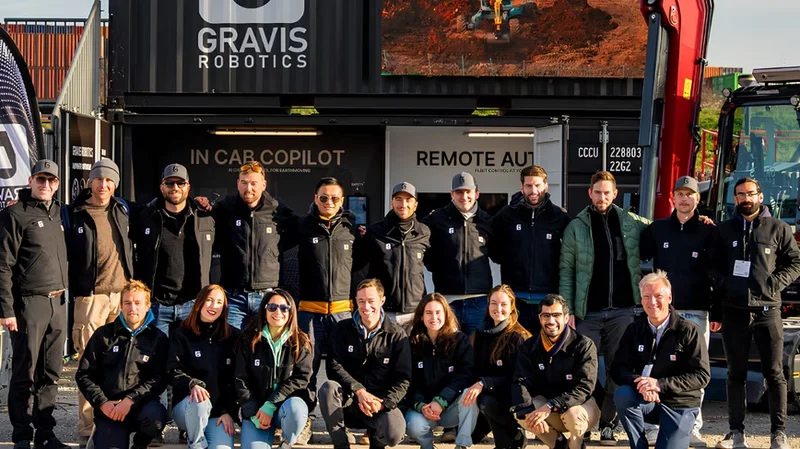
Gravis Robotics, an ETH Zurich spinout building software that lets excavators and diggers run themselves, has raised a $200m Series A led by SoftBank, a round it bills as the largest ever in construction robotics.
The deal confirms reports that surfaced earlier that Masayoshi Son’s conglomerate was circling the young company.
Gravis, founded in 2022 and headquartered in Zürich with outposts in Austin and Oxford, does not build machines of its own.
Instead it makes the brains that bolt onto someone else’s: a retrofit control kit called Gravis Rack, and an assistance layer, Gravis Copilot, that between them can turn a mixed fleet of diggers into autonomous or semi-autonomous ones.
The software is pitched as manufacturer-agnostic, claiming to run across kit from Caterpillar, John Deere, Volvo, JCB, Hitachi and others, rather than locking buyers into a single brand.
The company’s framing is that most robotics has taught machines to move through the world without changing it, whereas construction is the opposite: the whole job is to reshape the ground.
Gravis says its models are trained heavily in simulation to close the notorious “sim-to-real” gap, letting an excavator work with something closer to factory-floor precision on a muddy, unpredictable site.
It claims productivity gains of up to 30% over manual operation, deployments across four continents, and a place on an $8m, UK-government-backed autonomy project with plant-hire firm Flannery.
For SoftBank, the cheque fits a pattern. Son has spent the past year assembling what looks like the most ambitious robotics-and-AI portfolio outside China, from reported talks to back an $800m round for Germany’s Agile Robots to a torrent of spending on data centres and chips.
His thesis, that “physical AI” is where the trillions go next, needs precisely this kind of company: software that makes existing industrial hardware drive itself.
Construction is a shrewd place to test the idea. It is a trillion-dollar industry chronically short of skilled operators, dangerous enough that taking humans out of the cab has obvious appeal, and repetitive enough in its digging and grading that automation looks tractable.
A retrofit kit also sidesteps the hardest problem in robotics, building reliable hardware from scratch, by riding on machines the industry already owns and trusts, and it lets Gravis sell into fleets without asking anyone to scrap their existing kit.
“Largest Series A in construction robotics history” and “up to 30% productivity” are the company’s own framing, the kind of superlatives funding announcements are engineered to produce, and a headline gain on a controlled site is not the same as a fleet-wide average in the rain.
Autonomous heavy machinery also carries a stiff burden of proof on safety, liability and regulation that no amount of venture capital resolves overnight.
There is a SoftBank-shaped asterisk, too. Son’s robotics record is not all triumphant, his consumer robot Pepper was quietly discontinued, and his firm’s habit of writing enormous cheques has produced spectacular hits and spectacular misses in roughly equal measure.
A $200m Series A signals conviction, and perhaps a pre-emptive move to lock up a promising team before rivals can, but it is a bet on a market that has promised full autonomy for years and so far delivered it in slices.
Still, the direction is unmistakable. Between cheap Chinese humanoids, warehouse arms and now self-driving excavators, the money chasing physical AI is real and swelling, and SoftBank intends to be its biggest backer even as Son bristles at the word “bubble”.
Whether Gravis can turn a $200m vote of confidence into diggers that reliably run themselves across thousands of messy sites is the question the next few years, and a great deal of that capital, will answer.
Get the TNW newsletter
Get the most important tech news in your inbox each week.