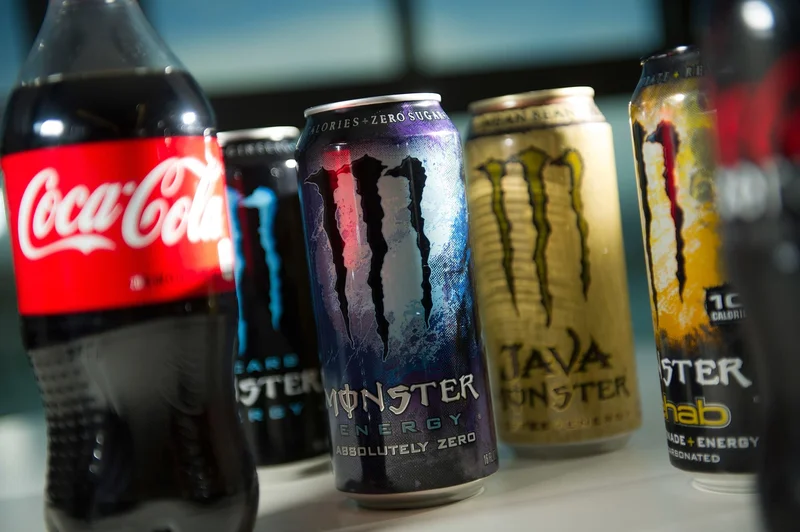
(This is The Best Stocks in the Market , brought to you by Josh Brown and Sean Russo of Ritholtz Wealth Management.) Josh — Thirsty? Good, because we have two beverage stocks worthy of your attention. Back in February, we introduced the idea of HALO stocks . Two of the names we mentioned in that column, Coca-Cola (KO) and Monster Energy (MNST) , have remained on our radar ever since. Many people think of the HALO theme as simply businesses with heavy machinery or physical, hard to replace assets on their balance sheets. It is that, but it's also chocolate, coffee, eggs, cereal and, yes, soft drinks. These are the commodities that make life worth living. Many of these consumer staples are sold by brands so deeply woven into daily life that disruption simply doesn't apply to them. No algorithm is going to train a generation of kids to put down their white Monsters before a workout. No GLP-1 is convincing the world to stop celebrating with a Coke. These are not businesses competing on price or features or quarterly product cycles. They compete on identity, on ritual, on muscle memory that was built over decades. Monster is up 16% since that column. Coca-Cola is up 12%. Both have been on the Best Stocks list without a single interruption since the day we wrote about them. What makes this week's column unusual is that these two companies aren't just related by industry, they're literally partners. Coca-Cola owns roughly 19.5% of Monster Beverage and has served as its global distribution arm since a $2.15 billion investment in 2015. Monster's extraordinary international growth, 56% in Latin America, 35% in Asia Pacific, 62% in China last quarter, rides almost entirely on Coca-Cola's existing truck routes and retail relationships. When you own one of these stocks, you partially own the other. They are the same thesis told twice, with differences in growth rates and flavors. The reason we're revisiting both right now is that the fundamentals just got materially better. The charts are confirming it. Monster just completed a 2-for-1 split and followed it with a blowout quarter. Coca-Cola raised full-year guidance and posted its strongest Trademark Coke volume growth in 17 years. Sean is going to walk you through both sets of numbers. I'll be back after each section with a look at the chart and what to watch from a risk management standpoint. As of Aug 17, there are 216 names on The Best Stocks in the Market list. Top sector ranking: Top industries: Top 5 best stocks by relative strength: Sector spotlight: Breakout updates Monster Beverage Corp. (MNST): Sean — There are at least five white Monster cans in my fridge at all times. It's a thing — search white Monster on TikTok and you'll see every young person drinking it before the day starts. It is also apparently a great investment thesis. Over the last 25 years, Monster Beverage is the single best-performing stock in the S & P 500 — $10,000 put in back in 2001 would be worth about $23 million today. Since inception, it's up more than 230,000%. We wrote about Monster on Feb. 9 alongside a dozen other staple names during the first HALO rotation. It's up 16% since then and has stayed on the Best Stocks list the entire time. Monster is a pure-play energy drink company consisting of Monster Energy, Reign, Predator, Fury and a smaller alcohol segment of craft beers and hard seltzers. Coca-Cola (which we'll talk about later) owns roughly 19.5% of the company and is its global distribution partner, an arrangement that started with a $2.15 billion investment for 16.7% in 2015 and has drifted higher through buybacks. Monster has been scary good internationally as the U.S. consumer has matured. Q2 net sales rose 20.2% to $2.54 billion with double-digit growth in every international region. International sales grew 34.6% and now make up 46% of the total, up from 45% in Q1. Latin America grew 56.1%, with Brazil up 82% and Mexico up 29.5%. Asia Pacific grew 35.7% with China up 62.5% and India up 84%. U.S. and Canada, the mature market, grew 11.5%. Gross margin improved to 55.9% on pricing and mix, partially offset by higher aluminum and freight. Diluted EPS was $0.59, up 19%. The energy drink company completed a 2-for-1 split on Aug. 11 with a $900 million buyback program still authorized. The company just reported in early August, for the next report, the street expects 13% revenue growth and 11% EPS growth year over year. Josh — As Sean mentioned, MNST has never left our list. The buyers are incredibly committed and have come in to rescue the uptrend repeatedly and without fail. Monster ran cleanly above the 50-day from September all the way through January before running into a wall of sellers near $50. The correction that followed was real: sharp, elevated volume, RSI down into the low 30s, the most washed-out reading on this chart in over a year. But the accumulators came in exactly where they had to — just above the rising 200-day. The stock bottomed in early spring and has spent the last several months climbing back from the low-to-mid $30s all the way to $47. Here's where it gets interesting. The 50-day is sitting right at $47 as well, which means this is the test. Buyers either prove they've absorbed the supply here or they don't. The split on August 11 brings fresh attention and the stock is making its attempt right now. RSI is at 49, neutral, which means a clean breakout above the 50-day has room to run. Don't use the 50-day as your stop. You're sitting on it, so it's not a stop, it's the battle. My trader stop is $41, the top of the gap after last quarter's incredible earnings report. Below it and we could be looking at a more intense pullback. For investors, we want to focus on $35 instead. That was the last time this name made contact with its 200-day and would be a natural spot for support to arise. A violation on a closing weekly basis means the sentiment has turned negative and we're out. The Coca-Cola Co. (KO): Sean — If you own Coke, you already own a slice of the above. Coca-Cola's 19.5% Monster stake is worth roughly $18 billion against a market cap in the $370 billion range, so it's not the reason to own the stock, but it does mean the two names on this list are pretty tied together and operate in the same industry. Coke is up 12% on price and 14% on total return since we wrote about it on Feb. 9, and it has also been on the list continuously. Q2 was the cleanest quarter Coke has printed in a while. Net revenue grew 7% to $13.4 billion, organic revenue grew 6% and global unit case volume grew 5%. Gross margin came in at 62.9% and comparable operating margin at 35.6%. I guess GLP1s haven't slowed down the Coke drinkers yet? Coca-Cola just had a big pop in volume too. The FIFA World Cup campaign drove the strongest Trademark Coca-Cola volume growth in 17 years at 5% and Powerade volume grew 8%. Management raised full-year guidance to roughly 5% organic revenue growth and 9%-10% comparable EPS growth, with free cash flow around $12.4 billion. Coke trades around 25x forward earnings against 9%-10% guided EPS growth — a decent multiple for a staples business, which is the case across most of this sector right now. Josh — KO has also been on this list continuously since February. Coke spent the fall of 2025 struggling below its 50-day, unable to find consistent buyers. But each time sellers tested the 200-day, they ran into real buying. The stock built a base through October and November, then began one of the cleaner uptrends in the sector, riding the rising 50-day all the way through the winter. There was a sharp shakeout in March that took the stock back near $77 and the 200-day, and the same buyers showed up again. New all-time highs followed. The stock is now at $88, with the 50-day at $83 and the 200-day at $77. RSI is 62. That's a healthy, trending stock without being over-extended. The March retest of the 200-day and the recovery to new highs is the tell: real buyers have been committed at every level on the way up. For traders, the stop is below $83, the 50-day moving average that has been acting as support recently. Below it and Coke has lost that near-term floor. Trim and wait for a better entry. For investors, we want to focus on the $74-$75 area instead. That's where buyers stepped up in force during the March and April lows and held the line both times. If those lows give way on a weekly close, the buyers who held twice are done and so are we. DISCLOSURES: (None) All opinions expressed by the CNBC Pro contributors are solely their opinions and do not reflect the opinions of CNBC, or its parent company or affiliates, and may have been previously disseminated by them on television, radio, internet or another medium. THIS CONTENT IS PROVIDED FOR INFORMATIONAL PURPOSES ONLY AND DOES NOT CONSTITUTE FINANCIAL, INVESTMENT, TAX OR LEGAL ADVICE OR A RECOMMENDATION TO BUY ANY SECURITY OR OTHER FINANCIAL ASSET. THE CONTENT IS GENERAL IN NATURE AND DOES NOT REFLECT ANY INDIVIDUAL'S UNIQUE PERSONAL CIRCUMSTANCES. THE ABOVE CONTENT MIGHT NOT BE SUITABLE FOR YOUR PARTICULAR CIRCUMSTANCES. BEFORE MAKING ANY FINANCIAL DECISIONS, YOU SHOULD STRONGLY CONSIDER SEEKING ADVICE FROM YOUR OWN FINANCIAL OR INVESTMENT ADVISOR. Click here for the full disclaimer.
The two 'HALO' stocks that haven't left Josh Brown's list since being added earlier this year