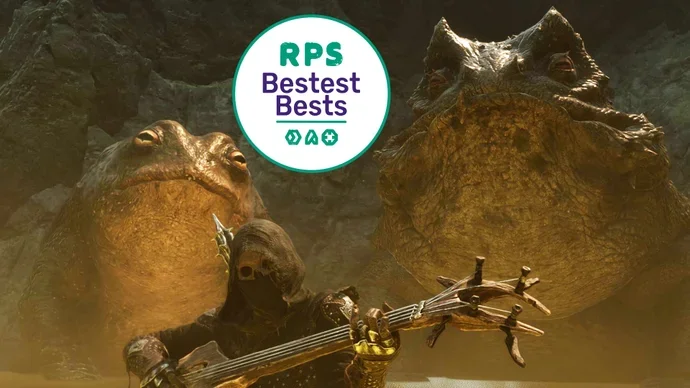
A few hours into your sojourn across Mortal Shell 2's harsh realm of Fainweald, you might stumble upon a tavern called The One Legged Wolf. In a monstrous land inhabited by pasty-faced brigands who refer to you as "brev" right before shanking you, this watering hole exudes novelty. Here, said thugs congregate to make merry and listen to the strums of the shirtless lute-player on stage. Even if you do as I did, and accidentally massacre the guy with a shot from your sidearm, nobody minds. The One Legged Wolf is a weird, memorable place where folk are free to do their own thing.
In many ways, The One Legged Wolf is emblematic of Mortal Shell 2, a sequel that stands out from the pack by melding the modern dark fantasy Soulslike with a willingness to ditch genre formula, a cheeky sense of humour, and the DNA of a PC-only game from yesteryear. The result is a goth cousin of more mainstream fare like Elden Ring, not to mention a phenomenal effort that outclasses its prequel in a manner that we probably haven't seen since The Witcher III.
Let's backtrack. The first Mortal Shell came out in 2020, and while Ed (RPS in peace) liked parts of it , he also criticised its pervasive jankiness and confounding level design. I can't blame him. I enjoy Mortal Shell 1, largely due to its compact 15-hour size and unique take on character classes, but most people seem to play it for 30 or so minutes before giving up. This sequel requires no prior knowledge of the first game, thankfully, though diehards who stuck it out in Fallgrim's swamps will find returning characters and Easter Eggs aplenty.
More important is the fact that Mortal Shell 2 improves upon every single aspect of its predecessor, making it look like a tech demo in comparison. Once again, you play as a creature who can inhabit the "Shells" of fallen warriors, which replace standard classes. Instead of wrangling with numbers in a lengthy character creation process, the being you control - known as the Harbinger, and a great deal hardier than the first game's Foundling - has a few base stats that go up with each level. The bulk of your abilities come from the Shells that you inhabit, like a parasitic entity wearing a cast-off chrysalis.
Each Shell features its own skill tree that embodies a mix of RPG archetypes, and the first you find will probably be Tiel the Acolyte, a thief who blends into shadows and delivers sneak attacks in typical rogue fashion. Other personal favourites include Proxima, a femme version of the Predator, and Lazlo, a chonky armoured fella who made me say "oh lawd, he comin'" every time I collided with a mass of opponents. Even Sester Genessa, who served as the first game's save system, is back as a playable Shell, and while I struggled with her skillset, build-maxxing players are probably going to love her ability to summon clones.
While the original Mortal Shell only featured four Shells, Mortal Shell 2 boasts eight, and all possess memories that you can unlock by spending a currency called Glimpse. These tangible, character-driven backstories provide a straightforwardness rare in Soulslikes, which are overly fond of hiding their obfuscated lore in a million different item descriptions. There is a overarching narrative at work here, with your Harbinger acting as the servant of an entity dubbed the UnderMether, and tasked with collecting her unbirthed Ova - but it's an affair mostly left in the background. The real crux of the narrative lies in the Shells and the stories behind them, from Tiel fighting his throes of addiction to Proxima finding an unexpected camaraderie with the shopkeeper NPC.
While many of these tales are dark, know that there is actually a wild amount of bleak humour in Mortal Shell 2. What other game features dancing babkas who try to kill you with accordions in the first village you come across? What about the boss who turns you into a sheep, and the other who pilots a rocket-powered mobility scooter like some reject from the Twisted Metal series? And isn't it funny how you start the game with a pretty Midsommar flower crown, and can proceed to put it on all of your Shells, including the big bastard named Gragu?
The number of amusing bits and bobs go on and on, and there's a goofy-yet-awesome flavour to many of them. Take the Troubadour's Lute, for instance, one of the best sidearms in the whole game. You can use it to fire off magical blasts that confuse enemies, or you can sit down to play at any moment if you just want to rock out to sick tunes. This makes Mortal Shell 2 the only Soulslike I know of to actually let you assume the role of a D&D-style bard - and by the way, the Troubadour's Lute is precisely the item that I used to kill the on-stage guy in the One Legged Wolf, whoops.
Plot aside, Mortal Shell 2 also marches to its own beat by foregoing a Stamina bar, allowing players to be as speedy and aggressive as they like. While Sekiro also did this, Mortal Shell 2 doesn't necessarily demand pinpoint parry precision to make up for the inability to become fatigued. Instead, the game offers three different ways to deal with incoming damage, tying each to equippable Seals. There's Guard, which is activated via the Untarnished Seal and lets you block damage at the price of diminished posture. There's Parry, which is self-explanatory, and equipped via the Infinite Seal. And then there's Harden, which is granted by Vatra's Seal, turns your Harbinger to stone, and was the main ability of the first game.
Guarding, Parrying, and Hardening are surprisingly well-balanced. All have the ability to deal Break damage to a foe, opening them up for a riposte, but there are benefits and drawbacks to keep in mind. Guarding is more manageable at the price of less Break potential, while Parrying requires greater timing for better Break damage. Harden is the obvious choice for those who struggle with the art of deflecting an opponent's attack with their own blade, since it potentially lets you forego timing completely and stay in your stone state forever as long as an enemy doesn't hit you. That said, it forces you to monitor a cooldown bar at the bottom of the screen, offering up a different layer of complexity.
Tying pivotal mechanics to items in this manner is unorthodox, and not all players will like it, but I found it a fine way of providing in-game justifications for your abilities. With parrying so prevalent in today's landscape - to the point where it seems pigeonholed into everything in the same way that all games in the late 2000s adopted a beige aesthetic - it's refreshing to be given alternatives.
And Mortal Shell 2 has even more alternatives up its chainmail sleeve, including the Slayer Seal, an item that initiates easy mode by giving you a pulverising punch and your ranged weapons the ability to deal Break damage. Then there's the secret hard mode, which is activated by lighting an item called the Gloombound Candle atop the tower that serves as your hub. The candle turns the world to night, rendering enemies stronger and opening up hidden dungeons designed to test the mettle of more experienced players.
All of these alternatives make Mortal Shell 2 the most accessible and flexible Soulslike I've played, and they've been integrated into the experience in a manner that goes beyond simply being able to call in a summon to assist during a boss fight. Mortal Shell 2 even goes out of its way to acknowledge those who hate the idea of an easy mode by making the Slayer Seal disable Achievements. "It's there for the brevs what need it, an’ for them what couldn’t give a toss about Achievements," the game almost seems to cackle. "But if ye're man enough to hack it in this grimdark world, just go an’ light that Gloombound Candle an’ show us yer hardcore side!"
I'm reminded of how DOOM features similar difficulty options, from "I'm too young to die" to "Ultra-Nightmare." And while modern audiences will probably make plenty of comparisons between Mortal Shell 2 and 2016's DOOM, from the aforementioned Slayer Seal to the way your Shell rips and tears baddies in epic finishing moves, this game made me feel waves of nostalgia for id Software's 1993 original - not to mention the heavy metal-infused era of PC gaming era that it ushered in. I'm talking stuff like Heretic, Hexen, Rune, hell, even Severance: Blade of Darkness.
There's just something about Mortal Shell that makes it feel like a modern descendent of those grim and gritty '90s and early 2000s games, moreso than many boomer shooters. The soundtrack and visuals certainly seem in line with what a modern Heretic might wear, if Raven Software were ever freed from the Call of Duty treadmill to give us one more adventure starring Corvus the Sidhe Elf.
But where this comparison becomes most apparent is in the dozens of dungeons that dot Mortal Shell's landscape. You'll enter these tombs whenever you need to cleanse a save point or investigate a hidden area, and they are delicious nuggets of old-school PC gaming level design. I'm talking enemies perched atop high ledges, secret passageways, archways that you've got to step through to create portals through walls, keys that must be located to open doors. There's even a dungeon that is, I kid you not, clearly homaging the E1M1: Hangar level from DOOM, right down to the shadow line that activates the hidden lift.
Yes, plenty of Soulslikes feature excellent dungeons, but Mortal Shell 2's feel like they might have been pirated as a "top 100 maps" package back in 1998, which is both a sincere compliment and a massive upgrade from the confusing levels of the first game. They are, in many ways, reminiscent of what John Carmack and John Romero might have whipped up at the height of their collaborative years, if only Soulslikes had been a thing back then. And the fact that this game manages to tie retro-feeling maps into an expansive open world that might not be as big as Elden Ring's or Nioh 3's, but is arguably tighter with more interwoven areas, is astounding.
I'm gushing a lot here, but of course there are a few issues. I ran into a handful of bugs on my playthrough, including Sester Genessa's clones missing their attacks more often than not. Stretches of the map need more save points to alleviate lengthy boss runbacks (I'm looking at you, north-eastern Fainweald). It's also clear that Mortal Shell 2 wants you to commit to one or two Shells at most, which might disappoint some. You simply won't gather enough Glimpse to min/max them all, and I expect that many will play through the whole affair as either Tiel or Proxima, simply because they're the two Shells you unlock first.
Still, these problems are tolerable. A patch will likely render the bugs and runback criticisms obsolete, and committing to a single Shell or two is less of an issue and more of a design choice to encourage New Game + playthroughs. This is, in fact, one of the few games that I feel the urge to replay immediately, largely thanks to a desire to experiment with Smert, a badass old warrior monk who can stop time.
Ed recently wrote that Soulslikes have failed to innovate since Elden Ring, and called upon FromSoftware to deliver us from stagnancy. I'm not sure of Ed's opinion on Mortal Shell 2, but in my eyes, this sequel is proof of innovation, and manifests the dream that the developers clearly had with the original Mortal Shell six years ago. Genre standbys have been tweaked, accessibility has been added, and callbacks to PC classics are aplenty - all within a single package packed to the brim with gothic, weirdo charm.
If Dark Souls and Elden Ring are the equivalent of Dungeons & Dragons in this genre, spawning a million imitators, then Mortal Shell 2 is Warhammer Fantasy Roleplay, or perhaps even Fighting Fantasy. An alternate choice - perhaps notorious for its oddball characters and setting where everything is a little bit shite - but one that will delight you with its bizarre unorthodoxy. So take a seat at The One Legged Wolf, pour a glass of moonshine, and stay a while, brevs. That lute sounds mighty fine in the background, and here's hoping you'll take to the stage and rock alongside it. Just try not to rip the poor mook standing beside you to shreds, ya hear?