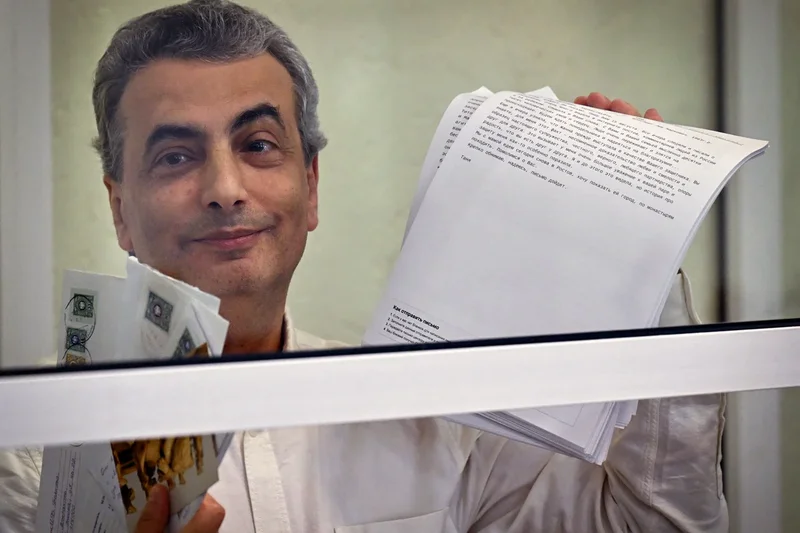
A prominent figure in Russia’s liberal Yabloko party has been handed an 11-year and one-month sentence in a penal colony after denouncing the conflict in Ukraine as a disaster for his country.
Lev Shlosberg, who serves as the party’s deputy chairman, faced charges of discrediting the Russian armed forces alongside disseminating false information regarding their actions.
Addressing the court in the city of Pskov during his final statement last Friday, Shlosberg asserted his innocence, arguing that he was undergoing a politically motivated trial while renewing his demands for an immediate ceasefire in the four-and-a-half year war.
The ruling, published by the court, follows a 10 August decision by Russia’s Supreme Court to exclude Yabloko from contesting a parliamentary election next month.
As the sole registered political entity advocating for an end to the war, Yabloko has faced mounting pressure from state authorities in the run-up to the election, where a significant anti-war vote risked causing embarrassment for the Kremlin.
Shlosberg used his final address to deliver a scathing critique of the ongoing conflict.
"The lives of countless thousands of people have been cut short during this time. Sooner or later, the precise and complete death toll - with names included - will be made public, and the entire nation will shudder at this list of martyrs," he said, according to a transcript by Mediazona.
"Today, cemeteries in our country, including military ones, are growing far more rapidly than maternity wards, kindergartens, and schools," he said.
Data compiled from publicly available records by Mediazona alongside the BBC Russian service has documented the names of at least 239,354 fallen Russian service members.
By reviewing records of the estates of deceased individuals to calculate excess mortality among Russian men, the outlets estimate that the true death toll exceeds 350,000.
Official, up-to-date casualty figures are published by neither Russia nor Ukraine.
Moscow maintains that its military actions aim to address security threats from NATO and Ukraine while defending the rights of Russian speakers living in Ukraine. Kyiv and its Western partners reject these arguments as a fabricated justification for launching Europe’s deadliest conflict since World War Two.
Shortly after launching its full-scale invasion of Ukraine in February 2022, Russia enacted legislation establishing long prison terms for anyone convicted of "discrediting" the military or deliberately spreading false information about the war.
As a result, public condemnation of the conflict is rarely heard inside the country. Nevertheless, figures such as Shlosberg, human rights advocate Oleg Orlov and the late dissident Alexei Navalny, defending themselves at trials with no realistic chance of acquittal, have seized the opportunity to speak out from the dock against what they have described as tyranny and repression.
While such criticism is omitted from state media reports, citizens using virtual private networks to bypass government internet restrictions are able to read these statements online on websites that would otherwise be blocked.
According to Mediazona, the presiding judge repeatedly interrupted Shlosberg's speech, urging him to stick to the facts of the legal case against him. However, the politician insisted on his right to continue speaking.
"A single person is imprisoned, yet fear seeps into the hearts of millions," he said.
The politician was first detained in June of last year and charged with discrediting the army after characterising the war in Ukraine as a game of "bloody chess" during a video debate.
Prosecutors subsequently added a charge of spreading fake news about the war over a repost shared on his Telegram channel.
Monday's verdict follows the conviction in June of Yabloko’s deputy leader Maxim Kruglov, who was jailed for seven years for spreading lies about the military.