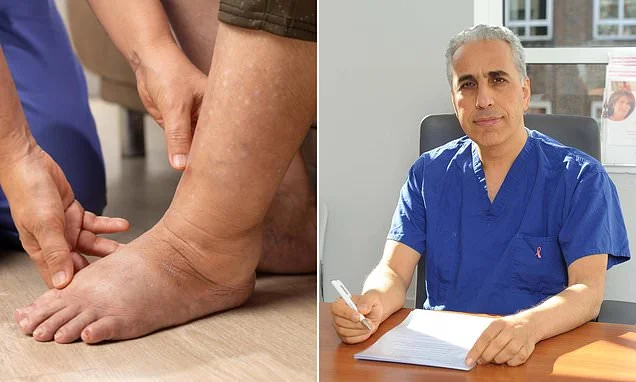
Food additives used to boost flavour in apple juice, yoghurts and red wine could hold the secret to treating lymphoedema – severe swelling in the arms and legs.
Research published in the journal Nature found that the compounds, called cyclodextrins, may be able to reverse the swelling.
The findings, based on animal studies, could potentially improve the lives of up to 450,000 people in the UK who live with the condition, many as a result of treatment for cancer.
For example, about one in five people will develop lymphoedema in their arm following breast cancer treatment, such as surgery to remove lymph nodes or radiotherapy to clear cancer cells.
Lymph nodes are bean-shaped structures located all around the body that filter waste from lymph fluid, which is formed of liquid and waste produced by tissues.
The nodes clean the fluid carried in the lymphatic vessels before it joins the bloodstream.
But the nodes are also often the first place cancer cells migrate to when they develop in nearby tissues such as those in the breast, head or neck, before travelling on to other vital organs such as the lungs.
Surgically removing the nodes – to reduce the risk of cancer spreading – or treating them with radiotherapy can damage and cause blockages in the lymph system, leading to a chronic build-up of lymph fluid, causing swelling – sometimes so severe it can make simple tasks such as getting dressed or finding clothes to fit extremely difficult.
The new study's findings, based on animal studies, could potentially improve the lives of up to 450,000 people in the UK who live with lymphoedema
Research suggests the impact on quality of life can be considerable.
Treatment options are limited. Patients are initially told to try compression sleeves or stockings on their swollen limbs.
But these must be worn daily and can cause skin irritation and itching which may be uncomfortable and also restrict movement.
Another option is a type of massage, manual lymphatic drainage, which patients can do themselves. This needs to be done regularly to have good results.
Surgery to ‘replumb’ lymphatic vessels so fluid does not build up is available on the NHS, although at around £15,000 the procedure is used sparingly. Likewise, liposuction – where excess fluid and fat is broken up using lasers or high-frequency sound waves, before being sucked out by a machine – may help but is not widely available on the NHS.
The latest study, by scientists at the National University of Singapore, suggests there is a cheaper and more practical solution.
The researchers focused on cyclodextrin, which forms from starch, which for years has been used throughout the food and drink industries to improve the smell and taste of numerous products.
This is because it has a unique cellular structure which means it can ‘trap’ unwanted odours in foods and drinks that might sour the overall flavour and experience.
Professor Kefah Mokbel, a consultant breast surgeon at the London Breast Institute, said the findings open a 'new therapeutic avenue'
Crucially, cyclodextrin is also widely used to remove cholesterol from dairy products such as cheese and butter to produce low-fat versions. It does this by encapsulating cholesterol crystals inside its hollow interior and then attracting water to flush them away.
This is significant because when the Singapore team analysed skin tissue from women with lymphoedema who were having treatment for breast cancer, they found that reduced lymphatic flow was associated with large amounts of cholesterol accumulating in surrounding tissue.
Lymphatic vessels transport cholesterol from the tissues back to the bloodstream. But this study showed a build-up of cholesterol in the surrounding tissues plays an active part in causing lymphoedema. This cholesterol was found to be causing inflammation and scarring to the vessels which also blocked the normal flow of lymph.
The next step was to see if cyclodextrin’s cholesterol-lowering powers could alleviate this swelling.
The researchers treated mice that had lymphoedema by injecting cyclodextrin into the affected area regularly over eight weeks.
The results showed it significantly reduced the swelling and inflammation – but as a bonus, researchers also found that cyclodextrin appeared to help regenerate the damaged lymphatic vessels, leading to a gradual reversal of the symptoms.
Babak Mehrara, chief of the plastic and reconstructive surgery service at Memorial Sloan Kettering Cancer Center in New York, who wrote a review of the recent study for Nature, said: ‘Lymphoedema is a fluid retention problem but fluid accumulation causes inflammation, which inhibits the function of existing lymphatics.
‘That leads to more fluid accumulation and more inflammation. Fat deposits and cholesterol build-up then occurs as a result of the inflammatory changes.’
Professor Kefah Mokbel, a consultant breast surgeon at the London Breast Institute, said the findings open a ‘genuinely new therapeutic avenue’.
He added: ‘This is potentially groundbreaking because lymphoedema remains a chronic condition with no cure.
‘The study identifies excessive cholesterol deposition in affected tissues as a potential target for treatments. But we need carefully designed human trials to establish safety and efficacy.’
He added that cholesterol-lowering drugs such as statins would be unlikely to work as they target cholesterol in the bloodstream, rather than specifically in the lymph nodes.