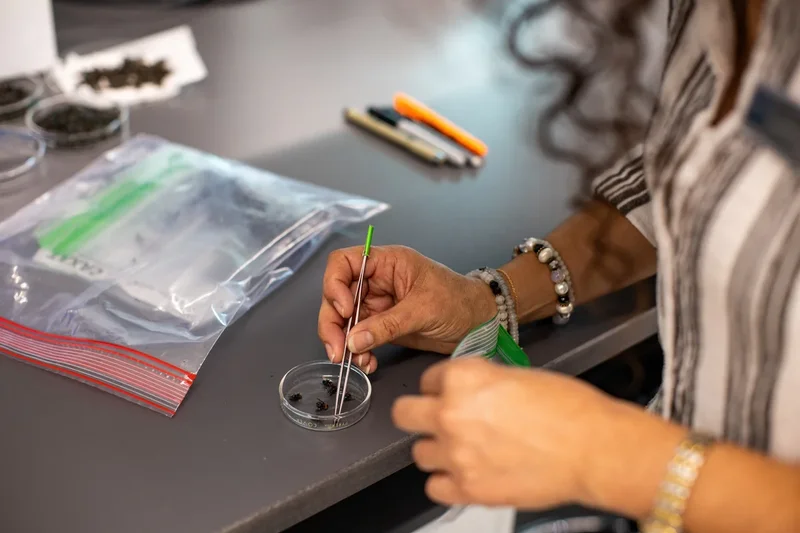
Scientists at a U.S.-funded facility in Panama are preparing to launch the first outdoor tests of genetically modified screwworm flies, a significant step in developing a more effective weapon against the flesh-eating parasite that has spread through Central America and into the United States.
Researchers will confine the flies in mesh cages, exposing them to Panama's heat and humidity. This aims to measure their survival outside laboratory conditions before advancing to later stages of field testing.
The Trump administration has touted the genetically modified fly, named NovoFly, as a game-changer in the fight against New World screwworm. Widespread infestations could cause estimated losses exceeding $1 billion to Texas' livestock industry and threaten other U.S. states.
Screwworms are parasitic flies whose females lay eggs in open wounds and mucous membranes on warm-blooded animals. Once hatched, hundreds of larvae use sharp mouths to burrow through living flesh, eventually killing their host if untreated.
For decades, the most effective tool was widespread dispersal of sterile screwworm flies, mostly produced at the Panama facility. The U.S. Department of Agriculture and Panama's Ministry of Agricultural Development jointly manage this plant, opened in 2006, intended to maintain a barrier against wild screwworms moving north.
However, wild screwworm flies have now spread throughout Mexico and, in June, infested Texas farms for the first time in decades. With cases over a large area, the 100 million sterile flies produced weekly in Panama are insufficient. Experts say 500 million a week are needed to push the parasite back to the Darien Gap, the rainforest between Panama and Colombia.
Enter NovoFly, a screwworm fly genetically engineered to produce only males. Once these male offspring are sterilized, they can be released to mate with wild female screwworm flies, which then lay unfertilized eggs.
Wild female screwworms typically mate only once, so sterile male flies can progressively decline the population until eradication. The USDA began using this technique in 1957, eradicating the pest from the United States by 1966, and using it for later outbreaks.
The NovoFly project aims to boost sterile fly production. Currently, the Panama facility produces both males and females. Females are useless in controlling wild populations, but separating them is difficult, according to the USDA and entomologists.
"It's going to allow us to almost instantaneously double the number of sterile flies that we put in the fight," Scott Hutchins, USDA's chief scientist and an undersecretary, said at a June news conference. "It's going to give us a tremendous edge."
The USDA conducts some screwworm research at the Knipling-Bushland U.S. Livestock Insects Research Laboratory in Kerrville, Texas, named after entomologists who developed the sterilization process. Flies are blasted with radiation before release, a process also for NovoFly.
Officials at the Kerrville lab told Reuters on an exclusive tour that scientists expect imminent approval from Panama's biosecurity agency to begin NovoFly tests outdoors at the Panama lab.
The Panama-United States Commission for the Eradication and Prevention of Screwworm (COPEG), which operates the Panama plant, deferred information requests to the USDA. The Panamanian Food Agency declined to comment.
SUCCESS NOT GUARANTEED
The outdoor testing is critical to determining the potential effectiveness of the NovoFly. Scientists do not know whether it will have the strength and virility to fly far enough to find and attract wild mates.
After the initial tests in Panama, larger field trials on NovoFly are expected to begin at a ranch nearby in nine to 12 weeks, when researchers will release 50,000 of the insects every few days, said Alex Arp, a USDA research geneticist working in Panama. The flies will be marked with fluorescent dyes visible under black light, and traps around the ranch will allow researchers to track how long each release survives, he said.
Field tests typically run for about six to eight weeks, said Maxwell Scott, an entomologist at North Carolina State University who helped develop NovoFly, warning that success was not guaranteed: "We may get out in the field, and it may not fly very well."
If NovoFly performs well in trials, it would take time to scale up production, according to the USDA. Rather than producing NovoFly initially in Panama, it may be less risky to do it at a new sterile-fly production facility expected to open in Texas late next year, experts said.
Adding NovoFly to the facility in Panama could risk disrupting the largest source of sterile flies and a collapse of production, if scientists fail to establish the correct diets, temperatures and conditions for the new strain.
"The last thing we'd want to do is rush a process to be able to have what's called a total brood collapse," said Rear Admiral Michael Schmoyer, who is leading USDA's efforts against screwworm, at a legislative hearing in Texas. "You start with zero, and then you have to build up again."
The U.S. Environmental Protection Agency published a proposed decision to register NovoFly in June, according to the USDA. If fully approved, NovoFly would become the first genetically modified insect to get full EPA clearance, Scott said.
Even a modest increase in the number of sterilized males could lead to a quicker eradication of wild screwworm flies, said Edwin Burgess, an assistant professor of veterinary entomology at the University of Florida who is not involved in the project. However, researchers need to make sure NovoFly is competitive against wild male screwworm flies for mating and can be reared successfully on a large scale, he said.
"There are still a lot of things that need to be done to get that technology to where it needs to be," Burgess said. "But it's certainly very, very promising."
Mexico supports using the male-only flies and could be producing them by the end of the year at a newly reopened production plant, said Gabriel Ayala, head of animal health for Mexico's National Service for Agri-Food Health, Safety and Quality. Eventually, they could be produced in Panama, Mexico and at the planned U.S. plant in Texas, he said.
Kerrville lab director Kim Lohmeyer said she hopes the U.S. can eradicate screwworms much faster than the decades it took before the pests were controlled in the 1960s. But, even if the NovoFly trials succeed and it is brought into production, it will likely take more than a year to control the pest, she said.
"It will take some time and effort," she said. "We need more flies."