Several times a week, I sit myself down in front of a baseball game either in person or on television, I retrieve my book and my pen, and I keep score. I feel my brain relax, my mind soften, my attention fully focus on one thing in a world where that rarely happens. It is a grandma hobby like knitting or embroidery or sourdough, and I love it. Scoring a game is one of the great mundane joys of my life, and I will not shut up about it.
A few seasons ago, I taught my dear friend Dana Murphy to score and now we sit in our row at the baseball game, recording each out and hit in our slightly varying scripts, in the same scorebook. People stop —mostly, it is older men who used to keep score with their fathers or grandfathers— to tell us they love to see people scoring the game still, that it reminds them of their childhood, of a slower world. You can still score, we say. Everybody can score! Dana agreed to help me, so I decided that I would attempt to host a class to teach the people of Philadelphia how to score. I made a little poster for promotion, and advertised it on Instagram and Bluesky. Worst case, I figured, no one would come and my friends and I would just watch the game together at a bar.
I felt my first twinges of hesitancy when I tried to explain the event to Julia Golda Harris, one of the owners of Val's Lesbian Bar in Philadelphia, on the phone. Julia was open to my event, but ... she didn't understand what it was. On the phone I tried to explain that it's like a worksheet you fill out while watching a game. I wandered off in my pitch, talking about the history of scoring, and the first woman to be a professional scorer, and how the written record is all we have of those games from baseball's early days. Julia still did not really understand what I was talking about, which was fair, but she agreed to host anyway. As long as I thought I could get 15 people to come.
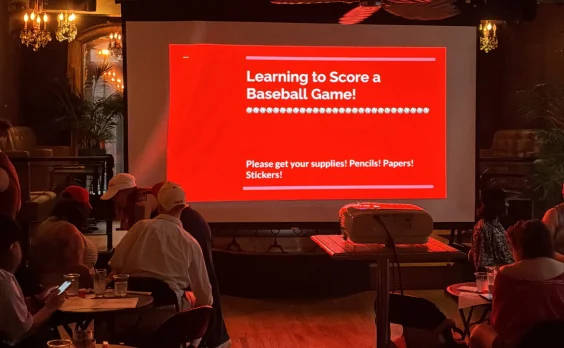
Because I cannot do anything in a casual way and because I believe that all events should include a souvenir, I decided to gather supplies for my class. I bought red pencils for everyone to use. I called the class Everybody Hits because when everybody hits, everybody scores. Bethany Heck, creator of my favorite scorebook the Eephus HalfLiner, generously agreed to help me. She designed a single game score sheet for me to teach off of, and several stickers including a holographic hot dog. I printed 60 of each sticker, and 60 copies of the scoresheet in color. Surely, 60 would be plenty. My students can take two or three copies if there are extras! I thought with a beautiful naivety.
On Tuesday, Aug. 11, I arrived at Val's an hour early. They had put up a little sign outside to advertise my event!
I knew almost immediately that this was going to be bigger than I had anticipated. Despite arriving a full hour early, a few eager beavers were already there. This was convenient because Julia and I needed to set up the chairs and tables for my event, and the early-arrivers helped. We set up about a dozen small cafe tables, and 40 foldable chairs. Val's also had a few booths and side-rails where people could lean. We also got my projector set up, so that I could teach.
By 6:45, still a half-hour before the start of the event, all of our beautiful chairs were full. People began to sit on the floor. By 7:00, we were out of scoresheets. Dana brilliantly innovated and began tearing pages from a HalfLiner she had brought with her. The room became very crowded, as if my scoring event were a cool indie band and not a nerd activity. People stood shoulder to shoulder. The heat from all the bodies made me sweat. "I was astounded by the turnout!" Julia told me. Same! Based on our estimates (60 printed pages plus torn scorepages), we think there were about 115 people in the upstairs bar at Val's (too many, some might say!) when my lesson began.
I took a poll. A small handful of people did not know the rules of baseball, and roughly the same amount already knew how to score a game. Everyone else was somewhere in between. This seemed reasonable. I offered a brief overview of the rules of baseball, a quick history on scoring—with my beautiful slides—and then went through the nitty-gritty on how to number the players, how to score a play, and specific things they needed to know. I included sage advice from Ray Ratto: "When in doubt, everything is a fielder's choice."
The real lesson I wanted everyone to take away was that there is no right way to score a baseball game. It is a craft, and the craft belongs to you. You can score it however you want, with whatever symbols you want, because the only person who needs to like it or understand it is you. Your book; your rules, I said over and over again.
But like driving a stick shift or speaking a new language, the only way to learn to keep score is to do it. We watched a few game clips I had put together, and practiced scoring them. Then we turned on the Phillies game live. I held a whiteboard, and after each play, I wrote down how I would score it in my book.
Kathryn came to my event, too. "I brought a friend who had never watched a baseball game in her life, which is sort of like the equivalent of those infant swimming videos where they just huck a cherubic little orb into the deep end and watch them float," Kathryn said.
"After the fact, she told me that she was under the impression from how I'd talked about it before that scoring was a normal activity to do and not niche sicko bullshit. Oops! But even knowing next to nothing about baseball, she still had a great time; the vibes were incredible, even if the game was very boring."
The Phillies lost to the Cardinals 2-0. Nobody even committed any errors! There was only one interesting thing to score: a 3-2-3 double play.
Many of my students scattered after the lesson. I learned later that they bled out with their scoresheets to score the game from elsewhere. Some sat downstairs and scored using the MLB app. Some went to neighboring bars to watch and score there. The whole neighborhood was flooded with scoresheets. But the event remained standing-room only until after the seventh-inning stretch, which I felt was pretty incredible commitment for a Tuesday game in August.
Someone left me a little note about how much scoring means to them. "It made me feel great!" Dana said. "There were so many new friends who want to love the same weird thing we do!"
A few days later, someone tagged me in a photo of them scoring the Phillies' Field of Dreams game. In the box where Kyle Schwarber hit his first home run sat an adorable drawing of a bomb to indicate a Schwar-bomb. It's a small innovation, but I did tear up a little. That's all I wanted from my class: for people to learn to score their own way, to make a baseball game their own.