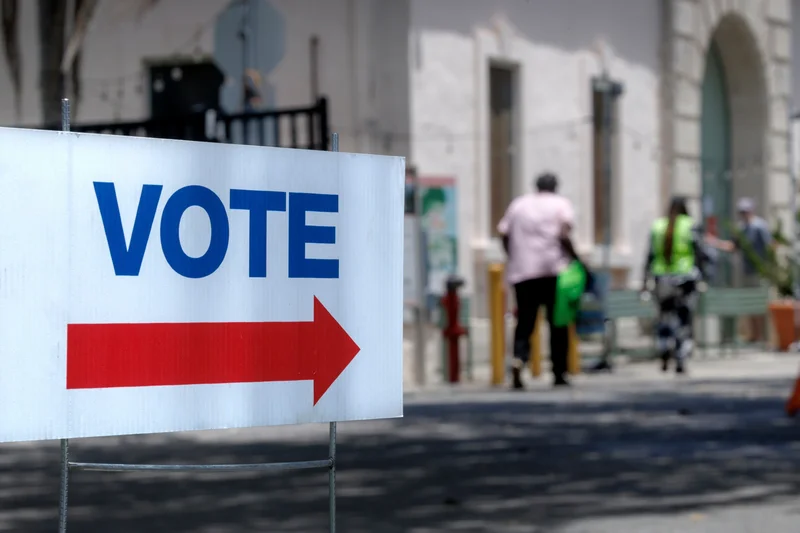
Florida will be at the center of attention on Tuesday as voters choose the candidates who will compete in November for governor, a U.S. Senate seat and several seats in the House of Representatives. The election will also test U.S. President Donald Trump’s influence in the state and take place under a new congressional map designed to favor Republicans.
The race to succeed Governor Ron DeSantis is the most closely watched contest. Eleven Republicans are seeking their party’s nomination, including Congressman Byron Donalds, who is backed by Trump, and Lieutenant Governor Jay Collins, a DeSantis ally. On the Democratic side, six candidates are seeking to break through in a state where the party has not won a gubernatorial election in more than three decades.
Florida will not be the only state holding primaries on Tuesday. Wyoming will go to the polls with an unusually high number of open statewide offices, while in Hawaii, a corruption investigation involving Lieutenant Governor Sylvia Luke is shaping one of the day’s key contests.
When and what time are the elections?
The primaries will be held Tuesday, August 18.
In Florida, most of the state is in the Eastern Time Zone, and polling places will close at 7 p.m. Some counties in the western part of the state are in the Central Time Zone, so their polls will close at 8 p.m. Eastern Time.
In Wyoming, polls will close at 7 p.m. Mountain Time, equivalent to 9 p.m. on the East Coast.
Who are the candidates?
The most closely watched election in Florida is the Republican primary to succeed DeSantis, who is barred from seeking a third term.
Byron Donalds, backed by Trump, enters the race as the favorite after supporting the president over DeSantis in 2024. His main rival is Jay Collins, the lieutenant governor and an ally of the current governor, who is seeking to “protect the DeSantis legacy.” James Fishback and former state House Speaker Paul Renner are also among the candidates.
On the Democratic side, there are six candidates, including David Jolly, a former Republican who switched to the Democratic Party in 2025 and leads the field in fundraising alongside Gwen Graham. The party is seeking to break a more than three-decade streak without a victory in the governor’s race.
In the Senate race, Republican Ashley Moody, who was appointed by DeSantis in 2025, faces no significant primary opposition and will take on the Democratic winner of the contest between Angie Nixon and Alex Vindman in November.
These are the first congressional primaries held under the new map approved by Republicans, which seeks to reduce Democratic representation and could effectively eliminate four districts currently held by the party.
What’s happening in Wyoming?
Wyoming’s primary is significant because several Republican-held offices are up for grabs.
Governor Mark Gordon and Senator Cynthia Lummis are not seeking reelection, while Harriet Hageman is running for Lummis’ Senate seat. It is the first time in 32 years that the governorship, Senate and House seats are simultaneously open in the state.
Megan Degenfelder, who is backed by Trump, is the favorite in the gubernatorial race. Hageman also has the president’s endorsement and a financial advantage in the Senate contest.
Wyoming is one of the most Republican states in the country, where Trump recorded his strongest results in 2020 and 2024.
And what’s at stake in Hawaii?
In Hawaii, five Democrats and four Republicans are competing for the lieutenant governor’s office following the departure of Sylvia Luke, who is under investigation on alleged bribery charges.
The position is significant because the governor and lieutenant governor are elected separately and the office has often served as a stepping stone to higher office in the state.
The Democratic primary for Congressman Ed Case is also drawing attention, as he faces four challengers. One of them, state Senator Jarrett Keohokalole, has criticized Case for his support of the SAVE Act, backed by Trump.
Case’s district is heavily Democratic, making the primary winner the favorite heading into November.
Who can vote?
Florida and Wyoming have closed primaries. Voters registered as Republicans may participate only in Republican primaries, while Democrats may participate only in Democratic primaries. Independent and unaffiliated voters cannot vote in either party’s primary.
Hawaii uses a different system: any registered voter may participate in either party’s primary.