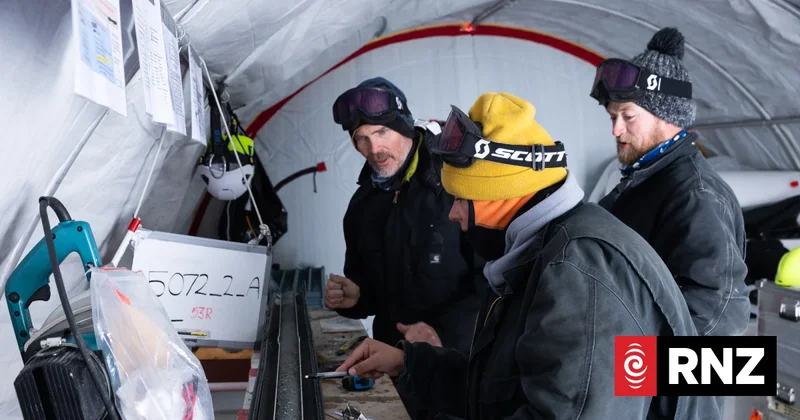
It's mid-June and in a cold, echo-filled warehouse space on the University of Otago campus an international team of scientists and technicians has gathered.
For a moment the deafening sound of a diamond blade saw slicing through sediment and rock drowns everything, before the background chatter of different researchers hunkered over benches, discussing findings, re-emerges.
This is the Otago Repository for Core Analysis, nicknamed ORCA, and for these two weeks it is hosting a rare and hard-won core of sediment retrieved from under the ice in Antarctica.
A cylinder of sediment that the team hopes will help us understand what will happen as our climate warms.
The precious sediment core
There are a number of reasons why the team in ORCA are so excited about this particular tube of rock and mud.
After two failed attempts in the two previous years, this was the third go at retrieving such a core.
The previous failures came down to technical reasons, but there's no doubt the team had set themselves an unprecentented and extremely difficult task.
The 218 metres of sediment they finally recovered (a record-breaking length) was only drilled after they'd used hot water to melt a hole through 523 metres of ice, all at a distance of about 700km away from the nearest base.
But perhaps the number one reason for the excitement is where the sediment has come from, and the story it can tell about how this part of Antarctica has changed in the past.
Their drill site was at a place called Crary Ice Rise where a finger of the West Antarctic Ice Sheet juts out, still sitting on the bedrock of the Antarctic continent.
This ice sheet is essentially a massive glacier, sitting on the rock. Where it meets ocean the ice flows off the land to float on the seawater, forming an ice shelf, hundreds of metres thick.
When the ice sheet shrinks it ultimately results in more fresh water being added to the ocean, contributing to sea level rise globally.
So the question this massive international project wanted to answer was: what has happened to the ice sheet in the past, at times when our climate was much warmer? And can this help us predict what is coming our way?
'Like you read a book'
Earth Sciences New Zealand's Dr Georgia Grant was on the ice when the core started to come up - a "pinch yourself" moment for her.
A sedimentologist, Georgia says her training allows her to read in the rocks the clues of what's happened in that area across time.
Different types of sediments found in the core point to different past environments.
In open ocean, fine particles and microfossils settle gently to the seafloor. Larger stones found in that sediment may have been dropped by melting icebergs.
But when an ice sheet is directly involved, it can grind and mix everything together - from fine glacial flour to cobbles and boulders.
"Ice causes chaos," says Georgia. "But again, in a very particular way, in a way that is recognisable."
The core they recovered has the telltale signs of both the presence of ice and open water. Near the bottom, the oldest part of the core, they found microfossil-rich muds from a warmer time period, followed by a long section where ice was present, and then the muds indicating open ocean again higher in the core.
Key then is to figure out the age of the different sections of the core, so that they can be lined up with existing evidence of what was happening to the climate and environment at the time.
Dating the sediment
Amy Leventer from Colgate University has swapped a New York summer for a Dunedin winter to sit in front of a microscope to study microfossils.
Part of the biostratigraphy team, she's doing some of the important work of dating the sediments using the remains of tiny single-celled photosynthetic algae called diatoms. Diatoms make their shells out of silica and are common in such polar marine sediments.
Decades of research has established time constraints for different species of diatoms, says Amy.
"We use microfossils that have first appearances and last appearances. We know when they lived. And so when we observe them, we can pretty precisely tell... the age of the material."
Age estimates show most of the recovered core spans 7-10 million years ago, with the final 20 metres at the bottom dating back to 17 - 19 million years ago.
This overlaps with a geological time period called the Miocene (23 - 5 million years ago), for which there are some data sets on carbon dioxide levels and estimates of ocean temperatures determined using chemical proxies, as well as models for what the temperatures would have been across that time.
Because it is a massive stretch of time there are significant changes within the Miocene, but in general it was a period much warmer relative to today, by at least three degrees.
What it means for our future
The Paris Climate Agreement aims to hold global warming well below 2 degrees, but the Climate Action Tracker website currently says global policies put us on track for a 2.6 degree rise by 2100.
One of the questions the project set out to answer was around the sensitivity of the West Antarctic Ice Sheet to 2 degrees of warming.
They wanted to investigate this by looking back to the middle Pliocene, around three million years ago, when average global temperatures were 2-3 degrees warmer.
They didn't collect sediments of that age in this core, but they hope to find the resources to return to another site which they suspect might have those younger sediments.
So while open ocean in this part of Antarctica might not be in our immediate future, co-chief scientist Associate Professor Huw Horgan still found it a challenging sight when the core started coming to the surface.
"It was confronting, where we're over 500 kilometres from the open ocean. We had this huge ice shelf between us that that has been there for all of human history. We've only known that ice shelf to be there. And yet here we are looking at a record from 82 degrees south with no ice shelf."
Initial investigations of the more subtle evidence suggested there was still ice nearby, with further ongoing study they hope to get a clearer picture of the changes in this part of Antarctica across the time period they've collected.
While it is a significant sediment record, it is still just from one point, right on the edge of the ice sheet, says co-chief scientist Associate Professor Molly Patterson. She says it would help to have more sediment cores from other areas.
While Associate Professor Huw Horgan agrees, when it comes to the question of what should ideally happen next, his answer is simple.
"In an ideal world we would stop warming the planet."