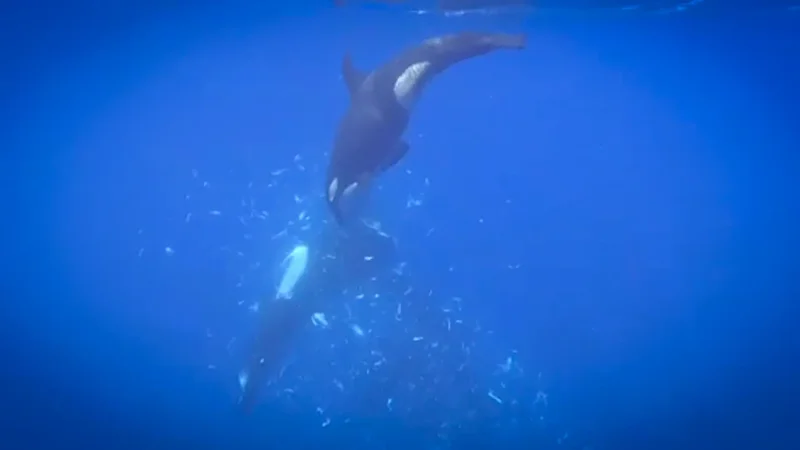
Orcas filmed smashing giant sunfish into thousands of pieces
Orcas were caught using high-speed teamwork to blast sunfish into bite-sized pieces, revealing another astonishing hunting behavior.
- Date:
- July 23, 2026
- Source:
- Frontiers
- Summary:
- Researchers in the Gulf of California have documented a dramatic orca behavior never described before. In two separate encounters, one orca gripped a dead sunfish by the fin while another charged into it at high speed, blasting the carcass into thousands of pieces.
- Share:
Orcas are among the ocean's most intelligent and formidable predators. They have been seen targeting many kinds of animals, including whales larger than themselves, and they rely on a remarkable range of coordinated hunting methods. Now, researchers in the Gulf of California have documented a behavior that has never been formally described before.
"We document how one orca holds the sunfish and lets go just before another orca hits it at high speed, causing the tissue to break apart into thousands of pieces," said first author of the Frontiers in Ethology article, Dr. Kathryn Ayres, a scientist at Beneath The Waves, a non-profit organization promoting ocean health. "We think this may help younger orcas feed more easily or it could also just be for fun. Orcas are known for playing with their food."
Orcas Shatter Sunfish at High Speed
Sunfish can exceed three meters in length and weigh as much as 2,000 kg. Although they travel through different levels of the ocean, they often rise to the surface to rest, regulate their body temperature, or have parasites removed. That behavior leaves them exposed to predators.
In the Gulf of California, sunfish are among the animals most frequently hunted and eaten by orcas. The newly reported behavior was recorded during two separate events that took place slightly more than a year apart.
In July 2024, Ayres watched a group of orcas, including a juvenile, handle a dead sharp-tail sunfish that they had already killed. A female gripped the fish by its large tail fin, which provided a secure hold, while a male gained speed and charged toward them.
The female released the sunfish just before the male struck it. The force of the collision broke the fish's tissue into fragments that drifted through the water. The juvenile then ate the smaller pieces, while the adults consumed the remaining carcass but left the scattered fragments behind. [See link to video after the end of the article.]
A second incident was filmed by Héctor Franz in September 2025. It followed the same sequence of holding, releasing, ramming, and feeding.
A Newly Documented Food Processing Strategy
The forceful collisions caused much of the prey's tissue to disintegrate. Researchers say ramming has not previously been documented as an orca predation strategy.
In both cases, the animals appeared to work together. One orca held the carcass steady, allowing the other to strike it with greater precision. Because the sunfish were already dead, the researchers believe the impacts were used to process the prey rather than kill it.
Sunfish have a gelatinous outer layer known as capsule, and both this layer and the skin contain a distinct microbiome. When the tissue breaks apart, the microbial taxa living within it spread into the surrounding water and change its nutrient composition.
This fragmentation may increase contact between sunfish and orca microbiomes. Researchers suggest that such exposure could offer nutritional advantages or other benefits, including possible immune regulation.
Smaller Pieces for Young Orcas
The behavior may also represent parental investment. Breaking the carcass into smaller portions would make it easier for a calf or juvenile to feed, which is consistent with other known orca behaviors.
"Orcas often tear apart prey and share it with other members of the group, including calves and juveniles," said Ayres.
However, feeding may not have been the only purpose. The interactions could also have had a social function, or the orcas may simply have been playing.
Clues About Sharp-Tail Sunfish
The observations may also reveal something unusual about sharp-tail sunfish. So far, this type of tissue fragmentation has only been recorded in that species.
The researchers suggest that sharp-tail sunfish tissue may respond to powerful impacts in a distinctive way. Other, larger sunfish species may not break apart as easily under similar conditions.
Scientists do not know whether the same orcas participated in both events. More high-quality footage is needed, particularly clear views of dorsal fins and eye patches, which can be used to identify individual animals.
"Collecting good identification photographs whenever possible is key: we are still seeing new techniques of how orcas hunt and process their prey," concluded Ayres. "They're one of the most iconic marine predators in the world, yet they continue to surprise us."
Journal Reference:
- Kathryn A. Ayres, Austin J. Gallagher, Christine V. Avena, Carlos M. Duarte, Jesús Erick Higuera Rivas. Fragmentation of sharp-tail sunfish (Masturus lanceolatus) caused by high-impact ramming behavior in orcas (Orcinus orca).Frontiers in Ethology, 2026; 5 DOI: 10.3389/fetho.2026.1835536
Cite This Page:
ScienceDaily. Retrieved July 23, 2026 from www.sciencedaily.com