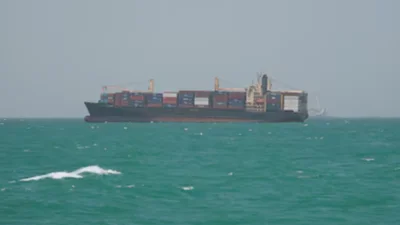
An oil tanker carrying Saudi crude to India changed course in the Red Sea on Tuesday following a warning from Yemen's Houthi militia. The tanker, Rodos, was carrying around 700,000 barrels of Saudi crude destined for India.
According to news agency Reuters, it turned around in the Red Sea and headed north towards the Suez Canal instead of continuing south through the Bab el-Mandeb Strait.
Another tanker, Xin Long Yang, loaded with about 2 million barrels of Saudi crude for China, also reversed course on the same day.
The sudden change in route comes after the Houthis declared a naval blockade against Saudi Arabia and warned shipping companies not to load or unload cargo at Saudi ports. They said vessels involved in such trade could be targeted "in any location".
For India, the immediate concern is not a shortage of crude but the possibility of delays, higher shipping costs and rising insurance premiums if vessels continue to avoid the southern Red Sea.
INDIA'S OIL SUPPLIES IN FOCUS
The diversion is significant for India because Saudi Arabia is one of the country's largest crude oil suppliers.
Since the Strait of Hormuz became inaccessible after blockade due to flare-up in US-Iran conflict, Saudi Arabia has increasingly relied on its Red Sea export terminal at Yanbu to move crude to international buyers. Oil loaded at Yanbu normally exits the Red Sea through the Bab el-Mandeb Strait before entering the Gulf of Aden and the Arabian Sea on its way to India.
The latest Houthi warning has now put that route under fresh threat.
WHY THE TANKER TURNED BACK
The Houthis, who control much of northern Yemen and the coastline overlooking the Bab el-Mandeb Strait, announced on Monday that they were imposing a naval blockade on Saudi Arabia.
In an email sent to shipping companies, the group warned against loading or unloading cargo at Saudi ports. It said ships involved in such operations could become military targets regardless of their location.
Shipping data cited by Reuters showed that both Rodos and Xin Long Yang altered their course shortly after the warning.
Another Very Large Crude Carrier, New Prime, which was due to arrive at Yanbu later this week to load crude, also turned back near Oman before entering the Red Sea.
LONGER ROUTE COULD DELAY DELIVERIES
The decision to head north has also highlighted the limited alternatives available for tankers carrying Saudi crude to Asia.
The Suez Canal is not a direct route to India. Instead, ships moving north through the canal enter the Mediterranean Sea. From there, they would have to sail around the Strait of Gibraltar, travel down the west coast of Africa, round the Cape of Good Hope and then cross the Indian Ocean before reaching Indian ports.
Such a diversion could add several months to the journey.
Longer voyages also mean higher fuel costs, increased freight charges and bigger insurance bills. These additional expenses could eventually raise the overall cost of transporting crude to Asian buyers, including India.
SHIPPING INDUSTRY ON ALERT
Despite the heightened tensions, Yanbu port continues to operate.
Shipping sources told Reuters that Saudi Arabia is still loading crude onto vessels already inside the Red Sea or those entering through the Suez Canal.
Ship tracking data showed that the tanker Olympic Luck was still heading towards Yanbu after entering the Red Sea through Suez. Several other vessels already near the port also continued their journeys.
However, the security situation has already pushed up war risk insurance costs.
British maritime security company Ambrey advised ship operators to carefully reconsider sailing through the Red Sea after calling at Saudi ports.
"Vessels calling at Saudi Arabian ports are advised to reconsider transiting the Red Sea and to consider implementing enhanced mitigation measures," Ambrey said, as quoted by Reuters.
Shipbroker Clarksons said a complete blockade remains unlikely because it would require significant resources. However, it warned that any escalation could increase the risk of attacks on Saudi-linked vessels passing through the Bab el-Mandeb Strait.
On average, about 10 crude oil tankers transit the Bab el-Mandeb each day.
- Ends
With inputs from agencies
Published By:
Satyam Singh
Published On:
Jul 22, 2026 00:13 IST