Viktor Wang has a favourite piece of history.
In 2019, OpenAI’s GPT-2 showed that a machine trained on nothing but internet text could write like a person. It was crude, but it was a hinge. Wang thinks robots are about to have the same moment. He is raising money to be there when they do.
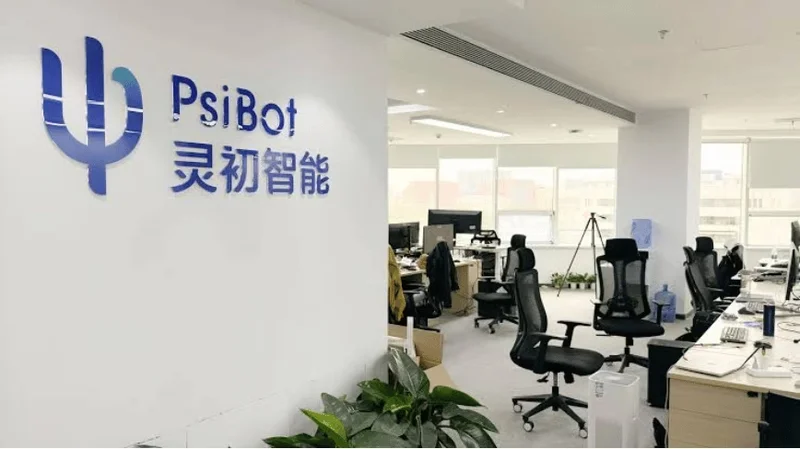
His startup, Psibot, also known as Lingchu Intelligence, is close to raising nearly $100m at a $1.48bn valuation, Bloomberg reported. Chery, the carmaker, leads the round, alongside Lens Technology, a sensor maker that supplies Apple and Tesla. Founded only in 2024, Psibot has now raised about $300m.
The company works on world models. This is AI that helps robots and self-driving cars perceive and respond to the physical world, not just answer questions. “World models aim to achieve something more consequential than the large language models and chatbots,” Wang said. It is a crowded field, and a central front in the US-China AI race.
The founders are the tell. Three people built Psibot: a Peking University dean, an Alibaba and Tencent robotics veteran, and a Stanford scholar. That scholar studied under Fei-Fei Li, who helped start modern computer vision. This is not a fringe bet.
Data is the moat, and the wall
Wang’s thesis rests on data, which he calls both China’s edge and its bottleneck. Psibot gathers its own, using bespoke gloves and humanoid robots. It tests its systems at a big Chinese logistics firm and a major fibre-optic cable maker. The hard part is volume and quality. “Even the frontier AI labs in Silicon Valley such as OpenAI and Meta don’t have good data,” he said. His goal this year is one million hours of it.
The bet is not lonely. Chinese firms are among the world’s most aggressive builders of world models. They lean on state support, industrial data, and a deep open-source scene. The company’s own account traces a fast climb from angel funding to unicorn in barely two years. This week another Chinese world-model startup, GigaAI, filed for a Hong Kong listing.
The two-year clock
Wang is putting a date on it. “We should see the GPT-2 moment in embodied AI in two years,” he said. He means the moment machines start to generalise about the physical world, as chatbots did with language. He may be early, or wrong.
But a $1.48bn valuation, in a field that barely existed two years ago, says plenty. Serious investors are willing to set their watches by him. Earlier rounds, Sahm Capital reported, drew state-backed and industrial money too.
Get the TNW newsletter
Get the most important tech news in your inbox each week.