Anthony Albanese’s infamous exchange with a podcast host about Japanese Prime Minister Sanae Takaichi’s melon gift may have been crass, ill-advised and cringeworthy. Indeed, it certainly was. The big unanswered question was whether the prime minister’s bawdy banter with a so-called bush Barbie, and his steadfast refusal to apologise to Takaichi, had fundamentally damaged the relationship with one of Australia’s most important strategic partners.
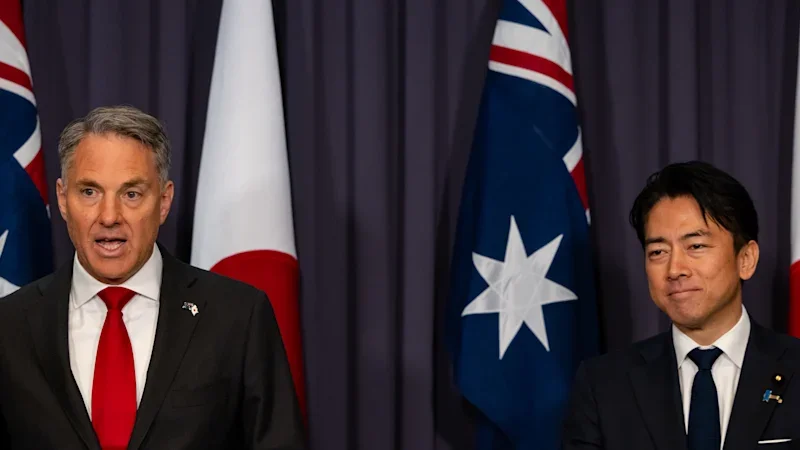
A week after Albanese’s remarks dominated the national news cycle, a chance to test this proposition arrived with exquisite timing. One of Takaichi’s most senior ministers, Japanese Defence Minister Shinjiro Koizumi, arrived in Canberra on Tuesday for meetings with counterpart Richard Marles. And a joint press conference too.
While Koizumi’s visit may have seemed risky, it offered an opportunity to clear the air and demonstrate that, whatever bafflement Albanese’s comments caused behind the scenes in Tokyo, the Japan-Australia relationship is too important to be derailed by a dodgy double entendre. So it proved.
Crucially, it turned out that Koizumi not only met with Marles during his visit but with Albanese too, a privilege not often afforded to visiting ministers. So, did he raise melon-gate with the prime minister and register concerns on Japan’s behalf? No.
“There was not such a discussion today,” Koizumi said when asked whether he had broached the topic with Albanese.
“Before I visited Australia, the Australian side had already told the Japanese side that Mr Albanese ... did not really mean it that way.”
Koizumi, a suave operator, is the son of a former prime minister and has often been discussed as a possible contender for the top job himself.
As he spoke, you could almost hear the sighs of relief – if not hollers of delight – emanating from the prime minister’s office, a few doors away.
Rather than melons, Koizumi had other things on his mind – specifically lasers and hypersonic weapons.
The ministers announced two important developments on defence co-operation.
First, Australia and Japan are partnering to develop a sophisticated laser capability that can be added to military platforms on land and water to detect incoming threats. The project is named Boobook, after an Australian owl that sees well in the dark.
Secondly, as first flagged during Takaichi’s visit in May, Australia will open up its military ranges for Japan to test-fire weapons including hypersonic long-range missiles. Koizumi hailed this as a “groundbreaking development”, second only to Japan’s existing weapons testing arrangements with the United States. Australia’s vast geography is a crucial asset to a densely populated and relatively tiny island nation like Japan, which is rapidly beefing up its military capabilities.
These announcements come on top of other recent advances, including Australia’s purchase of a fleet of Japanese-designed Mogami-class frigates and regular rotations of Japanese troops through the Top End.
With US President Donald Trump scaling back military exercises with democratic Seoul and cosying up with autocratic Pyongyang, Canberra and Tokyo are also in synch on the need to keep the US engaged with the Asia-Pacific.
To those doubting the strength of the bilateral relationship, Marles effectively said: look at the scoreboard. “The relationship with Japan is at a high watermark,” he declared. “It has never had the level of depth and engagement that it has right now. We do, next to the United States, as much with Japan as any defence force in the world, and we do as much defence diplomacy together as we do with any other country in the world.”
Lest anyone have any doubts, Marles said that he and Koizumi communicate virtually every day and have met in-person five times this year. It’s now up to Albanese to move past his melon gaffe and cultivate a similarly close relationship with Takaichi.