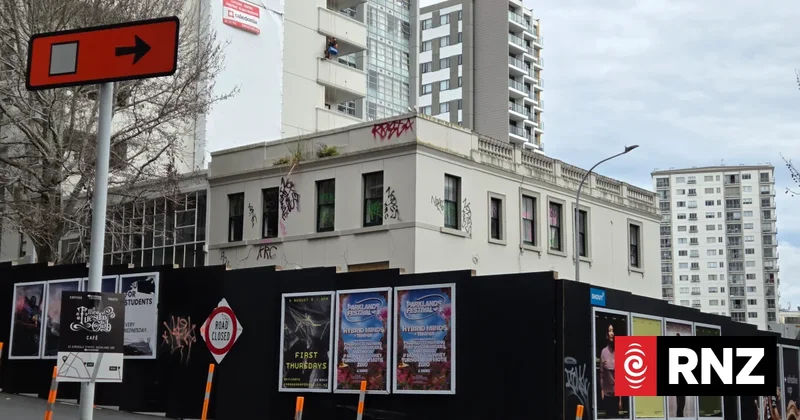
'It's going to hurt' - neighbour wants council to work with owner of cracked heritage building
A neighbour of a cracked and deteriorating Auckland heritage building wants to see a collective effort to repair it.
Built in 1854, the former Fitzroy Hotel, the corner of Wakefield and Lyndock Streets, is considered the oldest remaining brick building in Auckland's CBD.
But Auckland Council has deemed the building dangerous, and arguments over fixing it are lumbering through the courts.
In the meantime, the building is empty and deteriorating behind timber hoardings spread across the road to protect the public.
Initially installed close to the building in 2023, the hoardings have closed Lyndock Street entirely for more than a year.
Behind them, Nick Worthington runs The Tuesday Club, a cafe and creative hub in what he described as "a little backwater that's right in the heart of it".
"It's a stone's throw from the town hall, right next to the library, the art gallery, there's all the colleges here full of young people."
Worthington said the hoardings have stymied foot traffic, and impacted the heritage building.
"It just meant all of the...graffiti artists and vandals and, you know, quite destructive people felt protected behind those fences, and basically broke windows, broke doors, and went in there and vandalised the interior."
Worthington said it was "pretty mindless" and "really distressing for the building owner, who personally was legally not allowed to enter the building".
Auckland Council has issued multiple Dangerous Building Notices requiring the building's owner The Fitzroy Hotel Auckland Limited, and the company's director Terry Huang, to make it safe.
In March 2024, when the company and Huang had not complied with a notice issued in October 2023 demanding work be carried out to to make the building safe, the council took them to court.
The case was heard in May, in a judge-alone trial in the Auckland District Court before Judge Edwin Paul.
In his July decision, Judge Paul found both the company and its director had failed to comply with a Dangerous Building Notice.
"The stark reality is no works or actions were ever undertaken to reduce or remove the danger."
Paul said the dangerous building notice identified the building needed propping.
"Given the dangerous nature of the building and risk to public safety, as a minimum on any assessment, it would be reasonable to expect that the defendants install propping to ensure against any possible collapse..."
Huang faces a maximum fine of $300,000 and his company faces a fine up to $1.5m. They are due to be sentenced in November.
The degradation of the building is a source of frustration for Allan Matson, who lived across the road from the former hotel more than two decades ago. A newly qualified architect with an interest in heritage protection, Matson pushed the then-Auckland City Council to add the building to its heritage schedule.
"It was a hotel, and later it had in the basement both the Pilgrim Press and Wakefield Press, which typographer Bob Lowry ran and published the works of Baxter, Shadbolt, Kernow, some of the great New Zealand poets.
"The thing is just so rich with history.
"It was there since 14 years after the Treaty of Waitangi was signed."
The building's then-owner had already applied for consent to demolish it, but the scheduling process was started anyway, Matson said.
"After hearing all the evidence, including mine, they decided that it was, under Auckland City Council's own old system, 72 points. At 75 it would have been a category A, so this was one fact under a category A."
Matson appealed the decision to the Environment Court.
"All in all, it took about five years and at the end it came out a category A building with a score of 96."
The demolition consent was granted, and later lapsed.
Heritage New Zealand Pouhere Taonga listed the building as a Category 1 Historic Place in 2004.
A former member of the Waitematā Local Board, Matson wanted the council involved in fixing it.
"I'd like to see a responsible attitude by council in protecting the heritage of the city, so I'd like to see them prop the building and the law enables them to put a first charge against the title to recover those monies."
Worthington said fixing the building will take a collective effort from council agencies and the owner.
"It would be a folly to do any remedial stuff to the building if you haven't sorted the foundations out, which spread beyond the boundary of the building," Worthington said.
"They've got to do it together and then it's going to hurt, it's going to cost money, but the solution's going to be way cheaper the sooner you do it and it's going to be better for everyone the sooner you do it. The more the bickering happens, the more expensive it gets."
In the May court hearing, Huang highlighted an issue 10 years ago with an underground water pipe in front of the building. But in his decision, Judge Paul said there was no expert evidence connecting the 2016 watermain event to the dangerous condition of the building as at October 2023, and no evidence established the cause of the building's subsidence.
Auckland Council investigations team leader Paul Cowling said the council "would act on evidence of a significant and imminent risk if the building's structural integrity changes materially".
He said building movement is monitored "to enable the timely identification and assessment of any material changes".
"The council's position is that responsibility for ensuring the safety of the building remains with the owner."
Cowling said the court decision did not give the council authority to conduct work on the building.