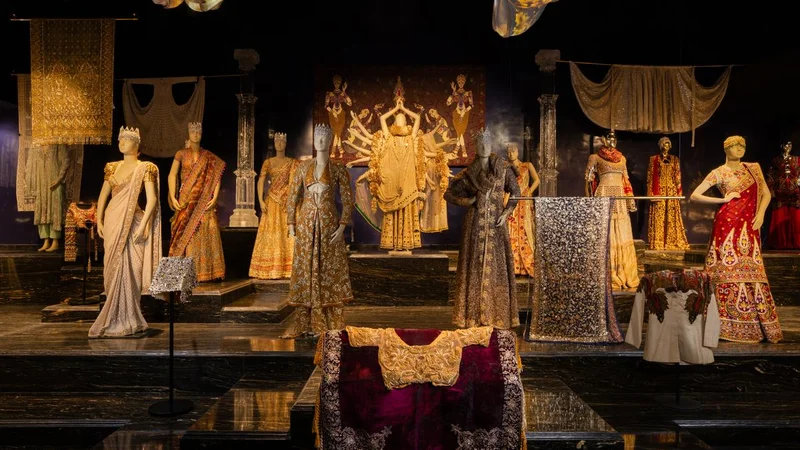
A mythical brass city hangs upside down, an ivory Shola tree blooms indoors, while the Mumbai skyline becomes a gilded promenade, while an archive unfolds through the geometry of Indian stepwells. This is Mubarak Baug, Mumbai-based designers Abu Jani and Sandeep Khosla’s new 20,000-square-foot Mumbai flagship — a maximalist dream that marks four decades of their couture house.
Mubarak Baug is not A Wonder Room, the duo’s new art and design gallery, but it offers perhaps the clearest glimpse yet of the thinking behind it: a belief that art, craft, architecture, objects and fashion need not stay in their respective corners.
Bringing together art, craft, furniture, textiles, lighting and commissioned works, the gallery allows the designers to curate, collaborate and commission beyond couture.
The idea, however, is hardly new. “A Wonder Room is a universe because it is not defined by a single discipline or object,” says Sandeep Khosla. “Our goal is to bring together art, craft and culture within these curated environments, where the space itself becomes the canvas.”
And Mumbai, naturally, gets a starring role. Art Deco influences run through the space, including the ‘Bombay Skyline Corridor’, where artist Shilo Shiv Suleman has hand-embossed the city’s urban sprawl onto brass panels. Photographer Viraj Nayak’s wall of black-and-white Mumbai photographs adds another layer, while Wolf Jaipur turns embroidery and fabric offcuts into floor-to-ceiling sculptural panels. Then there are painted frescoes by artist Shine Shivan, conjuring mythology, architecture and fantastical landscapes. It is a wonderfully busy conversation between Mumbai, craft, art and imagination.
For years, the concept has found expression through the designers’ spaces, objects and celebrations. Couture, too, has never been a self-contained discipline for the duo. “We have never seen couture as merely fashion,” says Sandeep. “We have never limited ourselves to what we derive inspiration from, be it architecture, theatre, food, hospitality and the way a person experiences beauty.”
Formalising A Wonder Room as a gallery gives this instinct “a fully realised home, a discipline and a future”, he says. It also creates a platform for more deliberate collaborations with artists and craftspeople. “It is not a departure from couture. It is the next natural turn in a creative journey that has always extended far beyond fashion.”
The room as a work of art
At A Wonder Room, the room itself becomes part of the work. Objects are not presented as anonymous inventory but placed within authored environments, with their provenance, context and relationship to surrounding works forming part of the experience. .
That expansive approach is encapsulated in the designers’ phrase ‘India Maximal’. It may sound like a licence for more colour, ornament, pattern and embellishment, and, well, the duo has never exactly been accused of underdoing things, but Sandeep sees it as something more considered.
“India Maximal is often mistaken for abundance and opulence alone,” he says. “There is so much emotional depth to it. It is the freedom to use beauty fully and unapologetically.”
The aesthetic draws from India’s layered visual culture of colour, pattern, symbolism, ornament and craftsmanship. But it is not intended as a reproduction of the past. “It is not about reproducing the past. It is about taking the richness of our traditions and expressing it in an original language.”
There is also a discipline to the exuberance. “Maximalism without thought can become noise. For us, every detail must earn its place,” says Sandeep
The larger argument is that Indian design does not need to strip away its identity to appear contemporary or global. India Maximal, he says, allows the country’s creative inheritance to remain rooted while being expressed in an original, forward-looking language.
The impulse is to make the visitor experience something rather than simply buy something. “Luxury, to us, is not only about possession. It is also about wonder, memory and the generosity of an experience,” says Sandeep.
That distinction is central to A Wonder Room, too. The gallery is conceived not as an interiors practice, collectible design store or conventional retail space, but as a place where objects can be encountered within a larger visual and cultural context.
Keeping craft alive
Craft sits at the centre of this universe, but Sandeep is wary of treating tradition as something to be preserved behind glass.
“Preservation cannot just mean placing craft within a glass box. A living tradition must be practised, challenged, commissioned and given new contexts.”
A Wonder Room aims to create that exchange by bringing artists, craftspeople and designers together as creative equals. Materials such as Shola, brass, embroidery and handwoven textiles can be explored at different scales, forms and settings, while retaining the knowledge embedded in the techniques.
For Sandeep, keeping craft relevant means allowing it to evolve. “For a new generation to value craft, it must encounter it as something alive, relevant and capable of surprise.”
The gallery therefore becomes as much about what comes next as what has already been made. As the couture house marks four decades, Sandeep sees legacy not as an archive but as an opportunity to create new conditions for creativity.
1st Marine Street, Framjee Cawasjee Institute, Anandilal Podar Marg, Dhobi Talao, Kalbadevi, Mumbai
Published - August 18, 2026 12:44 pm IST