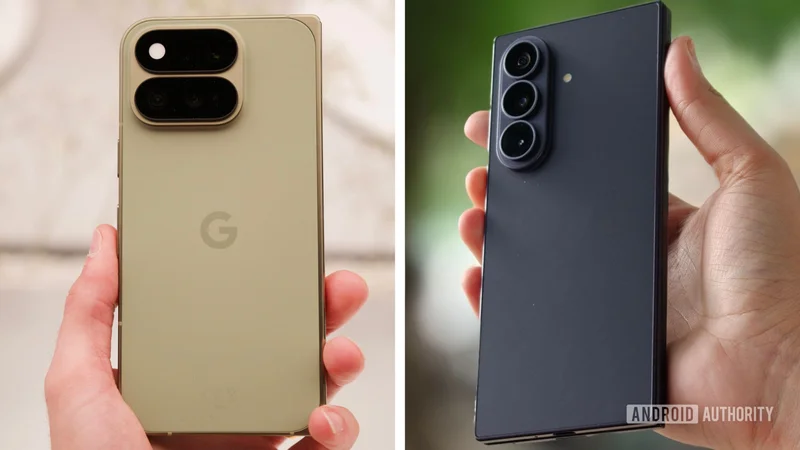
If I'm spending $2,000 on a foldable, I'm skipping the Pixel 11 Pro Fold for Samsung
Aug 18, 2026 — 5:00 AM ET
The Google Pixel 11 Pro Fold is now officially here, packing the latest Snapdragon processor and several other upgrades into a sleeker, slimmer design. However, it’s not the only game in town.
While I have recommended the Pixel 11 Pro XL over the Samsung Galaxy S26 Ultra, the foldable market is a whole other animal. Samsung has been at this for a long time, after all. While both brands have their own pros and cons, I’d personally pick the Galaxy Z Fold 8 Ultra over Google’s foldable — and there are a few reasons why.
| Pixel 11 Pro Fold | Samsung Galaxy Z Fold 8 | |
|---|---|---|
| Display | Pixel 11 Pro Fold Inner: - 8-inch OLED Super Actua Flex display - 2,076 x 2,152 - Up to 2,400 nits (HDR) and up to 3,600 nits (peak brightness) Outer: - 6.5-inch OLED - Super Actua display - 1,080 x 2,342 - Up to 2,400 nits (HDR) and up to 3,600 nits (peak brightness) | Samsung Galaxy Z Fold 8 Inner: - 7.6-inch Dynamic AMOLED 2X - 1-120Hz refresh rate (LTPO) - 2,448 x 1,848 resolution - 403ppi - 4:3 aspect ratio Outer: - 5.5-inch Dynamic AMOLED 2X - 1-120Hz refresh rate - 1,972 x 1,248 resolution - 428ppi - 10:16 aspect ratio - Gorilla Glass Ceramic 3 |
| Processor | Pixel 11 Pro Fold Google Tensor G6 Titan M3 security coprocessor | Samsung Galaxy Z Fold 8 Qualcomm Snapdragon 8 Elite Gen 5 for Galaxy |
| RAM | Pixel 11 Pro Fold 16GB | Samsung Galaxy Z Fold 8 12GB, 16GB |
| Storage | Pixel 11 Pro Fold 256GB 512GB 1TB | Samsung Galaxy Z Fold 8 256GB, 512GB, or 1TB No expandable storage |
| Battery & Charging | Pixel 11 Pro Fold 4,750mAh Fast charging: up to 50% in about 30 minutes using 30W USB-C PPS charger (sold separately) Qi2.2 Pixelsnap wireless charging up to 25W | Samsung Galaxy Z Fold 8 4,800mAh dual-battery 45W wired charging 20W Fast Wireless Charging Wireless PowerShare |
| Cameras (Rear) | Pixel 11 Pro Fold -48MP Wide (Quad PD, ƒ/1.70 aperture, 85° field of view, 1/1.56" image sensor size) -10.5 MP ultrawide (Dual PD, Autofocus, ƒ/2.2 aperture, 127° field of view, 1/3.4" image sensor size) -10.8 MP telephoto lens (Dual PD, ƒ/3.1 aperture, 23° field of view, 1/3.2" image sensor size, 5x optical zoom, Super Res Zoom up to 30x) | Samsung Galaxy Z Fold 8 - 50MP wide, 1.0μm, OIS, Dual Pixel AF, ƒ/1.8, 85° FoV, 8K 30fps video recording - 50MP ultra-wide, 0.7μm, ƒ/1.9, 120° FoV |
| Cameras (Front/Inner) | Pixel 11 Pro Fold -Front Camera: 10 MP Dual PD, ƒ/2.2 aperture, 87° field of view -Inner Camera: 10 MP Dual PD, ƒ/2.2 aperture, 87° field of view | Samsung Galaxy Z Fold 8 -Front Camera: 10MP ƒ/2.2, 1.12μm, 85° FoV, 4K 60fps video recording -Inner Camera: 10MP ƒ/2.2, 1.12μm, 100° FoV, FHD 60fps video recording |
| Dimensions | Pixel 11 Pro Fold Folded: 155.2mm x 76.0mm x10.1mm Unfolded:155.2mm x 150.4mm x 5mm | Samsung Galaxy Z Fold 8 Folded: 123.9 x 81.9 x 9.7mm Unfolded: 123.9 x 161.4 x 4.5mm |
| Weight | Pixel 11 Pro Fold 239g | Samsung Galaxy Z Fold 8 201g |
| Durability | Pixel 11 Pro Fold -IP68 dust and water resistance -Ceramic cover glass -Composite matte back | Samsung Galaxy Z Fold 8 -IP68 dust and water resistance - Gorilla Glass Victus 2 |
| Security | Pixel 11 Pro Fold Android 17 7 years of OS, security, and Pixel Drop updates | Samsung Galaxy Z Fold 8 Android 17 7 years of OS updates and fixes |
| Connectivity | Pixel 11 Pro Fold -Wi-Fi 7 (802.11be) with 2.4GHz, 5GHz, 6GHz, 2x2 MIMO -Bluetooth v6 -UWB -NFC -Google Cast | Samsung Galaxy Z Fold 8 - 5G - Wi-Fi 7 - Bluetooth 6.0 - NFC |
| Colors | Pixel 11 Pro Fold Obsidian, Olive | Samsung Galaxy Z Fold 8 Global: Lavender, Graphite, Creame Samsung Exclusive: Pistachio |
The Galaxy Z Fold 8 Ultra is sleeker, slimmer, and lighter
The Samsung Galaxy Z Fold 8 series marks a big change for the company, as the base model is now slightly shorter and wider, making it feel much more compact even if it’s a bit thicker as a result. The regular Z Fold 8 is a fascinating phone, but for those looking for a more direct successor to the Pixel 11 Pro Fold, the Z Fold 8 Ultra is what you’ll be considering.
Regardless of which model you choose, you’ll find Samsung is thinner and lighter. While the Google Pixel 11 Pro Fold is thinner and lighter than last year’s model, it’s still 10.1mm thick when folded and weighs 239 grams. In comparison, the Galaxy Z Fold 8 is just 9.7mm when unfolded and is just 201 grams. The Z Fold 8 Ultra is even thinner at just 8.9mm, though it’s a tad heavier at 215 grams.
Both have decent cameras, but Samsung thinks differently
The Google Pixel 11 Pro Fold doesn’t make any dramatic changes to its camera configuration this year, though its main camera is getting a small upgrade. While it’s still just a 48MP shooter, the new camera at least provides better light sensitivity, with Google claiming a 56% improvement overall.
As for Samsung? The Fold 8 Ultra trades out the older 12MP ultrawide secondary camera for a newer 50MP shooter, though it retains its predecessor’s 200MP flagship shooter and 10MP telephoto cameras. On paper, this certainly sounds impressive, but it’s important to remember specs alone don’t make for a great camera experience.
Samsung's camera configuration stands out a bit more thanks to its 200MP main shooter and dual recording support.
Google has proven itself an expert at camera optimization in the past, and I’m sure that will hold true here too. It’s too early to judge the Pixel 11 Pro Fold’s camera performance, but given its mild upgrades, I still think Samsung probably holds at least a slight edge here, though it will mostly come down to personal preference, as both handle processing quite differently.
As much as I think both cameras are pretty well-matched, Samsung makes better use of the form factor. The Galaxy Fold 8 Ultra’s software supports dual recording, allowing you to use both the front and rear cameras simultaneously. This might not be useful for everyone, but it’s nice to see Samsung thinking outside of the box. There’s also a newly updated ProVisual Engine that’s supposed to reduce shot noise.
The Z Fold is better suited for power users
While the Google Pixel 11 Pro Fold packs a reasonably strong punch, the truth is that the Tensor G6 just isn’t in the same class as the Snapdragon 8 Elite found inside the Galaxy Z Fold 8 Ultra.
If you are an average user, the differences might not be noticeable in everyday use, as the Tensor G6 can still handle every app and game you throw at it, helped by the fact that the Pro Fold packs 16GB of RAM into every configuration. Where the Snapdragon’s extra oomph really matters is for those who push their phones to the limit with photo editing, video editing, emulation, and high-end mobile gaming. It also makes the Galaxy much more future-proof.
It’s not just that Samsung has a stronger processor or a higher megapixel count on its camera, either. Samsung tends to take an “everything but the kitchen sink” approach to software, which can feel like overkill to some but is a natural fit for those who love to tinker. Of course, the fact Samsung has spent more time baking its multitasking features also helps.
Samsung still leads when it comes to foldable software
It’s no secret that Google is faster with Android updates and bug fixes, as the latest Galaxy flagships typically see new OS versions about two to three months after the Pixel family. For those with an older Galaxy, times can slip even further to six months or more, whereas Google released Android 17 the same day for every Pixel going back to the Pixel 6 series.
As much as this is a major plus for Google, Samsung is still quite speedy compared to other Android brands like Motorola and Nothing. It also has an advantage Google doesn’t, at least on the foldable side: more experience with foldables.
Samsung has been in foldables longer, and in that time it’s worked hard to establish itself as the multitasking champion, with deep UI-level integration for multi-window support and other pro-level multitasking features. Samsung also adds pop-floating windows to the mix, the ability to create two- or three-app pairings for quick launching, and extras like the Good Lock Suite, which give you granular control over aspect ratios and window behavior. There are even features like Samsung Dex that can effectively transform your device into a makeshift computer.
Google might be the king when it comes to Android features and updates, but Samsung has more experience with foldable multitasking features.
While Google obviously has its own multitasking features, Google tends to go with a cleaner, minimalist approach here. For example, you can only stack two primary windows into split screen on a Pixel Pro Fold, but Samsung allows you to split your screen into three windows. Less is more is a strategy I can get behind for traditional phones, but that’s not necessarily what users are looking for when you’re talking about a nearly $2,000 purchase. I understand some people really do just want a bigger screen for social media and other casual uses, but this feels like a lot of wasted potential.
Of course, Samsung’s approach isn’t without its downsides. It can feel pretty bloated, and finding specific settings can be a challenge sometimes. Google also might not throw as many features into the ring, but what it does offer packs a ton of polish and stands out against Samsung’s approach. This includes features like fluid app continuity between the outer and inner screen as well as its dual-screen preview mode and its clean notification shades.
Pixel 11 Pro Fold vs. Galaxy Z Fold 8 Ultra: Which would you pick?
I prefer Samsung here, but the Pixel 11 Pro Fold is no slouch
The Pixel 11 Pro Fold is an attractive-looking phone with more than enough power and performance for just about every type of user out there, but I can’t help but feel like you are owed more than that when you are spending laptop money on a phone. The Samsung Galaxy Z Fold 8 Ultra feels like the more polished, powerful option that truly earns that kind of spending, as it can arguably replace a computer for light work, and it also largely replaces the need for a tablet, even if it’s quite a bit smaller than most of today’s Android tablets.
What if you don’t want or need a powerhouse and really just want a phone that can occasionally provide more screen real estate for better gaming, movies, and browsing? That’s where the Pixel 11 Pro Fold shines.
Google’s software is all about minimalism, and so the Pro Fold is a great choice if you just want to jump into your favorite apps without worrying about feature overload. Its extra heft might turn off some folks, but it also gives it a solid, durable impression, further backed by its higher dust-protection rating. While the Pixel 11 Pro Fold is entirely dust-tight, the Z Fold 8 Ultra only protects against larger objects (1mm or bigger) and provides virtually no protection from dust or sand. The Pro Fold supports Qi2 magnets, something that the Z Fold 8 Ultra doesn’t offer. Google’s foldable flagship also offers slightly faster wireless charging than the Z Fold 8 Ultra, though Samsung offers much faster 45W wired speeds.
Those aren’t insignificant advantages, and they’re well worth considering. Still, if it were my money being spent on a new foldable in 2026, the Galaxy Z Fold 8 Ultra would be my choice every single time.