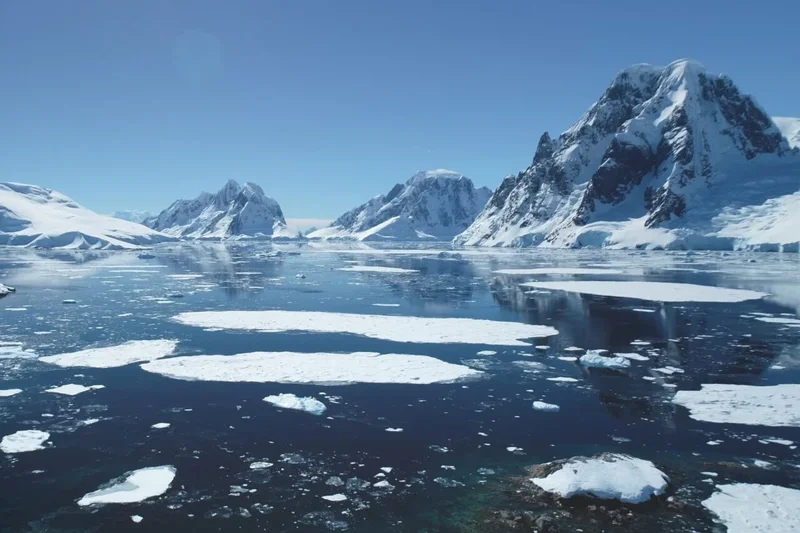
When it comes to hotspots of toxic heavy metal pollution, Antarctica probably doesn’t come to mind. This remote region is nowhere close to any major city or industrial facility, and yet, mercury is accumulating in the seafloor sediments surrounding the Antarctic Peninsula at an alarming rate.
That’s according to a study published July 27 in the journal Proceedings of the National Academy of Sciences. The findings suggest that increased anthropogenic mercury emissions and climate change are working together to pump more of this dangerous element into the Southern Ocean than ever before, threatening marine ecology.
“The results reveal that polar warming is turning Antarcticaâs cryosphere from a mercury sink into an active secondary pollution source,” the authors write.
From sink to source
Mercury is a neurotoxic heavy metal that can damage both human and environmental health. While it can be emitted by natural sources, mercury pollution mainly stems from human activities.
Mercury emissions from industrial facilities such as coal plants, waste incinerators, mines, and cement plants travel hundreds of miles through the atmosphere to Earth’s polar regions. Then, they get deposited onto snow, ice, and open ocean water, eventually becoming incorporated into the ice sheet and seafloor. In this way, both the Arctic and Antarctica have historically served as global mercury sinks, but that appears to be changing.
In this study, researchers reconstructed the past 200 years of mercury source-sink dynamics in the Antarctic Peninsula, the continent’s fastest warming region with the most pronounced glacier melting. They did so by analyzing geochemical and isotropic records from 16 sediment cores collected from the continental shelf off the Peninsula, using a computer model to quantify the amount and sources of mercury deposited in the sediment.
They found that, despite its remoteness from anthropogenic emission sources, the Antarctic Peninsula shelf exhibits a mercury accumulation rate twice the global shelf average. “Since industrialization, this accumulation rate has increased by 160%, making the Antarctic Peninsula one of the major hotspots of marine mercury enrichment,” the authors write.
The model revealed two coupled mechanisms behind this acceleration. Firstly, more mercury is falling from the atmosphere into the Southern Ocean (largely due to rising anthropogenic emissions) and as sea ice melts and open water expands, the ocean is able to absorb more mercury from the atmosphere. Secondly, melting glaciers and erosion are releasing mercury that has long been stored in land and ice on the Antarctic Peninsula into the ocean.
“The coupling of these two loops has increased ice melt-driven terrestrial mercury release by 550% and airâsea exchange by 350%” over the past 200 years, according to the researchers. “Thus, climate warming is turning the large historical mercury reservoir in Antarctica into an active secondary pollution source, amplifying polar mercury pollution risk.”
Not just Antarctica
Previous research has suggested that the Arctic is undergoing a similar change. A 2024 study found significantly elevated mercury levels in riverbanks and sandbars on the Huslia and Yukon rivers in Alaska. This suggests that permafrost thawed by climate change is releasing stored mercury into Arctic waters. While the exact amount of mercury stored in Arctic permafrost is unknown, it could very well be enormous.
âThere could be this giant mercury bomb in the Arctic waiting to explode,â coauthor Josh West, an environmental scientist at the University of Southern California, told Yale E360 at the time the study was published.