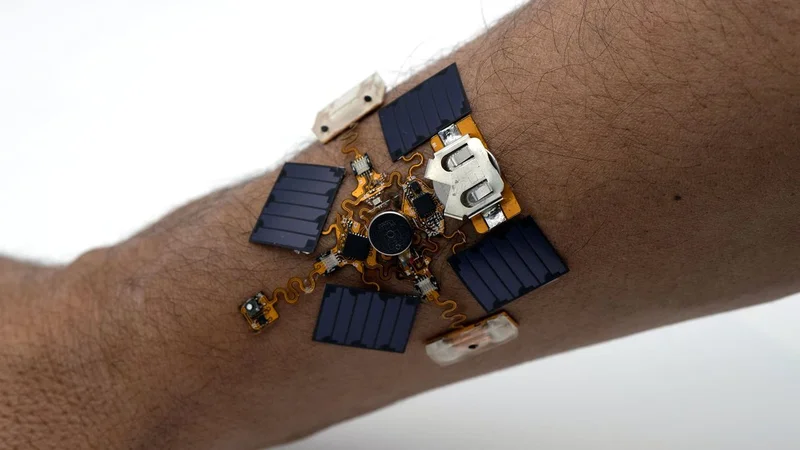
- Researchers have created a wearable patch that detects poisons
- It sends a haptic buzz to your arm whenever toxins are sensed
- Each poison type has its own haptic feedback pattern
There are many professions that regularly put people in contact with dangerous substances — bacteria, toxic gases, you name it. What if there was a way to quickly and easily detect these hazardous compounds before they damage your health?
Well, new research suggests there might be just such a method. A paper published in the journal Device (via North Carolina State University) details how a wearable skin patch could warn you if a range of hazardous elements are found. If that happens, it delivers “target-specific vibrations to alert the wearer” of the risk to their health.
That means you can tell in an instant what the patch is trying to tell you — a certain vibration might mean one toxin has been identified, while a different form of haptic feedback may correspond to a different poison. The user can then take appropriate action without a delay or the need for additional tests.
This approach has the advantage of being highly direct. Other patches exist that can also sense environmental contaminants, but many of these send warnings to your smartphone. That’s impractical if you don’t have your phone or if you’re trying to use it while wearing protective gear. A vibration-based skin patch, on the other hand, can tell you what’s happening without you even needing to look at it.
Life-saving tech
The patch is currently able to detect six contaminants: heavy metals, particulate matter, high or low temperatures, humidity, volatile organic compounds, and nitrogen oxide gases. It’s also rechargeable and uses a solar-powered battery to stay topped up in use.
A key facet of the patch is its modularity. According to Amay Bandodkar, a corresponding author of the paper, the modularity means “you can add or remove sensors that monitor for whichever hazards are most relevant to the application,” a feature that makes the device “extremely flexible.”
The patch isn’t just useful for humans, as the developers have created a version that can be applied to robots. This harnesses an “e-skin” made from piezoelectric material that can then be attached to a robot. When it detects toxins, it sends an electrical signal to the robot warning it of the danger.
Sign up for breaking news, reviews, opinion, top tech deals, and more.
It’s an interesting example of wearable technology moving beyond simple health analysis into something more serious. Who knows — maybe one day it could save your life.
➡️ Read our full guide to the best laptops**1. Best overall: **
Apple MacBook Air 13-inch M5**2. Best budget: **
Apple MacBook Neo3. Best Windows 11 laptop
Microsoft Surface Laptop 13-inch4. Best thin and light:
Lenovo Yoga Slim 9i5. Best Ultrabook
Asus Zenbook S 16
Alex Blake has been fooling around with computers since the early 1990s, and since that time he's learned a thing or two about tech. No more than two things, though. That's all his brain can hold. As well as TechRadar, Alex writes for iMore, Digital Trends and Creative Bloq, among others. He was previously commissioning editor at MacFormat magazine. That means he mostly covers the world of Apple and its latest products, but also Windows, computer peripherals, mobile apps, and much more beyond. When not writing, you can find him hiking the English countryside and gaming on his PC.