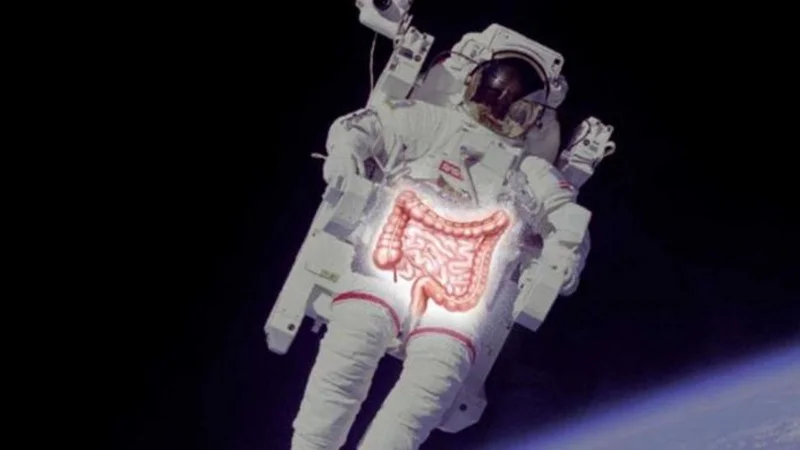
Astronauts have long struggled with constipation in space. Now, scientists may finally understand why.
A new study of 52 astronauts who lived aboard the International Space Station (ISS) suggests that microgravity may slow the movement of food through the intestines, changing how gut bacteria break down nutrients. The findings could ultimately help researchers develop dietary strategies to keep astronauts' digestive systems running smoothly during future missions to the moon and Mars — while offering new clues about digestive problems here on Earth, according to a statement from the University of Copenhagen.
Constipation is a common problem among astronauts, but exactly what happens inside the gut during spaceflight has remained less clear. To investigate, researchers from the University of Copenhagen and NASA analyzed blood samples collected from astronauts before, during and after missions aboard the space station.
"We see changes in astronauts' blood samples that indicate that the gut bacteria begin to ferment protein to a greater extent than usual within weeks after the astronauts arrive in space, and this change continues until they are back on Earth," Giorgia La Barbera, co-lead author of the study and associate professor at the Department of Nutrition, Exercise and Sports, said in the statement.
The team used a technique called metabolomics to measure small molecules circulating in the blood, providing a biochemical snapshot of how the astronauts' bodies — and the microbes living inside them — were responding to spaceflight.
In total, the researchers analyzed 488 plasma samples from 52 astronauts who spent between two and nine months aboard the orbiting lab between 2006 and 2018. They identified changes in around 40 circulating compounds during spaceflight, including several metabolites produced when bacteria in the colon ferment proteins. Those compounds increased while the astronauts were in space, suggesting food was spending more time moving through their intestines, according to the statement.
Normally, bacteria in the colon ferment fiber and carbohydrates for energy. But when digestion slows, those carbohydrates can become depleted, causing microbes to break down more proteins instead and produce different metabolites that can enter the bloodstream. The changes appeared shortly after astronauts entered space and largely subsided within days of their return to Earth, providing biochemical evidence that digestion slows in space. Differences in diet, including caffeine, fish and fat intake, accounted for less than one-third of the metabolic changes, suggesting diet alone couldn't explain the effect.
"The lack of gravity in space probably causes food to move more slowly through the intestine, and this fits with the fact that we are seeing signs of increased protein fermentation," Henrik Roager, co-author of the study and also an associate professor at the Department of Nutrition, Exercise and Sports, said in the statement. "This may also help explain constipation in astronauts."
However, while the researchers did not directly measure how quickly food moved through the astronauts' digestive systems, the metabolic changes they observed suggest that it moved more slowly through the gut.
The findings could become increasingly important as astronauts spend months — or eventually years — away from Earth. Beyond the discomfort of constipation, increased protein fermentation can produce compounds such as ammonia and hydrogen sulfide, and the researchers say some of the metabolites associated with this process have been linked to other negative health effects.
One potential countermeasure may be relatively simple: more fiber. The team suggests increasing astronauts' intake of slowly fermented carbohydrates, which could give gut microbes more carbohydrates to consume and reduce their reliance on protein fermentation.
Understanding how microgravity affects digestion and gut bacteria could help keep astronauts healthy on increasingly long missions to the moon and Mars, while also offering new clues for treating digestive problems on Earth by revealing how slower movement through the gut changes microbial activity.
Similar studies of astronaut health in microgravity have also yielded insights for people back on Earth. Bone loss is one prominent example. Astronauts lose bone density much faster in microgravity than people typically do on Earth, and efforts to prevent that loss have helped scientists better understand osteoporosis and age-related bone loss. Spaceflight research has also offered insights into muscle loss, cardiovascular health and immune-system changes associated with aging and disease.
Their findings were published June 29 in the journal Nature Communications.