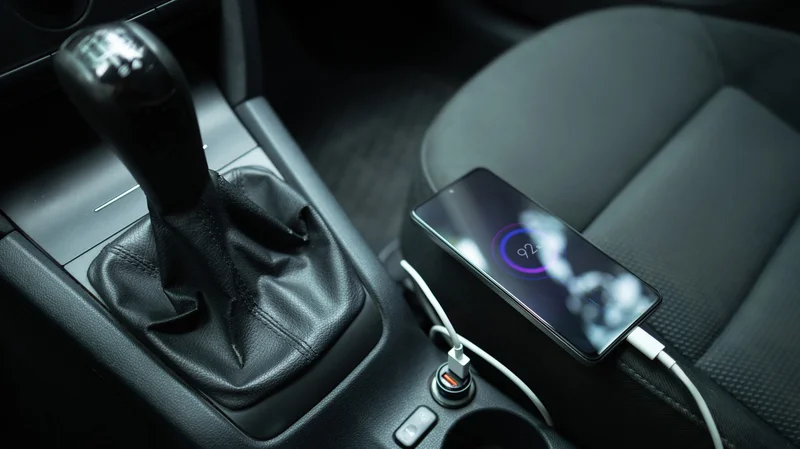
Does charging your phone in your car waste gas?
The short answer is no, not really.
Do you regularly leave home with a heavily drained phone? If you're a motorist, there's a good chance you're regularly charging said device in your car. That leads to a problem you may not know about: phone chargers technically consume fuel. Just how much gas is your smartphone guzzling each time you plug it into your car's charger? The actual impact on your vehicle's mileage is tiny. Still, in an era of skyrocketing gas prices, it all adds up.
If you're particularly cost-focused, there are definitely cheaper and more effective ways to power your phone than hooking it up to a car charger. Context is important, though. Technically, every part of your car eats away at mileage to varying degrees. Compared to a phone charger, the average car's air conditioning has a much larger impact on miles per gallon. Here's a breakdown on why charging a phone affects a car's mileage, while also examining just how much fuel the process can eat up.
Why does phone charging consume gas?
Like almost everything in your car, your phone draws electricity from your vehicle's alternator. In turn, the alternator draws power from the engine, and subsequently the engine consumes fuel to keep running.
The key point, however, is that chargers only consume a tiny amount of energy, relatively speaking — somewhere in the region of 5-15 watts. By comparison, your car's AC draws thousands of watts and so impacts fuel consumption to a greater (though not journey-ruining) degree. Even your car's indicators consume more electricity than a phone charger.
How much fuel does charging a phone consume?
In short: almost no fuel. As reported by Bloomberg (via How-To Geek), an average car charger uses about 0.03 miles per gallon. Or to put it another way, if your car gets roughly 20 MPG, a constantly active phone charger is going to take that number down to 19.97 MPG. That's a truly miniscule amount of fuel, and one that's certainly not going to impact your mileage in such a way that will adversely affect your journey. For context, air conditioning can increase fuel consumption up to 10% (via Kwik Fit). If you're a worrier, though, and own a hybrid, here are five easy ways to get more range out of your EV.
Does charging a phone drain a car's battery?
Some people assume that plugging a phone into a car's USB charger will drain the battery. That's not really the case, certainly not in motion. When your car is running, it's the alternator that supplies power to the 12V battery that charges your phone. This adds a tiny electrical load, but it certainly won't drain your vehicle's battery flat.
When the engine isn't running, that's a slightly different matter. If your car is switched off and you charge a phone, that's going to directly draw power from the car's 12V battery. Will charging your phone for multiple hours when the engine is off flatten your car's battery? That's unlikely, though not impossible. You should avoid charging your phone in a car when the engine is off if your vehicle hasn't been driven for an extended period of time or if your car's battery is quite old.
In general, you really don't have to worry about the impact charging a phone will have on either your car's mileage or its battery. That isn't to say you should leave your phone plugged into a car's USB charger for endless hours, but when it comes to fuel or battery consumption, it's not something that should be keeping you up at night.