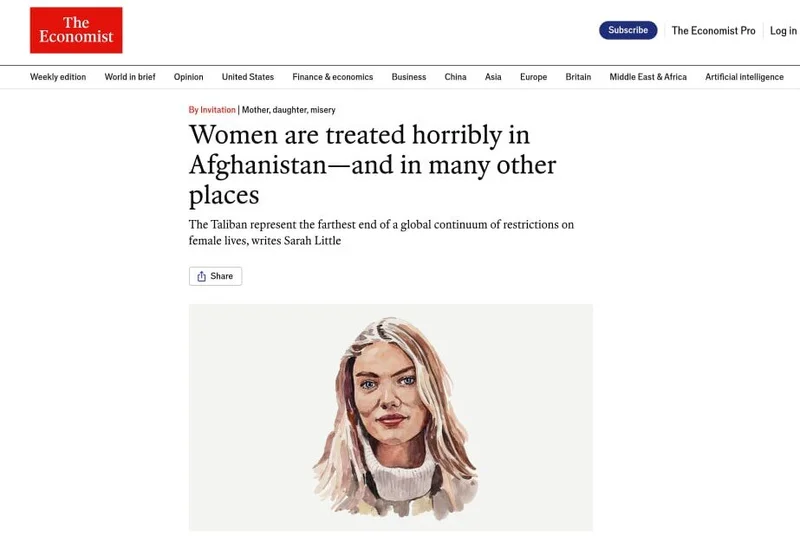
Sarah’s war against the rest of civilization
TEHRAN – Sarah Little writes in The Economist about a “war on women” in Afghanistan. If one looks only at the Taliban’s regulations concerning women, the phrase does not seem unreasonable. But this is precisely where the problem begins. Why is what the Taliban does through law, policing, and direct command described as “war,” while what dominant economic structures in Western societies do through media, culture, fashion, markets, the beauty industry, and the production of desire is rarely placed within the realm of war, coercion, or even power?
This question cannot be answered through a simple opposition between freedom and repression. That opposition is itself part of the problem.
Every society contains two major institutions of power: government and economy. One generates political power; the other economic power. The two are not always aligned. They may reach an accommodation, one may dominate the other, or, when accommodation fails, they may come into conflict. Much of what we call “social order” is produced by the relationship between these two forms of power.
The United States is a prominent example of the dominance of economic power over political power. Economic power is so extensive and organized that politics, across much of the field, operates within boundaries already shaped by economic interests. Taliban-ruled Afghanistan represents something close to the reverse: a politically assertive authority presiding over a weak local economy that has limited capacity to discipline political power or force it into accommodation.
The difference, then, is not between a “controlled society” and a “free society”. It is between two configurations of power.
Political power has a short and hard arm. It issues orders, makes laws, prohibits, deploys police, imprisons and punishes. The path of command is usually identifiable. Someone says what must be done, and someone else is expected to comply.
Economic power has another kind of arm: long, extensive and, along much of its length, invisible. Between the holder of economic power and the person who eventually performs the desired behavior lies a chain of intermediaries: media, advertising, fashion, cinema, entertainment, the beauty industry, labor markets, systems of status, social media, algorithms and the vast machinery of cultural production.
Economic power does not need to send an officer to my door every morning to tell me what to wear, what to eat, which bodies I should find attractive, which parts of my own body I should dislike, what I should regard as success, or what should make me feel ashamed. It can construct a world of meaning within which I will do these things myself.
The more successful this long arm becomes, the less visible it is.
At the beginning of the chain lies an economic interest. Media translate it into a value. Culture turns the value into a norm. The norm becomes desire in everyday life. At the end of the process, the individual says: “I chose this.”
This is where the idea of agency becomes complicated.
Suppose the same cultural apparatus that tells a woman that the hijab in Afghanistan is an instance of the management of the female body also announces that boots are fashionable for women this year. A woman wears boots through the hottest months of summer. She pays for them herself. She bears the physical discomfort herself. No armed officer is standing over her. She may even take pleasure in the feeling that she has chosen her own style and exercised her agency.
I do not regard these two forms of violence as equivalent.
On the contrary, violence that a person accepts voluntarily may be considerably more dangerous. Under overt coercion, there is still something called “I” standing opposite the command. I know who is demanding what from me, and even if I cannot resist, I can identify the source of the force. But when power has planted its demand within me, it no longer needs an officer to enforce it.
I pay the cost myself, endure the pain myself, carry out the instruction myself, and may even interpret the result as evidence of my own freedom.
At that point, power has done more than manage the body. It has participated in the formation of the body-owner’s desires.
This is why the division between the “political” and the “private” becomes so questionable. The Afghan woman’s body is political. Her clothing is political. Her relationship with her hair is political. But as soon as we reach the Western woman, makeup, fashion, cosmetic surgery, injections, body shape, the imperative to remain youthful or thin, clothing, and the public presentation of the face suddenly become “private matters”.
I see no convincing reason to accept this boundary.
What is presented as private may be deeply political, economic, and regulated. Indeed, defining certain domains as private may itself be one of the means through which power removes them from scrutiny.
For that reason, Sarah Little herself is not immune from this discussion.
She is not simply a woman who happens to live within her own society, whose private life I have arbitrarily decided to examine. She has entered the argument herself. She has looked at another society, discussed the bodies of women within it, interpreted the relationship between those bodies and power, and reached a moral conclusion.
She, too, can therefore quite naturally and understandably become a legitimate subject of the same kind of scrutiny.
Her appearance is visibly situated within the dominant aesthetic order. Her make-up, the way she presents her face and body, and even the reasonable possibility of more substantial cosmetic interventions to her face may all be considered within the analysis. I have not seen her medical records and do not claim to know what procedures she may or may not have undergone. My point is that, just as she draws structural inferences from a set of visible and social signs in another society, I am entitled to draw reasonable inferences from the signs available in her case.
The rule cannot be that the Afghan woman’s body is social evidence while Sarah Little’s body is private territory.
Nor is this asymmetry confined to Sarah Little. She speaks from somewhere that gives her voice weight: The Economist.
The media, in this context, are not merely carriers of information. They form part of the long arm of power. They determine what counts as an issue, what deserves global attention, who qualifies as a credible source, which experience comes to represent a society, and even which word is appropriate for naming an event.
When The Economist writes of a “war on women”, it is not merely reporting the world. It is framing it.
This is where colonialism enters the discussion—not as a poetic metaphor and not as a baseless suspicion, but as a real, organized historical structure whose power derives in part from having become normal.
There is a simple example. Niall Ferguson, a well-known British historian, published a book entitled Civilization: The West and the Rest.
Within mainstream Western intellectual culture, this is not regarded as a bizarre, scandalous or even particularly unusual title. That is precisely what makes it significant.
One part of the world has a name: the West. It has an identity. It stands as an independent category and as a point of reference. The rest of humanity is “the rest”.
Apply the same structure elsewhere:
Men and the others.
Whites and the other races.
Christians and the others.
The rich and the other human beings.
The discriminatory structure suddenly becomes obvious. Yet “the West and the Rest” has been normalized to the point that it scarcely registers as unusual.
This is one of the first things colonialism does: it normalizes its own hierarchy.
After normalization comes a more important stage: opacity—the production of invisibility.
Once a colonial order has been normalized, no one needs to repeatedly explain why London has the right to study Kabul, why a Western publication may determine what “the problem of Afghan women” is, why certain Afghan voices are accepted as representative of Afghanistan while others are not, or why the conceptual apparatus of the center should serve as the default instrument for understanding the periphery.
The process of selection recedes from view, while the product of that selection appears simply as “reality”.
It is at this stage that colonialism acquires far greater room for deception, conspiracy and bad faith. Colonialism is not merely a form of unconscious bias. It lies, designs operations, recruits people, directs resources and produces the truths it requires. But these practices become far more effective after normalization and the creation of opacity.
It does not even require a great deal of explicit falsehood.
One can have a hundred true facts, select five, discard the other ninety-five, construct a relationship among those five, and then call the resulting collection a “war on women”. None of the five statements need be false. The final narrative may nevertheless be profoundly misleading despite the factual accuracy of each individual component.
Nor does invoking a “local network” resolve the problem.
Having several reporters or contacts inside Afghanistan does not in itself amount to meaningful contact with Afghanistan. A network is itself a product of selection. Who entered it? Who is regarded as trustworthy by the foreign publication? Who possesses the language and conceptual vocabulary required to communicate with the center? Who receives funding and access to publication? Who understands what must be produced in order to become a credible source?
The limitation is not merely implicit in the structure of the network. In calls associated with More to Her Story, Little herself asks reporters to focus on “issues, not just individual stories”, and gives priority to issues that affect women specifically or disproportionately. In other words, before a witness and her testimony enter the media system, the boundaries of what is considered worth reporting have already been defined to some degree. The network does not merely select witnesses; it also establishes conditions affecting the kinds of testimony able to pass through its filters.
A local network may transmit reality. It may also become a network of trained intermediaries operating within a colonial cultural structure and producing, from local raw material, the truths required by the center.
Being “local” does not in itself settle the question.
We can now return to the original phrase: “war on women”.
The Taliban does not manage only women. Afghan men are also subjects of political power: their appearance, behavior, religiosity, work, movement and relationship with authority are regulated. Economic power in the United States does not manage only women either. Men’s bodies, careers, models of success, attractiveness, patterns of consumption and social value are also subject to an immense apparatus of pressure.
Women and men may be managed differently and with different degrees of intensity, but the fundamental issue is not a “war on women”. The larger issue is a war over the human being.
Political power and economic power both seek to manage human beings. One may send an officer into the street. The other may make a decision hundreds of miles away from the person affected—in a boardroom, newsroom, film studio, advertising agency, or algorithmic system—that years later the individual experiences as his or her own desire.
Under these conditions, what I ask of Sarah Little is simple: symmetry.
If the signs of everyday life in Afghanistan are sufficient grounds from which to infer structures of power, the signs of everyday life in London and New York must be treated in the same way. If the Afghan woman’s body can be read, Sarah Little’s body can also be read.
If the Taliban’s political and cultural network is part of the explanation for Afghan behavior, the West’s economic and media networks must equally form part of the explanation for Western behavior.
The analytical machinery cannot be used in Kabul and then switched off the moment it turns towards London, with a sign placed on the door reading “private matter”.
Sarah Little has declared a war in Afghanistan. The problem is not that she has spoken about Afghanistan. The problem is that she has drawn the battlefield in such a way that she, her publication, the political economy of her society and the history that has enabled this form of judgement remain outside the map.
They are not outside it.
Perhaps one could say to Sarah: “This is your war, and the West’s war, against the rest of civilization. We are civilized enough not to wage war against you, but to defend ourselves and examine you.” And perhaps one could be civilized enough not even to say that to her.
They are part of the same field. Their arm of power is simply longer, their commands travel through more complicated channels, and much of the mechanism through which those commands are exercised has become so normal that it is no longer seen.
And perhaps, precisely because of that invisibility, this form of power is more dangerous than a power that still has to issue its commands aloud.