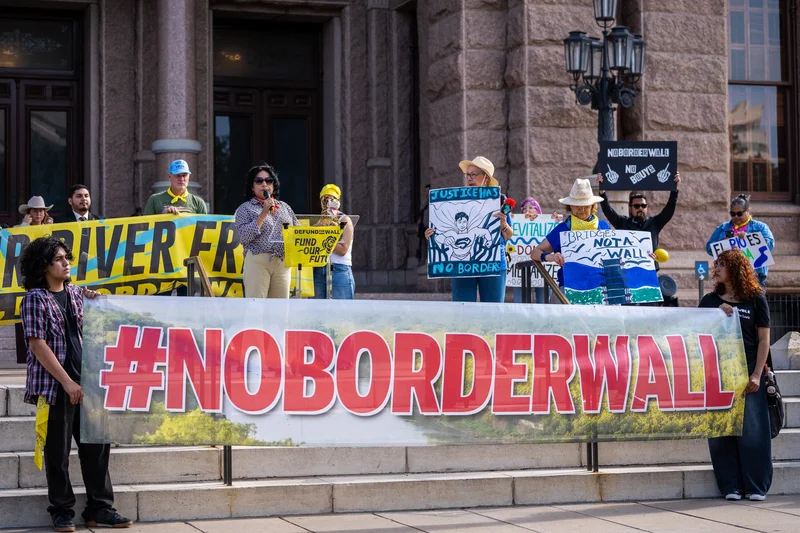
One of the most controversial projects in the Trump administration’s immigration crackdown has been temporarily put on hold after bulldozers and other heavy machinery began altering the landscape of Big Bend National Park in Texas. The decision to halt the work comes after weeks of criticism, protests, and lawsuits over plans to expand border infrastructure in one of the most remote areas along the U.S.-Mexico border.
Customs and Border Protection (CBP) Commissioner Rodney Scott announced Monday that all construction activities inside the park would be suspended while he travels to the area to conduct a personal evaluation and meet with local authorities, residents, and other affected stakeholders.
“CBP is pausing all construction activity in Big Bend National Park while I visit and conduct a personal, on-the-ground evaluation,” Scott said in a post on X. The official said the agency is committed to national security but also to protecting places such as Big Bend.
The pause came after images of bulldozers working inside the park triggered a new wave of questions about the project. The machinery began clearing land for work that includes patrol roads and barriers designed to prevent vehicles from crossing, although the administration had previously ruled out building the 30-foot steel bollard wall that is planned for other parts of the region inside the park.
The work is part of a much broader expansion of border infrastructure under Trump. Congress allocated about $46.5 billion for construction and expansion of the border wall in legislation the president signed in July 2025.
In the so-called Big Bend sector, the plans include a 9.1-meter (30-foot) steel bollard barrier in areas west of the national park, along with roughly 322 kilometers (200 miles) of patrol roads and 27 kilometers (17 miles) of vehicle barriers at specific locations. Another 266 kilometers (165 miles) of vehicle barriers are planned east of the park. The total cost of the project in the region could exceed $7 billion.
Although CBP decided not to build the traditional wall inside the national park and nearby Big Bend Ranch State Park, the work that has begun has generated much of the controversy. Critics have particularly questioned the need to open new roads in an area where rugged terrain already makes border crossings difficult.
The Big Bend sector covers roughly one-quarter of the U.S.-Mexico border but accounts for around only 1% of migrant apprehensions, partly because of its mountains, canyons, and vast desert areas.
Opposition that crosses party lines
Opposition to the project has become one of the few areas of Trump’s border agenda where Republicans and Democrats have found common ground.
Republican Texas Sen. John Cornyn called on Homeland Security Secretary Markwayne Mullin to halt the work, arguing that Big Bend’s terrain already represents a significant natural obstacle for people attempting to cross the border.
Several Republican sheriffs in the region have also spoken out against the project. Thaddeus Cleveland, sheriff of Terrell County and a former Border Patrol agent, believes the strategy should be adapted to the particular conditions of each sector and has advocated for greater use of technology instead of physical barriers.
Opposition also includes Democratic lawmakers, residents, business owners, former National Park Service officials and environmental organizations.
For critics, the problem goes far beyond the project’s visual impact. Construction could affect archaeological areas, sacred Indigenous sites, wildlife migration routes and the landscape on which much of the region’s tourism industry depends.
Business owners who organize river trips and other activities inside the park fear that construction could alter precisely the remote, natural character that attracts visitors.
Indigenous groups have also warned of potential damage to places used for religious purposes. One of the lawsuits filed against the project argues that construction could make it more difficult to access traditional sites used by the Lipan Apache Tribe.
The administration has accelerated the work after waiving or setting aside several regulations designed to protect environmental, historical, and cultural resources. At least four lawsuits have sought to halt different parts of the project in the Big Bend region.
For now, it remains unclear how long the suspension will last or whether it will substantially alter the Trump administration’s plans. Scott has said he expects the first layer of the border wall to be built by the end of next year.