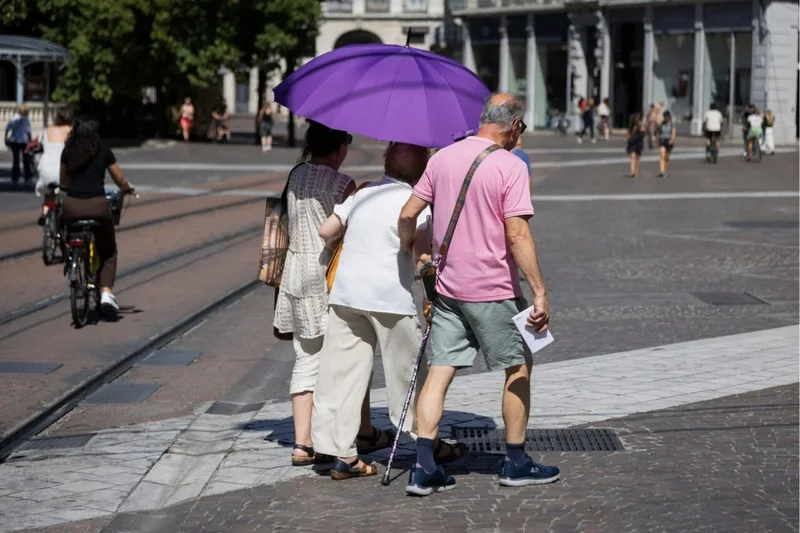
The dangers of extreme heat have been all too apparent this summer. According to preliminary estimates, punishing back-to-back heatwaves may have killed thousands of people across Europe and the United States over the past few months. While demographic data on these deaths is not yet available, it’s likely that many were older adults.
Research has consistently shown that people aged 60 and over are particularly vulnerable to heat-related illness and death, and yet, projections of heat exposure under climate change have largely failed to account for this. As temperatures rise and the global population ages, this oversight could seriously underestimate future heat risks.
A study published Monday in The Lancet Planetary Health aimed to fill this gap by accounting for how age-specific heat tolerance changes projections of heat exposure. The findings offer a grim outlook. At just 2.7 degrees Fahrenheit (1.5 degrees Celsius) of global warming, older adults could experience dangerous levels of heat exposure more often and at wider scales than younger adults would at 7.2 degrees F (4 degrees C) of warming.
“Our results suggest accounting for age stratified vulnerability, intolerable heat will be experienced at much larger scales and for longer durations, affecting far more people than previously estimated,” the authors conclude.
The dangers of aging in a warmer world
The number of people aged 60 years and older is expected to double from 1.1 billion in 2021 to 2.1 billion by 2050. At that point, this age group will represent 21% of the world’s population, more than two-thirds of which will reside in low-income and middle-income countries on the frontlines of climate change.
Without significant reductions in carbon emissions, Earth’s average temperature will likely approach 3.6 degrees F (2 degrees C) above pre-industrial levels by 2050.
Previous estimates of population-scale heat risks under future warming scenarios relied on heat limits developed for healthy young adults, potentially underestimating the risks faced by older adults. People in this age group can have a harder time recognizing when it’s too hot or if they’re dehydrated. Their bodies also hold more heat due to reduced circulation and sweat production. What’s more, older adults tend to have more underlying health issues, which extreme heat can exacerbate.
Compared with previous estimates, this new study found that using age-specific heat limits more than doubled the number of people expected to be exposed to at least 180 hours of dangerous heat per year. Older adults will make up the majority of this at-risk population.
At 2.7 degrees F (1.5 degrees C) of warming, roughly 290 million people aged 60 and olderâ22% of the world’s older adult populationâwould experience at least 180 hours of dangerous heat annually, the study shows. By comparison, under 7.2 degrees F (4 degrees C) of warming, about 490 million young adultsâ17.4% of the global young adult populationâwould face that level of dangerous heat exposure.
The authors believe their findings raise serious concerns about the long-term habitability of parts of the tropics and subtropics, especially for older adults. In densely populated areas such as the Indo-Gangetic Plain and the coast of the Persian Gulf, older people could face dangerous temperatures around the clock for several months at a time if global warming reaches 5.4 to 7.2 degrees F (3 to 4 degrees C).
This study offers a glimpse of our climate future, but the devastating heatwaves this summer show that extreme heat is already having a major impact on public health around the world. The authors hope their findings lead to adaptation plans that better protect older adults as the planet continues to warm.