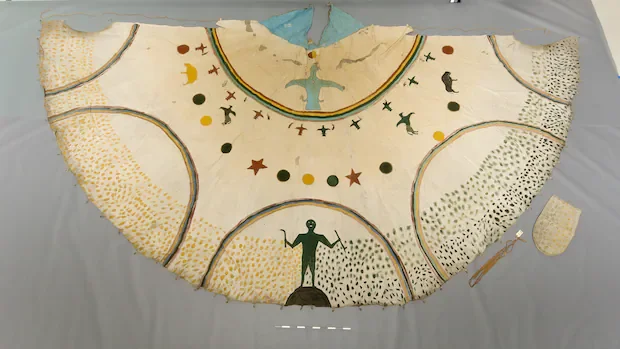
Teepee cover stolen 100 years ago finally being repatriated to Sask.
Family passed story of teepee down through generations
A Saskatchewan professor discovered a piece of the province's history in the collection of the Smithsonian in Washington, D.C. Now it's coming home.
Andrew Miller, a professor of Indigenous studies at the First Nations University of Canada, was using the Smithsonian's catalogue of holdings while studying birds. He spotted a teepee cover stolen from Kawacatoose First Nation roughly a century ago.
The cover was taken during the 1920s, yet the family kept its memory alive by sharing its story from generation to generation.
"I recalled a student mentioning, 'Oh, yeah, we've got belongings that are in big museums in the United States,'" Miller said.
Miller remembered that statement as he was going through the catalogue and saw the teepee cover, which was labelled, "Dustyhorn—File Hills" with an acquisition date of 1926.
He said he knows there are Dustyhorns around Touchwood, Sask. He reached out to Cory Dustyhorn, the current chief of Kawacatoose First Nation, about his finding.
Dustyhorn said he knew the story of his great-great-grandfather Sîpiskwêsîkan's teepee being stolen long ago. Sîpiskwêsîkan was promised payment for the teepee cover, but never received it.
Miller and Dustyhorn made contact with the museum. Miller said the Smithsonian was very understanding through the whole process.
"They recognize that some of these things shouldn't be in their collection, that they were collected in at a time when the ethics and the respect between different cultures was not what it is today," Miller said.
- Indigenous artifacts held in Vatican Museums finally heading back to Canada
- Dozens of artifacts repatriated after donation to Chief Poundmaker Museum
The museum listened to Dustyhorn and was open to the repatriation of the teepee cover. They just needed to be sure it was going to the right community.
"I told him a story that was handed down through our family, that somebody started in Alaska, collecting artifacts in Alaska, and they came across to Saskatchewan. Then they took our teepee," Dustyhorn said.
He said the museum representatives told him to stop right there, because the person who acquired the teepee back in 1926 did indeed start his expedition in Alaska. This confirmed the oral history.
In a statement, the Smithsonian acknowledged some of its artifacts were taken unethically. At the time, the Indian Agent acted as a intermediary between Indigenous owners and buyers.
In 2022, the museum adopted a shared stewardship and ethical returns policy in an effort to correct some of its past unethical practices.
"The policy acknowledges that ethical norms and professional practices in collecting have changed over time, and that the Smithsonian currently holds collection items it would not have acquired if present-day standards had been in place," the statement says.
Now, 100 years after it was stolen, the teepee is returning to its home community.
Dustyhorn said the return will strengthen the connection between his ancestor and him, his family and his entire community.
He said they plan to create a museum on Kawacatoose to display the teepee, but for now it will be held at the Royal Saskatchewan Museum in Regina.