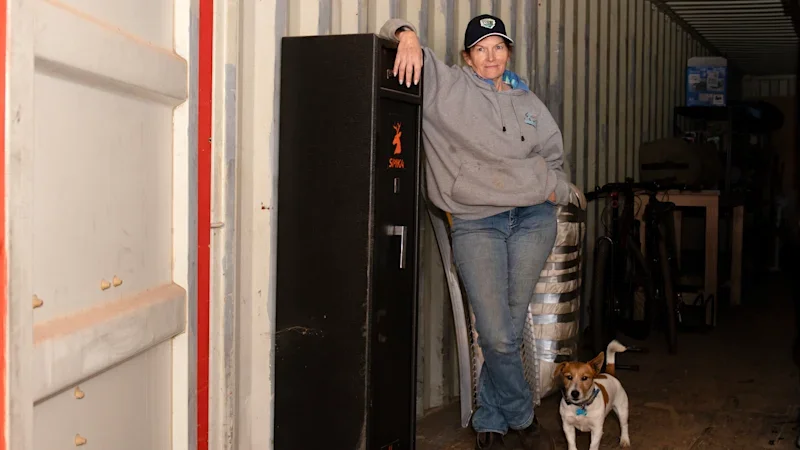
To illustrate why farmers are unhappy about new gun laws which cap how many firearms a person in NSW may own, Tracy Blackburn compares a fox’s skull to a pig.
“The firearm you use to get rid of a cat-killing native wildlife or a fox is very different to what you’re dealing with a wild pig. If you use the same firearm, it’s just going to look at you,” she explains.
“It’s just like a drill, or a spanner – if you haven’t got the right firearm, you aren’t going to be able to do the job. That’s what a gun is to us – a tool of the trade, not a hobby, and yet we’re being treated as bad people.”
Blackburn, vice president of the NSW Farmers Association Dubbo branch, is among those in the regions furious after the Minns government this week announced the state’s largest gun buyback in three decades after months of negotiations.
The buyback was flagged after the Bondi massacre and came as the government also passed changes that limited most owners to a maximum of four guns. Primary producers and sport shooters will be restricted to 10 firearms. It means about 274,000 firearms – roughly a quarter of the total number of registered guns in the state – will need to be handed back to comply with the limits.
Public opinion following the massacre overwhelmingly backed tougher gun laws. A poll by the Resolve Political Monitor taken in the aftermath of the shooting found 82 per cent of respondents supported a limit on the number of guns an individual could own. Only 5 per cent of respondents opposed such a proposal.
It has been backed by the Public Health Association of Australia, and gun control advocacy groups such as the Alannah and Madeline Foundation. The latter is a not-for-profit established after the Port Arthur massacre by Walter Mikac AM, whose daughters aged six and three were among the victims.
Yet in pockets of the population, the buyback has been met with fury. The NSW Farmers Association, which hosted Premier Chris Minns as recently as July at its annual conference, called it “a disgrace” and accused the government of ignoring primary producers’ concerns.
“Hurriedly pushed out on a weekend and made without meaningful consultation with those who work on the land, [the] firearm buyback announcement is nothing short of a disgrace,” association president Rebecca Reardon said.
Part of the blowback relates to the terms of the buyback itself. The government will not pay market rates for firearms – a departure from what was instituted after the Port Arthur massacre. People such as Blackburn also say they feel they are being punished for the actions of the Bondi shooters.
“We had nothing to do with [Bondi], but we’ve become the target,” she said. “It’s a knee-jerk reaction by city-centric people who don’t know what goes into running a property. If you’re not in a cafe sipping a latte from an eco-cup, you don’t know what’s right and wrong.
“On this side of the sandstone curtain, there is very much a them-and-us mentality.”
The timing of the buyback has the potential to set it up as an election issue, something Minns acknowledged when he announced it alongside Prime Minister Anthony Albanese.
The changes came with other post-Bondi changes to gun laws, such as restricting firearms licences to Australian citizens, stricter re-classifications of some firearms and shorter limits on licence terms.
While Labor is aware the buyback could hurt it in some key electorates, it decided not to push the buyback beyond the next election because it believed it needed to show progress on its post-Bondi commitments ahead of the one-year anniversary.
After the Liberal Party supported the gun ownership limits when they passed through parliament, leader Kellie Sloane has since called for them to be “revisited”. This week she labelled the buyback “half-baked” and a “very expensive solution to the wrong problem”. She also said that while she is not opposed to a buyback, it needed to “provide fair and reasonable compensation”.
It is a significant shift from the opposition. As the new laws were debated in parliament in the days after the massacre, several Liberal MPs spoke in favour of the changes. Sloane herself issued a press release stating there was “no credible justification for any individual in metropolitan Sydney to own or access multiple high-powered firearms”.
While gun ownership may be a marginal issue for most voters, it is a potential vote-changer for a smaller subset of the population.
Stuart Bonds, One Nation’s leader in NSW, says he has been inundated with messages from angry gun owners since the buyback was announced. He has said the party would repeal the laws, while also linking the legislation to concerns about organised crime.
The laws may prove particularly controversial in seats the right-wing party is targeting at next year’s election.
Camden, on Sydney’s south-western fringe, for example, is home to 2621 licensed gun owners – the highest number in Sydney – firearm licence statistics show. Other One Nation target seats such as Cessnock in the Hunter Valley also have a disproportionate number of licensed gun owners.