Colombia’s Law to Join the BRICS Bank Died in Congress Without a Single Debate
Colombia · Multilateral Finance
Key Facts
- Ten membersThe five founders — Brazil, Russia, India, China, South Africa — plus Bangladesh and the UAE in 2021, Egypt in 2023, Algeria in May 2025 and Uzbekistan on 5 June 2026.
- Five in the queueThe bank lists Uruguay, Colombia, Ethiopia, Angola and Zimbabwe as prospective members: admitted by the Board of Governors, but not members until they deposit an instrument of accession.
- Colombia’s bill is deadFiled in the Senate on 25 November 2025, it never passed a debate in either chamber. The Chamber of Representatives records it as archived under Article 190 of Ley 5 of 1992 — the rule that kills bills left unfinished when a legislature ends.
- What it would have costColombia’s subscription is 5,125 shares, US$512.5 million in total, of which US$102.5 million is paid in. That is close to the UAE’s US$556 million and Algeria’s US$614 million.
- UruguayAdmitted on 3 September 2021, the same round as Bangladesh and the UAE. Both of those completed accession within weeks. Uruguay never sent the matter to its Parliament.
- The balance sheetUS$42.9 billion approved across 139 projects, on the bank’s own count at end-2025, against US$100 billion of authorised capital.
- Who runs itDilma Rousseff, elected president in March 2023 and re-elected in March 2025 for a term running to July 2030. Headquarters in Shanghai; the Americas regional office is in São Paulo.
Being admitted to the BRICS bank and being a member of it are two different things. South America’s two candidates have now spent years in the gap between them.
On 13 August the governor of Iran’s central bank said his country would soon join the BRICS-founded New Development Bank. The bank’s answer was a study in politeness: it could not confirm that, a spokesperson said, but it could confirm who is actually inside. The list of New Development Bank members runs to ten countries, and neither Colombia nor Uruguay is on it — even though both were admitted years ago. Colombia’s problem is now concrete. The law that would have finished the job was archived in Congress.
How countries actually become New Development Bank members
The distinction the bank draws is formal, and it explains this entire story. A country is admitted when the Board of Governors votes to let it in. It becomes a member when it deposits its instrument of accession — the document that binds it to the founding agreement and to its share of the capital.
The bank’s members page says so in as many words: prospective members have been admitted and will officially become member countries once they deposit that instrument.
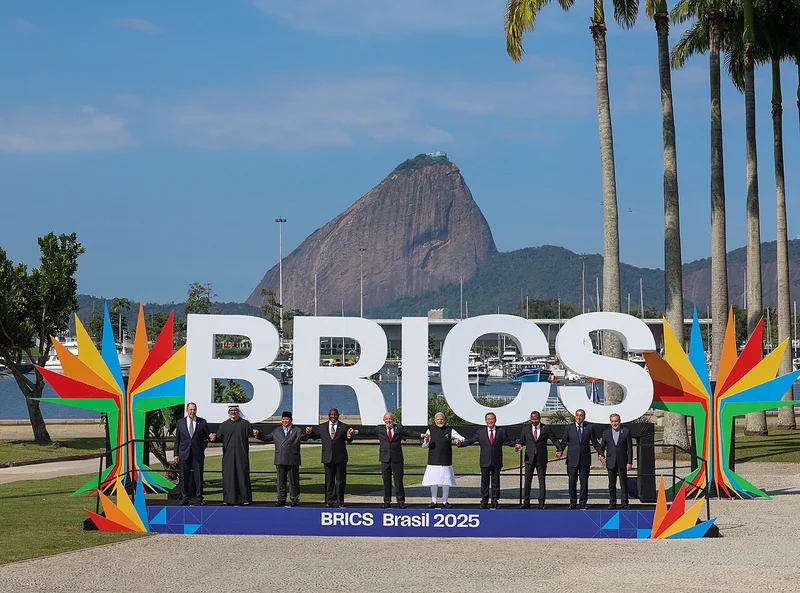
Coverage in June 2025 reported that Colombia had joined the bank. It had not. It was admitted at the annual meeting in Rio de Janeiro on 5 July 2025, in the same act that admitted Uzbekistan. Uzbekistan finished the process eleven months later. Colombia has not finished it at all.
How the Colombian bill died
Under Colombia’s constitution, joining a multilateral bank means ratifying a treaty, and a treaty needs a law: a bill approved by both chambers, then reviewed automatically by the Constitutional Court, before the executive can deposit anything.
The government filed that bill in the Senate on 25 November 2025 — the authors of record are Foreign Minister Rosa Yolanda Villavicencio and Finance Minister Germán Ávila — and in the Chamber on 16 December. It reached the Second Constitutional Committee, where a rapporteur produced a favourable report for the first debate.
Then it stopped. The Chamber’s own record now shows the bill archived under Article 190 of Ley 5 of 1992, the standing rule that a bill which has not completed its passage when the legislature ends is filed away. It never won a vote in either chamber.
To revive it, the government has to start again in the Congress seated on 20 July 2026 — and do it in a presidential election year, with a bill that identifies the country with a bloc that is itself an election issue. Anyone assuming Bogotá can borrow from the NDB is several steps ahead of the paperwork.
Uruguay has been in the queue since 2021 — but it is moving
Uruguay’s case is the older one. The bank admitted it on 3 September 2021, alongside Bangladesh and the UAE, and Marcos Troyjo, then the bank’s president, called it the first Latin American country to join as a new member. Bangladesh completed accession thirteen days later. The UAE took about a month. Uruguay never sent the matter to Parliament at all.
What has changed is the government. Rousseff met President Yamandú Orsi in Montevideo in December 2024 and pressed the case, pointing out that the board had already approved Uruguay. In July 2025 Foreign Minister Mario Lubetkin said publicly that the file had not been on the new government’s agenda and was not in its plans, but that ministers were now trying to understand it — and that before anything else Uruguay would have to settle its capital quota and send the question to Parliament.
That is not a commitment. It is the first movement in five years, which in this file counts as news.
What Iran’s bid actually tells you
Abdolnaser Hemmati, governor of the Central Bank of Iran, made his statement in India ahead of a meeting of BRICS finance ministers and central bank governors. Iran joined BRICS itself in 2024, but the bank is a separate institution with its own accession process, and Iran does not appear on its prospective list.
The bank’s reply was carefully empty: membership is open to UN members, borrowing and non-borrowing alike, and Uzbekistan is the tenth country in. It did not say yes and it did not say no.
That caution has a reason. The NDB put new transactions in Russia on hold in March 2022, and it carries ratings of AA+ from S&P and AA from Fitch that rest on being read as a conventional multilateral lender. Admitting a heavily sanctioned member is a decision with a price, and the silence is the sound of it being weighed.
Why this matters if you are in Latin America
The practical question for governments in the region is whether the NDB is a real alternative source of infrastructure money or a diplomatic gesture. On the numbers it is real enough: US$42.9 billion approved across 139 projects, a growing share in local currency, Brazil as a founding shareholder and the Americas regional office in São Paulo.
But the door only opens for members, and neither South American candidate has walked through it. Colombia’s route now requires a new bill in a new Congress. Uruguay’s requires a decision its last government never took and its current one is still describing as something it is trying to understand.
If you follow project finance here, the signal worth watching is not the admission announcement. It is the deposit of the instrument of accession — and for both countries, that still has not happened.
Frequently Asked Questions
How many members does the New Development Bank have?
Ten: Brazil, Russia, India, China, South Africa, Bangladesh, the United Arab Emirates, Egypt, Algeria and Uzbekistan, which joined on 5 June 2026.
Is Colombia a member of the BRICS bank?
No. Colombia was admitted by the Board of Governors in July 2025 and the bank still lists it as a prospective member. The law needed to complete accession was filed in November 2025 and archived without passing a debate in either chamber.
What does “archived” mean for the Colombian bill?
It was filed away under Article 190 of Ley 5 of 1992, which disposes of bills that have not completed their passage when a legislature ends. The government would have to introduce it again in the new Congress.
Why is Uruguay still not a member?
It was admitted in September 2021 but never sent the accession to Parliament. The Orsi government has said it is examining the question and would first need to settle its capital quota.
Is Iran joining the New Development Bank?
Iran’s central bank governor said on 13 August 2026 that it would join soon. The bank said it could not confirm that, and Iran is not on its list of prospective members.
How much has the NDB lent?
US$42.9 billion approved across 139 projects on the bank’s own published count, against authorised capital of US$100 billion.
Connected Coverage
Sources: New Development Bank — members and prospective members; Cámara de Representantes — Acuerdo Banco de Desarrollo, arch; Swissinfo/EFE — Uruguay evaluates joining the BRICS bank; CNBC Africa — Iran looks to ramp up its BRICS alliance
This article was produced by The Rio Times’ automated newsroom system. How we use AI · Report an error