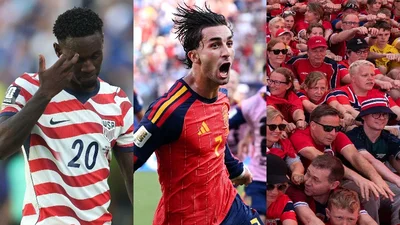
The past six weeks across the USA, Canada and Mexico have been so full of life, colour, controversy, and chaos that the longest men's World Cup in history feels like it has zipped past all too fleetingly.
The 'sad Pablo Escobar' memes are now in overdrive in social media algorithms that have been contorted into a daily World Cup newsfeed delivered in a very 2026 way.
Loading Instagram content
It is very likely that even if you were not a fan beforehand, you at least know about the Viking row, the Tartan Army, that Cabo Verde is a country and one that is quite good at football, and basically everything and anything about Erling Haaland.
Whether consumed through meme form, subtle second screening while at work, watch parties, or attending live, this tournament has delivered on its promise of capturing the world's attention.
But mega sporting events always do that, so how was this one any different, and what sort of legacy will it come away with?
Bringing people together
FIFA President Gianni Infantino is a hype master and summed it up in spectacularly hyperbolic terms.
"This World Cup has not just broken all possible records, it has smashed them. It has destroyed every record," he said after Spain's victory in the final.
Spain celebrates winning its second men's World Cup trophy. (Getty Images: Alex Livesey-Danehouse)
"The official figures will come out soon, but probably over 6 billion people watching it from home. The world was standing still.
"I think we have to invent a new vocabulary, new words to define the success of this World Cup."
For now, we will go with the words we have.
Infantino is right about the omnipresence of this World Cup in powerful and unexpected ways.
It is no surprise that competing countries and diaspora communities were entranced by following their nation, with emotive scenes playing out all around the world as they lived and breathed their teams' campaigns, including in Australia.
Many Socceroos fans travelled to North America to follow the team. (Getty Images: Dean Mouhtaropoulos)
What was more evocative was the people who, on face value, had no real connection to the participating teams but felt drawn to them for their own varying reasons.
Like the pictures from Gaza of Palestinians supporting Egypt against Argentina in the round of 16, whilst sitting on the rubble of destroyed buildings.
Palestinians gathered among buildings destroyed by Israeli strikes to cheer on Egypt against Argentina. (Getty Images: Saeed M. M. T. Jaras)
Or the way the small Midwest town of Lawrence, Kansas, wholeheartedly embraced hosting the Algerian team who set up base camp there.
Dr Lindsay Sarah Krasnoff, from New York University's Tisch Institute for Global Sport, is an expert in sports diplomacy, and said connections between fans and communities would provide an important legacy.
"Small acts of sports diplomacy, particularly on a citizen-to-citizen level, add up and move mountains," she said.
Mexico fans were ubiquitous throughout North America. (ABC Sport: Amanda Shalala)
"However, I think it's important to note that it is not a magic wand. Sports diplomacy by itself cannot instantly fix things. It's not going to create world peace overnight. It's not going to resolve terse political, financial or other policy differences.
"But it does have that ability — once you interact with someone through sport — you understand a little bit more about them.
"And you'll also realise that there's a lot more that binds us together … than what sets us apart.
Dr Krasnoff added that players and national teams could help create change through their presence on the global stage.
Iraq played in its first World Cup since 1986. (Getty Images/FIFA: Maddie Meyer)
"Up until this summer's tournament, most of the Western and particularly the Anglophone press, whenever we've heard about Iraq over the last 20, 30 years, it's usually been in a very negative connotation," she said.
"Related to civil war, religious fundamentalism, bombing. However, by being part of the select 48 who were able to qualify for the tournament, they showed that they are just like everyone else in the world."
But as this tournament unfolded, two more people were shot and killed by Immigration and Customs Enforcement agents in separate incidents in Maine and Houston.
A phone call, making money, and going big
The biggest controversy of the tournament centred on the US President Donald Trump and a phone call to his friend.
The leader of one of the host countries freely admitted to calling FIFA president Infantino to ask for a favour for star American player Falorin Balogun to have his suspension wiped out.
US President Donald Trump presented Spain with the trophy after its victory. (Getty Images: Ian MacNicol)
FIFA insisted it was an above-board process undertaken by its independent disciplinary committee, but this is an issue which will not wash away in the positive afterglow of this tournament, and is still being probed.
It would be fair to say the hosting across three countries and expanded 48-team format was broadly a success.
There were no excessive blowouts, some all-time classics, stirring underdog tales and new heroes emerged.
On the flip side, there were some rather forgettable clashes thrown in, and the days with six games felt like too much, even for the most passionate fans.
But with broadcast deals its biggest source of revenue, there is no way FIFA will turn back to 32 teams now, although it could expand even further in four years' time.
Argentina's Lionel Messi had a brilliant tournament. (Getty Images: Tom Weller)
"The next one is at home! In 2030, the World Cup is coming to Uruguay, Argentina and Paraguay," CONMEBOL President Alejandro Dominguez wrote on social media.
"It will be a great opportunity for football, to celebrate the World Cup's centenary with a 64-team tournament."
FIFA has not confirmed the format for 2030, although it runs the risk of having too much of a good thing should it go down that path.
The ticket prices were another hot topic; ultimately, the market justified the inflated prices, as most stadiums were filled across the 104 matches.
But it is also worth pointing out that many of the atmospheres inside were not always the frenzied fever pitch that might be experienced in top domestic leagues.
At times the venues were more akin to the Super Bowl, where the diehards could not make it in, only those with the deepest wallets.
Whether or not you think that matters, all comes down to perspective.
The excessive heat was dangerous for players and fans at times, not helped by most marquee games kicking off in the afternoon, to accommodate European TV viewing schedules.
And the mandatory hydration breaks, while needed on a 40-degree day in Miami or Philadelphia, were laughable in an air-conditioned Atlanta or Dallas Stadium.
The match between France and Paraguay in Philadelphia was played in stifling heat. (Getty Images: FIFA/Maddie Meyer)
"I think we've seen up close and from the front row, FIFA diplomacy at work, in a wide variety of different ways, the good, the bad and everything in between," Dr Krasnoff said.
"And there's also likely a lot going on beneath the surface that hasn't yet made its way into the public spotlight.
"I think this was perhaps a rapid-fire immersion in the world of FIFA and how FIFA is its own entity. And sometimes things are not necessarily always as logical as one would think."
The greatest successes and positives of this tournament came from the players and the football being played on the pitch, and the fans who embraced it so wholeheartedly.
Curaçao Livano Comenencia celebrated scoring his country's first ever World Cup goal. (Getty Images: Alexander Hassenstein)
From the smallest nation to ever qualify, Curaçao, scoring its first World Cup goal, to 40-year-old Cabo Verde goalkeeper Vozinha becoming an international treasure, to the phenomenal feats of current greats like Lionel Messi, Kylian Mbappé, Haaland, Harry Kane, and the Spanish team.
And the scenes of the Dutch Oranje walk taking over Texas, Mexicans in literally every single North American city outnumbering any other fan in huge numbers, or Egyptians celebrating a loss as if it was one of their greatest victories.
Thousands of Dutch fans took part in the Oranje Fanwalk ahead of all their games. (Reuters: Joseph Buvid)
But this does not automatically absolve the key powerbrokers or negate the legitimate concerns and issues that were raised in the lead-up and throughout.
It just means the football did the talking for the most part as it usually does, and now the rest will come back into play.
Soccer converts
The bigger question of the legacy in North America, particularly in Canada and the USA where 'soccer' is not number one, is more difficult to answer in the immediate aftermath.
The conversation is different in Mexico, where football's status as number one has never been questioned, although its legacy will be tangled up in the immense cost to co-host, and whether it was worth it as it continues to deal with serious social issues.
Canadians watched and attended in record numbers, as the team had its best result, making it to the round of 16.
This was Canada's most successful men's World Cup campaign. (Getty Images: Fran Santiago)
Their engagement with the tournament is not overly surprising in a country where ice hockey is linked to its identity, but football is the number one participation sport.
"When you start seeing these top-level performances, say making it to the top 16 or coming top four or [the women's team] winning gold at the Olympics, in a sport so competitive as soccer, it has a different reckoning, I think for the audience and certainly for Canada," Dr Nicole Forrester from Toronto Metropolitan University said.
"If we're talking about the emotional impact and the intangible piece to it, I think it would be interesting to track how our athletes, our male athletes in particular, fare in future major international competitions.
"And with our audience in terms of how much we get behind, not just supporting, but perhaps there might be a shift where there's [more] expectation."
More on FIFA World Cup 2026
Major League Soccer (MLS) is already in overdrive trying to capitalise on the commercial success of the tournament and convert it to eyeballs on the domestic product.
The organisation has said it wants to become one of the best leagues in the world, alongside Europe's top five.
That is a big, bold ambition, and would need a lot more Messi/Inter Miami partnerships to bring that to fruition.
ABC Sport Daily is your daily sports conversation. We dive into the biggest story of the day and get you up to speed with everything else that's making headlines.
And while travelling fans and immigrant communities were always going to be swept up in the game here, the non-traditional football fans are the ones that now need to be converted.
Of the three co-hosts, the USA was always going to be the most scrutinised as a world superpower and hosting the most games.
Throughout the US, I spoke to countless locals who did not consider themselves football fans but were excited by the energy and buzz around their city hosting a World Cup.
They now need to hold onto that feeling and watch more games on TV and attend MLS and National Women's Soccer League matches.
Right now, there is still a high, a palpable buzz from having pulled off the most ambitious staging of the biggest standalone sporting event in the world.
But it is what comes next that will be most telling.