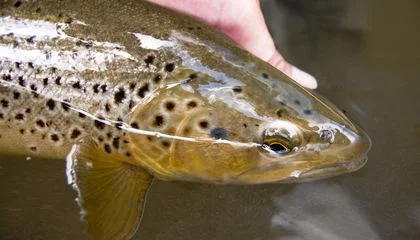
For thousands of years, brown trout have lived in the mountain lakes of southern Norway. But how they got there has been a mystery. After the thick sheet of ice covering the region retreated about 10,000 years ago, waterfalls and other barriers would have prevented the fish from reaching the bodies of water on their own.
Now, archeologists have uncovered 7,000-year-old fish traps in one of the area’s mountain lakes, hinting that hunter-gatherers brought the brown trout. The findings, published in the journal Antiquity on July 20, represent the earliest known example of humans bringing fish to a new location. The discovery also challenges the notion that before the rise of agriculture, Stone Age people simply lived off the land and moved in search of food.
“Hunter-fisher-gatherers’ release of brown trout into previously fishless lakes in the Norwegian mountains around 5000 B.C. is a very clear example of humans’ general capacity to reshape entire ecosystems, even before the introduction of farming” in the region, says study co-author Axel Mjærum, an archaeologist at the University of Oslo in Norway, in a statement.
More than 100 years ago, scientists first proposed that humans translocated the creatures to the mountain waterways, although they weren’t sure when. Another theory, however, posits that birds moved the fish or fish eggs to the area.
Answers came to light thanks to Lake Tesse, which sits about 2,800 feet above sea level. Before it became a hydropower reservoir in the 1940s, it was famous for being one of the most productive brown trout lakes in Norway, yielding up to roughly ten U.S. tons of fish annually.
Lowered water levels in 2022 revealed an area containing ancient fish traps, prompting a larger excavation project that uncovered several wooden contraptions held together by poles. More than 100 wood samples were taken from four traps and sent to a lab.
Radiocarbon analysis dated the two oldest traps to roughly 4950 B.C.E. and 5000 B.C.E. And a dating method that relies on counting tree rings suggested that one of the younger traps was built with wood from trees felled around 2669 B.C.E. and 2657 B.C.E.
Together, the dates suggest that humans periodically maintained the structures. “Therefore, it is possible that this form of trap fishing was ongoing in Tesse during much of the period between 5000 and 2650 B.C.,” Mjærum tells James Woodford at New Scientist.
Still, the researchers aren’t sure how these Stone Age people transported the trout into the mountain waters. They may have used leather bags called waterskins to carry the fish, an idea supported by archaeological evidence that people in the region were processing animal hides and skins at the time.
What’s more, the journey probably happened in stages, since fish would not have been able to survive long in a portable vessel. “This wasn’t something they did to get a return the same year, but for the future. It took many years before they could begin to reap the benefits of this work,” Mjærum tells Ida Irene Bergstrøm at Science Norway.
These hunter-gatherers likely visited the mountains to hunt reindeer, so introducing brown trout would have helped ensure they had access to a fresh, calorie-rich source of food even if they didn’t catch big game. This suggests that some of their societies were more complex than our notion of them as people who merely hunted and gathered whatever was available. They planned ahead, managed resources and reshaped their environment to meet their needs long before the advent of farming in Scandinavia.
“This study shows that people had a clear intention of returning and using the same places again and again,” says Knut Andreas Bergsvik, an archaeologist at the University of Bergen in Norway who wasn’t involved in the work, to Science Norway. “It says something about these people that they were able to plan all of this.”