- READ MORE: The exact age Gen Z consider you 'old', revealed
- See more Daily Mail on Google - save us as a Preferred Source
Scientists have uncovered the ultimate limit of the human lifespan, and it means that you could live to be 190 years old.
One of the key biological processes involved in ageing is the buildup of random mutations in our DNA.
If all other signs of ageing could be treated, these tiny 'somatic mutations' would still slowly wear down our body's ability to function.
Now, scientists from the Skolkovo Institute of Science and Technology in Russia have worked out exactly how long that would give us to live.
The bad news for longevity enthusiasts, such as Bryan Johnson, is that humans can't live forever, even if we invented a perfect anti–ageing medication.
But the good news is that the human lifespan could be vastly extended, with the average person living to be between 150 and 190 years old.
That is roughly double the average life expectancy for people living in the UK today, which stands at 83 for women and 79 for men.
And the researchers even say that some people could live far longer than that, up to a theoretical maximum of 627 years old.
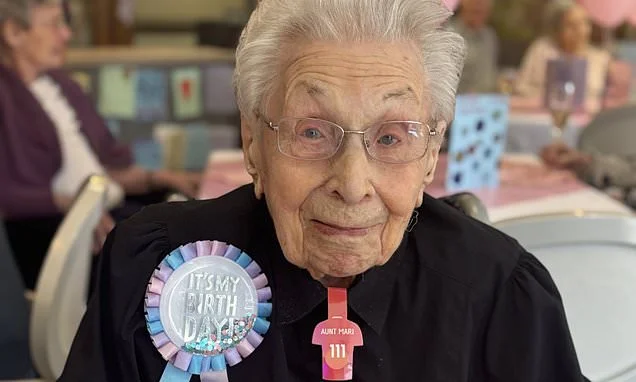
Scientists have discovered the ultimate limit of the human lifespan, and it means that people could live to 190 on average in the future. Pictured: Aunt Marj, one of Britain's oldest women, celebrating her 111th birthday
As we get older, our bodies pick up countless forms of wear and tear that we collectively call ageing.
At the biological level, these processes range from the shortening of 'caps' on our DNA strands called telomeres to our cells losing the ability to clear out waste.
The researchers didn't initially set out to work out the ultimate limits of the human lifespan, but rather to find a way of measuring how all these processes contribute to ageing.
What they found was that one inevitable process will bring our lives to an end, even if every other hallmark of ageing was treatable.
This process is the buildup of 'somatic mutations', tiny mistakes that can arise in our DNA every time a cell divides.
Our cells are really good at catching and repairing these errors, but they aren't perfect.
Most of these mutations are perfectly harmless, but they can sometimes give rise to dangerous cancer–causing changes.
Those cancers alone could be deadly, but even if medicine could keep cancer at bay, the mutations themselves would eventually become fatal.
Despite the hopes of longevity enthusiasts, such as the tech entrepreneur Bryan Johnson (pictured), this means humans cannot live forever even with a perfect anti–ageing treatment
Once somatic mutations build up to a certain level, they start to impair how the cell functions, wearing down our tissues and eventually leading to organ failure.
This puts a theoretical 'hard limit' on how long a person could live, but that realisation left one glaring question.
'What would be the lifespan of a human who has overcome all ageing mechanisms except somatic mutations?' asked lead author Dr Dmitrii Kriukov.
Dr Kriukov explains: 'We built a model of human ageing driven solely by somatic mutations.
'Our model estimates how this process alone affects lifespan by slowly depleting cells across tissues.'
If medicine could treat everything besides these somatic mutations, average lifespans range between 146 and 194 years old, depending on the exact model used.
'It’s not a verdict of inevitability', says Dr Kriukov.
'But it does highlight that somatic mutations, while surprisingly weak as a standalone ageing driver, may become critical when combined with other mechanisms.'
The researchers say that tiny errors in our DNA created during cell division, called somatic mutations, will eventually build up and cause organ failure (stock image)
While the researchers don't expect humans to start living this long any time soon, their data does show some places where treatments could be most effective.
For example, they found that cells in the skin and liver continuously replace old cells with new ones and can keep this replenishment going for a very long time.
Cells in the heart and brain, meanwhile, are largely irreplaceable, so they continue to accumulate mutations as the years go by.
That might come as a disappointment for the handful of scientists and entrepreneurs who have attempted to crack the secrets of immortality.
Earlier this year, the US–based startup Life Biosciences secured the first FDA approval for a human clinical trial to investigate partial human 'de–ageing '.
During the trial, scientists will turn back the biological clock on damaged cells in a person’s eye, rejuvenating the tissues and restoring function.
Likewise, entrepreneur Bryan Johnson claims 'we may be the first generation who won't die' and reportedly spends $2 million per year on an anti–ageing routine.
However, these results suggest that the pursuit of immortality through medical means could be a dead end.