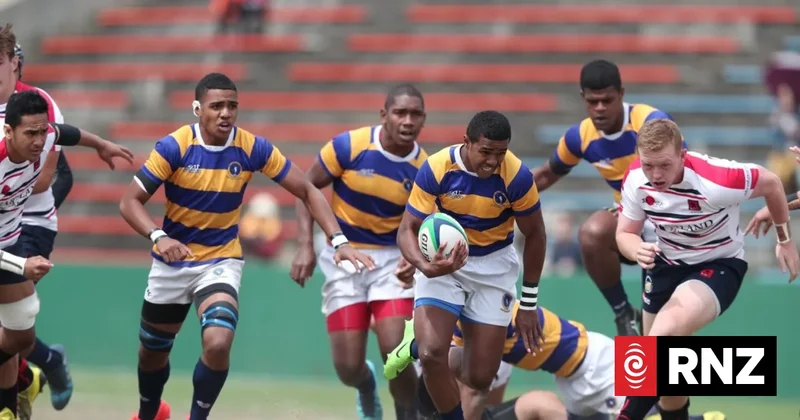
A former Fiji Secondary Schools' and Under-20 captain believes the current schools' rugby competition needs to be revamped so it can become a true breeding ground for players who can compete against the best in the world.
Andrew Durutalo, who is director of rugby operations at the Hong Kong Football Club (HKFC Rugby), says the current schools' rugby system needs to be reviewed for the purpose of developing players who can then continue up the development pathway into the national teams.
Durutalo started his playing career at the prominent Suva Grammar School in Fiji's capital, and played in the Deans Trophy competition, before making it into the Fiji U20s.
He also featured for Northland in the local premier rugby competition and trialled for the Flying Fijians to the 2011 Rugby World Cup.
However, a move to the United States saw him win a spot in the USA Eagles 7s team, before securing his spot in the Eagles' full 15s national side. He also played in the Super Rugby Pacific competition and had club experiece in the United Kingdom.
He said Fiji, like Samoa and Tonga, should not simply be happy with how they produce talented players, but focus on how they should develop, monitor and ultimately retain those players within a system that continues to benefit Fiji rugby.
In his current role, Durutalo is responsible for the strategic and operational leadership of HKFC Rugby, helping oversee player development pathways, elite performance programs, and the club's rugby operations from youth through to senior teams.
The role has also given him the opportunity to have a sneak view from outside of the Fiji Rugby systems, especially youth development.
"There's a lot that needs to be done so that Fiji is able to reap the benefit as intended," he he said.
More games
Durutalo believes the new 3rd and 4th Place play-off in the Under-18 Deans competition is great, but that should be extended to all grades, as extra matches for the schools.
He said players need to be playing more competitive matches, similar to what students in New Zealand and South Africa would be going through annually.
"Realistically, they'll (Fiji schoolboys) only play 11 games in one season for Under-18s," he said.
"We often look at New Zealand and South Africa as benchmarks for player development. We talk about their coaching, pathways, facilities and high-performance systems, but sometimes the simplest metrics tell an important story, and that is the number of games in a season."
He said it is also critical that players start getting into the system early, as young as 16 or 17 years old, and given the chance to play in the premier competition.
Players in South Africa players, playing in the U18s would play 25 games per season and if the players are 17 they would rake up 50 matches over two seasons.
In New Zealand, on average, schoolboy rugby players play 22 games per season, which would amount to 44 matches in two years.
Fiji, with the curremt format, only allows for 12 games per season, which would be 24 matches for a student player in two seasons.
"Before that player even leaves school, his South African counterpart could have accumulated more than twice the competitive match experience," Durutalo said.
"That is 26 additional opportunities to make decisions under pressure, manage different game situations, execute skills under fatigue, experience winning and losing, make mistakes and learn from them.
"The question for Fiji is how do we extend the season and increase meaningful competitive games to get closer to those numbers, because the potential issue here is not talent, but development volume and structure."
The more competitive rugby one plays, he added, the more opportunities they have to develop.
"Training matters, coaching matters, strength and conditioning matters.
"But there are lessons that can only be learned through meaningful competition. So, rather than continually introducing new rules and adding more complexity to the system, perhaps the answer to real development is much simpler:
"Create more opportunities to play, if we genuinely want to benchmark ourselves against New Zealand and South Africa, we cannot only compare talent or results. We also have to compare the volume of development opportunities our young players receive. That is more meaningful games, more decisions under pressure, more lessons, and more development."
He said the best development programme is simply giving players more opportunities to play the game.
He applauds the linking of the rugby league and rugby union competition, which he believes will give players the opportuity to play more matches.
"I think the inclusion of rugby league into the secondary school competition has been a great thing because then players are playing for longer," he said.
"Basically, if you think about that 11 games, then you think about getting involved in rugby league, they're still playing rugby.
"It'll be really interesting to see whether we have mandatory preseason games, made compulsory for schools, which would mean that teams would have to obviously start preparation earlier."
He said rather than viewing rugby league purely as competition, there is an opportunity to view it as a complementary development partner.
Many school-aged athletes spend a significantly longer season playing together in rugby league during Term 1 before transitioning into rugby union in Term 2, he said.
"From a high-performance perspective, this creates two clear advantages: technical skills are refined over a longer competitive season, while players enter the union season with higher levels of physical conditioning, cohesion and game readiness," he said.
"That continuity of training and competition is a design feature that should be understood and, where appropriate, leveraged rather than resisted.
"The influence of rugby league on the modern game of rugby union is undeniable. Many of today's tactical innovations have either been borrowed from or heavily influenced by rugby league. Concepts such as block players and decoy runners, the 50:22 kicking law and goal-line drop-outs have all been introduced to reward territorial play, create more attacking space and promote a faster, more entertaining game. The tactical convergence between the two codes continues to grow."
Start lower
Durutalo calls on the Fiji Rugby Union to work on two Rugby World Cup cycles, while planning for national teams, including the Under-20s, Fijiana and the Flying Fijians.
For the Under-20s he believes the cycle should start with the under-16s at college rugby, getting players indentified early and then planning their development into Under-18s before taking them into the junior national team.
Players who finish off from the Under-20s should then be drafted into either the Fijian Drua or the Flying Fijians squad.
One of his concerns is the average age of current Flying Fijians players, which stood at 29 at the Nations Championship last month.
Fiji had the oldest average players in its squad, compared to England, Wales and Scotland, whose average ages ranged between 22 and 24 years old.
He said one of the areas that would help the FRU moving forward is ensuring they are able to also capture Fijian heritage players across the world.
"We have to capture that as well because we're casting the net wide," he said of including players from Australia, New Zealand and Europe who compete in different age-group competitions for schools and local clubs.
"And secondly, they're also part of.quite established rugby systems So, we really need to also find a way to capture those kids as well that are willing to obviously, you know, play for Fiji.
"Get them into that system."
He said cost effective way of doing that is by visiting the different country's or working with Fijian coaches in those countries to identify the young players, adding that it is important to capture these players.
That would also help in the creation of a database that would include players who can then be monitored over the years.
Durutalo pointed to the systems in New Zealand and South Africa, where college rugby is televised.
In South Africa college rugby games from the Under-16 grades are televised, with footage kept to help monitor players.
In New Zealand most Under-18 games are television, while individual schools also provide footage of their grade teams on You Tube.
Fixing the foundation
He said high-performance systems are built from the ground up, not the top down.
Durutalo said the real question is not whether Fiji has talent but has the FRU and stakeholders been innovated in the way we develop and retain that talent.
"If we're serious about sustained international success, the greatest return on investment lies at the foundation of the pathway," he said.
"When you study the world's leading rugby nations, one trend is remarkably consistent, their strongest national teams are underpinned by world-class development systems.
"New Zealand and South Africa arguably have the two strongest school rugby competitions in the world. Those competitions are far more than annual championships, they are talent conveyor belts, high-performance environments and, ultimately, the cash cow of their player development systems.
"They identify, develop and prepare athletes long before they enter the professional game."
He said while he respects the secondary school rugby competition Fiji, having gone through that system himself, he believes from a high-performance perspective real questions need to be asked around quality of the competition and the quality of the outcomes it consistently produces.
"The evidence suggests there is a gap," he said.
"The standout players and teams from a successful Deans campaign typically form the nucleus of the following year's Fiji Under-20 programme, yet those performances have not consistently translated into equivalent success at age-grade international level.
"That observation is not a criticism of our schools or coaches,it simply highlights that a strong school competition, on its own, does not automatically produce a strong high-performance pathway."
He said the results at U20 level reinforce his point, because in the last five World Rugby U20 cycles, Fiji has not recorded a top-10 finish.
Of those five tournaments, Fiji only competed in three, one was cancelled because of COVID-19, while in another Fiji did not compete after being relegated from the Championship.
"These outcomes do not diminish the quality of our talent; rather, they expose a disconnect between the strength of our schools competition and the effectiveness of our national development pathway," he said.
"If the Deans Trophy consistently produces the core of our Fiji Under-20 squad, then the question becomes: why are those performances not consistently translating onto the international stage?
"That is the gap our system must bridge, not by asking more of our schools, but by creating a more connected, integrated and accountable pathway between schools rugby and the elite age-grade programme."
He said there needs to be a commection between the Deans competition to what comes next, the transition-from school rugby to the national age-grade system.
"That is arguably the most critical bridge in Fiji's player pathway," he said.
"If we can strengthen that bridge through better player monitoring, aligned coaching philosophies, physical development, skill acquisition and long-term athlete tracking, then the success we celebrate on Saturday afternoons has a far greater chance of translating into success on the international stage."
The other interesting issue is how some players fall out of the net and are never picked up locally.
He pointed to Virimi Vakatawa and Marika Korobete as examples.
The duo played together for Nasinu Secondary School in Suva, but were not picked up by the FRU and went on to be household names in Australia and France.
Koroibete made his name in rugby league before switching to play for the Wallabies, while Vakatawa made it into the French national side.
"Every year following the Deans Trophy competition, many of Fiji's most talented young players are recruited into overseas academies," he said.
"There is obvious value in this - those organisations are investing heavily in the development of our athletes. However, from a national high-performance perspective, retention becomes the critical issue.
"If we fail to maintain meaningful oversight and connection with these athletes, then the Deans competition risks becoming little more than a talent identification event for overseas clubs and, ultimately, other national teams."