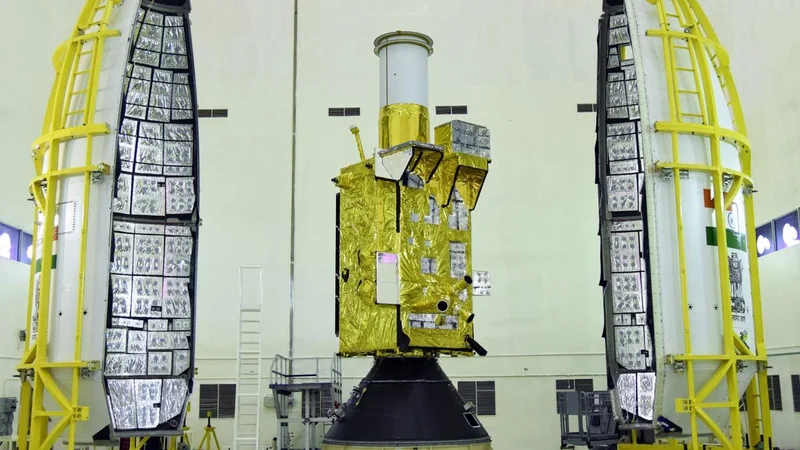
The Indian Space Research Organisation (ISRO) is set to launch the GISAT-1A satellite in September, in a mission that will be watched closely for many important reasons. Since the two successive PSLV mission failures, in 2025 and early 2026, ISRO had paused launches as it investigated the reason why its workhorse rocket had suffered such an uncharacteristic setback. In this time, important satellites were parked on the launchpad waiting for the clearance.
While Union Minister Jitendra Singh told The Hindu on June 13 that the government had determined the cause of the failures and had resolved them, he said the government would also not publish the ‘National Level Expert Committee’ report. This break from historic tradition, even if not from the recent past, raised public concerns and, in some quarters, ire. Now, with the GISAT-1A launch planned in a few weeks, ISRO will take to the skies again, hoping this time for success.
The launch is further significant because the rocket that attempted to launch the GISAT-1 satellite in 2021 failed, destroying the satellite as well. GISAT-1A is the second attempt.
What happened to GISAT-1?
On August 12, 2021, ISRO launched the GISAT-1 satellite, a.k.a. EOS-03, onboard a GSLV Mk-II rocket. The mission designation was F10. The rocket was supposed to launch GISAT-1 into a geosynchronous transfer orbit. From there, the satellite would use its own thrusters to climb into a geostationary orbit.
**
Editorial | A brittle shell: On ISRO and transparency**
The first and second stages of the GSLV Mk-II rocket performed as expected; however, the cryogenic upper stage failed to start.
The geosynchronous transfer orbit is a highly elliptical orbit: its closest point to the earth is at around 170 km and its farthest point, around 36,000 km. The cryogenic upper stage’s task is to set the rocket on this path and provide the speed. So its failure to start effectively doomed the F10 mission.
A subsequent failure analysis traced the cause back to a leak in a valve that depleted the pressure from the liquid hydrogen tank, which in turn prevented enough liquid hydrogen from reaching the engine. The cryogenic upper stage uses liquid hydrogen as the fuel and liquid oxygen as the oxidiser.
Aside from the rocket itself, India was looking forward to the GISAT-1 mission because of a gap in its space-based earth-observation assets. Earth-observation satellites typically operate in low-earth orbit and pass over a given location on the ground a few times every day. To provide more continuous observations, ISRO had built GISAT to watch the Indian subcontinent from a greater distance, thus keeping almost the entire landmass in its view for large parts of the day.
This ability is useful to track flooding, cyclones, agricultural activities, forestry, and other similar changes on the ground that occur in shorter timeframes.
The replacement GISAT-1A mission has the launch designation F17.
What caused the launch hiatus?
ISRO has suffered a string of failures of late. The two most prominent ones were the two PSLV missions turning belly-up: PSLV-C62 carrying the N1 satellite on January 12, 2026, and the PSLV-C61 mission carrying the EOS-09 satellite on May 18, 2025.
The GSLV-F15 mission last year succeeded in deploying the NVS-02 satellite to the geostationary transfer orbit, but then the satellite thrusters failed to move it to the intended final orbit. This was yet another failure — and in this case not just for the timing.
The NVS-02 satellite was to be part of India’s NavIC constellation of satellites that provide position, navigation, and timing (PNT) capabilities over the Indian subcontinent, much like the American GPS system does for the world.
NavIC requires at least four satellites to provide PNT services and, with the failure of NVS-02, continues to have only three. In this configuration, it can’t provide positioning services and is thus practically defunct for the main purpose for which it was launched.
Following the failures, ISRO suspended launches as its Failure Analysis Committee investigated the various causes. Now GISAT-1A has been cleared to fly, with another satellite, NVS-03, which is part of NavIC, currently expected to launch in October.
Do the PSLV failures affect GSLV?
The PSLV and the GSLV are different rocket families but they share some important design aspects. For instance, the PSLV and the GSLV Mk-II configuration share the S139 first stage solid motor lineage. They also have substantially common avionics and guidance systems, tracking and separation mechanisms, and manufacturing infrastructure.
Since the government has declined to place the failure analysis report in the public domain, it is hard to know which subsystems and/or systems were changed, across both the rocket and the launch infrastructure.
During each of the two failed missions, the PSLV rocket suffered anomalies during its third stage of operations. (The PSLV is a four-stage rocket.)
As with the F10 mission, the F17 mission will also launch onboard a GSLV Mk-II rocket. ISRO currently operates two classes of GSLV rockets, called Mk II and LVM-3 (previously called Mk-III).
The Mk-II features the indigenous CE7.5 cryogenic engine for its third stage and can carry up to 2.5 tonnes to the geostationary transfer orbit. The F10 mission also featured an Ogive payload fairing — a slightly more voluminous hold where the payloads to be launched by the rocket are placed — to accommodate the GISAT-1 satellite. ISRO has stopped availing the Mk-II rockets for commercial missions.
The LVM-3 has a different design, in appearance resembling Europe’s (now retired) Ariane 5 rocket. Its cryogenic upper stage uses the indigenous CE20 engine and the rocket as a whole can lift up to four tonnes to the geostationary transfer orbit.
An upgraded version of the LVM-3, called human-rated LVM-3, is planned to lift a small crew of Indian astronauts as part of the forthcoming ‘Gaganyaan’ mission.
What will the September launch test?
Given the wider context in which the GISAT-1A launch is set to take place, stakeholders and industry experts will have their eyes on at least four entities:
(i) The cryogenic upper stage of the Mk-II rocket, which failed during the 2021 mission;
(ii) Rocket reliability — given that the PSLV-C61 and -C62 missions both failed during their third stage’s operations, ISRO will want to show it has inspected and qualified the underlying quality-control processes, even for a different family of launch vehicles;
(iii) GISAT-1A reaching its designated orbit after being deployed by the rocket; and
(iv) the GISAT-1A payload itself: once it has reached its intended station, ISRO will have to commission its imaging systems and prove that it can acquire the hi-res wide-area images, including accounting for the effects of atmospheric haze, that India needs.
An additional demonstration will be the launch cadence, i.e. the rate at which ISRO launches (successful) missions, which is an indication of its reliability and of the health of its underlying manufacturing, procurement, integration, and delivery processes. Safety was understandably the priority during the launch pause, but the fact also remains that ISRO has managed only one launch this year and is staring at a long backlog.
Finally, while the GISAT-1A and NVS-03 launches have separate mission readiness checks and timelines, successfully launching and deploying GISAT-1A could give ISRO the confidence to proceed with NVS-03. Effectively, ISRO has a domino of important launches coming up.
Published - August 19, 2026 11:30 am IST