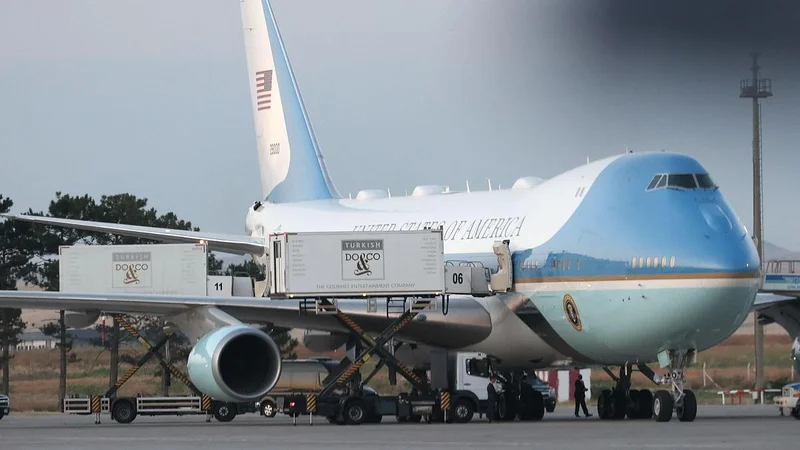
The story so far: United States President Donald Trump is reported to have faced a threat at the 36th North Atlantic Treaty Organization (NATO) Summit (July 7-8, 2026), held in Türkiye. Mr. Trump, according to reports, is said to have moved between and used different aircraft as he left the summit due to a possible threat to his life. He has said, “I go by Secret Service and the military. They wanted me to go in a different flight, different plane... I just have to do what they say.”
Why was the switch made?
U.S. media channels were recently told by U.S. officials that there was a “credible Iranian threat to fire a missile at the aircraft”; additionally, U.S. intelligence was in possession of information that an individual had been seen near the summit area with a shoulder-fired missile.
What were the transport arrangements to and from the summit?
Mr. Trump arrived in Ankara on the ‘new’ Air Force One, which is a Boeing 747-8 that has been gifted to the U.S. by Qatar. He was then to have left the summit on an older Air Force One, a Boeing 747-200B, or the VC-25A.
On July 8, television reports showed Mr. Trump boarding the VC-25A aircraft. He then paused for a while, waved, and entered the aircraft. But unknown to media personnel and White House staff on board — they were told to keep the window shades closed — he is said to have quickly moved to a catering truck that was positioned at the opposite aircraft door. He was then transported to a smaller C-32A military aircraft (a modified Boeing 757). An official site of the U.S. government says that officials and those who use this aircraft include the U.S. Vice-President, the U.S. First Lady, and members of the cabinet and Congress.
U.S. Defence Secretary Pete Hegseth boarded this aircraft (the C-32A) separately.
Those who remained on the VC-25A aircraft included some members of the Trump cabinet — reportedly U.S. Secretary of State Marco Rubio and Treasury Secretary Scott Bessent.
All the aircraft departed Türkiye with a stopover at RAF Mildenhall, the Royal Air Force station, in Suffolk, in the United Kingdom.
In another secret operation, Mr. Trump is said to have moved from the Boeing 757/C-32A and reboarded the Boeing 747/VC-25A aircraft. He was seen exiting this aircraft to make it appear as if he had been travelling on board. He then moved to the Qatar-donated Boeing 747 and returned to the United States. In short, this was a three aircraft switch.
What are the features of each of the aircraft involved?
The Qatar-donated Boeing 747-8 is the newest addition to the presidential fleet and is called the ‘Bridge aircraft’ or the interim presidential aircraft. It was offered by Qatar to the U.S. in 2025 in “as-is” condition, with the Pentagon to oversee the necessary security and crucial upgrades. The ‘donation’ of the more than 10-year-old jet, which was built as a luxury VIP jet for the Qatar royal fleet, caused political ripples and led to sharp criticism across the political divide — it was even called “a bribe”. However, the White House brushed this off by saying that there was a memorandum of understanding with Qatar, and that it was a “bona fide gift” with legal safeguards. The aircraft is said to have undergone inspections, which included intense checks for surveillance and espionage devices.
The aircraft still lacks the key features of the 30-year-old VC-25s, partly because Mr. Trump is said to have wanted the aircraft to be ready for the U.S.’s semiquincentennial (250th anniversary) on July 4, 2026. Defence contractors — one of them being L3Harris — are said to have been working on the jet, adding communication and security upgrades whose cost the U.S. Air Force has estimated at less than $400 million. While many of the features are secret, these are said to include military-grade and encrypted communication systems with capabilities that match those on the VC-25A. A Wall Street Journal article says that the plane has SpaceX’s Starlink high-speed satellite network connectivity. However, an Associated Press article has quoted a defence analyst as saying that this jet has a smaller number of communication antennas.
The same report quotes the U.S. Air Force as saying that “several highly complex engineering modifications were intentionally excluded as this is a ‘Bridge aircraft’”. For instance, the doors leading out of the aircraft were not widened, nor were stairs built into the plane.
A “purpose-built Air Force One” is meant to be a “flying Oval Office” and has anti-missile defences and protection from electromagnetic pulse attacks. It also has a fully-equipped medical suite and, most importantly, can be refuelled in midair. These are capabilities that are built over years.
The U.S. President is to receive two converted Boeing 747-8 aircraft/designated VC-25Bs, but the programme — it was part of a “fixed-price contract” signed with Boeing in 2018 — has been facing extensive delays and large cost overruns. A leading aerospace media site says that even a 2028 delivery timeline is in doubt. The issues include replacing a key and secret communications system (said to be over $70 million), supply chain issues for key components, important interior installations, electrical wiring and key structural checks and modifications.
The two VC-25As were inducted in September 1990 and March 1991 and are the mainstay of the U.S. presidential air transport fleet. They have top-grade electronic and communications equipment, a self-contained baggage loader unit, air stairs, and the key capability for inflight refuelling — which the Qatar-donated plane is said to lack. They are carefully engineered and heavily modified platforms, according to a Washington-based publication that writes on defence issues.
The publication claims that these include a fuselage and extensive wiring shielded against electromagnetic pulses to ensure operations even after a nuclear event or cyberattack; redundant power systems, flight controls, and communication paths; a classified suite of systems that includes radar-warning receivers, electronic jammers, infrared countermeasures, flare and chaff dispensers to ward off missiles; environmental and oxygen systems that can filter chemical or biological agents; upgraded navigation, communications, and electronic warfare consoles that ensure secure and encrypted links to ground networks and satellites.
Additional features, such as stealth-reduction features, self-sealing fuel tanks and war room functionality as well as laser systems to destroy missiles, are presumed. It is obvious that many of the aircraft’s features are classified.
The C-32A has an advanced electronics and avionics suite.
Published - August 19, 2026 11:58 am IST