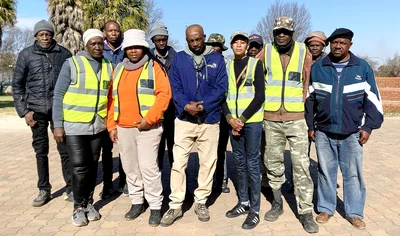
In Meadowlands, Soweto, about 30 to 40 community members walk the streets day and night. Armed with nothing but a torch and a two-way radio, they move quietly past darkened houses, listening for trouble the police are too stretched to respond to.
For several Soweto communities, rather than police with blue lights, safety now looks like ordinary neighbours who have chosen to take responsibility for protecting those around them.
Driven by a desire to see his communityâs crime-fighting work recognised, 56-year-old Collen Makgopela founded Put Patrollers First (PPF) in June 2024. What started as one group has grown into a network with multiple branches across Gauteng, working alongside SAPS and local Community Policing Forums (CPFs) to plug gaps in neighbourhood security.
Makgopela is one of dozens of volunteers patrolling nightly, unpaid and largely unrecognised. He finishes his shift at 8am, sleeps for a few hours, then goes to work.
Collen Makgopela (56), founder of Put Patrollers First (PPF) in Meadowlands, waits to change shifts in the morning. (Photo: Salim Nkosi)
On 22 June, Acting Police Minister Firoz Cachalia confirmed that R600-million earmarked for police stations and community policing had instead been redirected to security operations ahead of the anti-foreigner 30 June marches. For PPF, itâs money that could have funded police and community safety groups. The PPF volunteers pay for all their gear out of their own pockets.
Every member joins knowing there is no financial or other incentive. PPFâs members are mostly young people, although pensioners also join them, sometimes braving the cold winter nights on patrol.
âPeople in the neighbourhood just see our work and show interest,â Makgopela told Daily Maverick. âIf you join, make sure you do not expect anything from us as volunteers.â
Samson Ndhlovu (64), a resident of Meadowlands, who has been part of Put Patrollers First (PPF) since its founding. (Photo: Salim Nkosi)
For residents like 64-year-old Samson Ndlovu, who has patrolled since PPFâs founding, the group offers something the formal security system can increasingly no longer provide.
âIf we do not do it, then who will?â he asked.
âA wider pattern
This story is playing out across South Africaâs townships. As municipalities strain to deliver basic services and police stations are under-resourced, ordinary residents are stepping into the gap.
The inequality is stark. In Johannesburgâs northern suburbs, private security firms patrol on contract with rapid response times. In townships, police stations are understaffed, response times can stretch to hours and private security is out of reach for most residents.
Even as the national picture improves, Gautengâs share of the burden is not shrinking. SAPSâs latest quarterly crime statistics, released in May, showed murders down 9.5% nationally and house robberies down more than 20% compared with the same period last year, but Gauteng, with KwaZulu-Natal, the Eastern Cape and the Western Cape, still accounted for more than four-fifths of all murders recorded in the country in that quarter.
Township residents say the decline in crime stats isnât noticeable in their communities.
âPolice do not have a sense of urgency; they always take a long time to respond,â said Busisiwe Sambo, 25, a resident of Daveyton, roughly 45km east of central Johannesburg. âSame excuse â lack of resources.â
CPF friction
Although Meadowlands has a Community Policing Forum (CPF)recognised by the municipality, patrollers share a common grievance: they believe ward councillors benefit from their labour without doing the work themselves.
âThey take credit for our work every time we apprehend a criminal, because they know we cannot take the law into our own hands,â said Simphiwe Thinane (45), a PPF volunteer.
Simphiwe Thinane (45), a Meadowlands resident and member of Put Patrollers First (PPF). (Photo: Salim Nkosi)
Makgopela was previously a CPF member, but decided to leave and found PPF after he was expelled from that structure. Under the CPF, Makgopela said, members signed forms promising compensation for themselves or their families if they were injured or killed in the line of duty. That compensation never came when it was needed.
âI was fighting for justice for some of my friends who lost their lives sacrificing for this community; that is why they got rid of me,â he said.
When PPF apprehends a suspect, members say they use minimal force and try to restrain people properly, believing in the possibility of rehabilitation. âWe still call the police, even though they will show up very late,â Makgopela said.
The cost of protection
Members fund themselves. No government subsidy supports their work and the lack of resources means patrollers are sometimes injured during their shifts, armed with only a torch and two-way radio.
âThose are resources out of our own pockets. It is not equipment that we collectively have,â members told Daily Maverick during a morning patrol shift.
Thereâs also a personal cost. Patrollers describe exhaustion, strained family relationships and the constant low-grade anxiety of confronting suspects without backup or legal authority. Some have been attacked.
âWe have lost some members in the course of this work,â said Nhlanhla Maseko, 50.
Maseko worries most about what he is not protecting when he is on shift. âWhen I am here in the street at night, no one is left at home protecting my family. I carry my phone with me so they can call if anything happens,â he said.
For PPF secretary-general Sanny Nthabe, the toll has shown up in her relationship. She had to sit down and help her partner understand the significance of the work she is involved in.
Nthabe said her reason for volunteering was rooted in community pride and the well-being of future generations. âIt is no longer about me,â she said. âItâs about making the environment better for everyone.â
âWhat comes next
Makgopela is appealing directly to the municipality for recognition as a community neighbourhood watch group, which the PPF hopes will unlock resources.
He believes groups like his should be included when stations create opportunities or when community safety budgets are allocated, rather than watching from the sidelines. What he wants most is a formal base for the PPF, separate from the CPF or government structure that let his members down before.
âWe have people here who could go into formal policing training when recruitment happens,â he said. âInstead, the officials involved in doing that job look elsewhere, even though we are the ones out here every day.â
On the ground
For the patrollers, the work is measured less in arrests than in who did not get hurt. Elderly residents heading to the clinic before dawn, often carrying phones, purses, whatever cash they have, have become an easy target, so members now walk with them for the distance and wait until the doors open.
Commuters face the same risk before sunrise, so shifts are staggered to cover the empty, dangerous stretch to the station that patrollers say has seen shootings in both the early morning and evening hours.
The deterrent may not be obvious, but patrollers say it makes a difference; they often hear about a break-in only the next day, because criminals wait until the patrollers have gone home before striking.
Sometimes the job means confronting the very officials meant to help. Nthabe recalled watching a police officer walk into a Pakistani-owned spaza shop and take goods without paying. She followed him in, and stood beside him.
âWhatever you are taking, I also want,â she told him, refusing to pay for anything either, simply to disrupt the shakedown in progress. âThere is too much corruption,â she said. âWe cannot rely on our police. We cannot rely on criminals.â DM