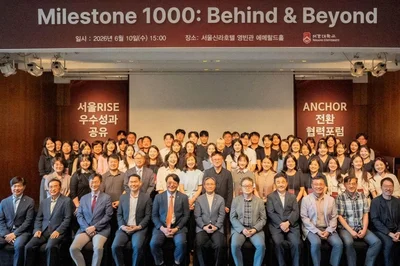
Sogang University faculty and staff pose for a group photo during a forum held at The Shilla Seoul on June 10. The forum was organized to review the university’s achievements under the government-funded Regional Innovation System \& Education (RISE) initiative, now rebranded as the ANCHOR program. Courtesy of Sogang University
Sogang University has laid out the blueprint for an advanced industry talent development model through the government-funded Regional Innovation System \& Education (RISE) program.
The model is designed to transform the university into Seoul’s premier hub for cultivating global talent in high-tech industries under the motto, “Educate in Seoul and expand globally.”
The university said the initiative has made progress in talent development and technological innovation since its launch last year.
The Ministry of Education has recently rebranded the RISE initiative as the ANCHOR program, placing talent development and regional talent retention at the center of its policy agenda. The program’s budget has increased from 1.94 trillion won ($1.3 billion) in 2025 to 2.14 trillion won this year.
Ahead of the transition to the ANCHOR program, the university held the Seoul RISE first-year achievement sharing and ANCHOR transition collaboration forum last month.
During the forum, faculty and staff reviewed the accomplishments of the program’s first year and discussed university-wide strategies for collaboration under the newly rebranded initiative.
“While the first year focused on laying the institutional and infrastructure foundation, the second year will be dedicated to delivering tangible results by attracting outstanding international talent and strengthening industry-linked education,” said Jeon Sung-ryul, the university’s executive vice president for academic affairs.
Jeon, concurrently president for the ANCHOR Project Group, added, “Our goal is to establish the university as Seoul’s premier hub for developing global talent in advanced industries.”
Jeon Sung-ryul, Sogang University executive vice president for academic affairs and president for the ANCHOR Project Group / Courtesy of Sogang University
Toward AI-driven university
Sogang University has pressed ahead with an “AI-driven university” strategy to integrate artificial intelligence (AI) across all aspects of university operations and promote innovation and entrepreneurship.
As a key AI initiative, the university created the Digital Information Affairs Office to build and manage graphics processing unit (GPU) infrastructure. It is also setting up the AI Impact Complex, the first open AI infrastructure hub at a Korean university.
The university said it has improved the efficiency of education and administration through an AI-powered personalized learning platform and automated grading and learning analytics systems.
It has made AI education mandatory for all students, establishing a comprehensive AI literacy curriculum across all academic disciplines.
The university also launched a Sogang AI convergence forum called SAIX Peers, providing a platform for interdisciplinary research across the humanities, social sciences, natural sciences and engineering to foster technological innovation.
In addition, the university established a provisional Students’ Creative Research Center to promote convergence research.
Ultimately, the university seeks to enhance its competitiveness by bringing together cutting-edge academic programs, including system semiconductor engineering and AI departments, while expanding collaboration among industry, academia and research institutions.
A Sogang University building that will house a provisional Students’ Creative Research Center, established to promote convergence research / Courtesy of Sogang University
Attracting global talent
The university said it has solidified its institutional foundation for attracting highly skilled international talent in advanced industries.
It established a global AI program at the Graduate School of AI and SW in 2025. The program admitted 35 of the 51 applicants for the spring semester in the 2026 academic year.
The program serves as a gateway for recruiting outstanding international students by offering globally competitive AI education in English, covering areas such as data science, machine learning and applied AI technologies.
In December 2025, the Ministry of Justice selected the university to participate in the Korea-Science and Technology Advanced Human-Resources Visa Track, known as the K-STAR visa.
The university has since set up a one-stop support system to help international STEM students find a job and settle in Korea on a long-term basis after earning master’s and doctoral degrees.
Following its selection for the 2026 Seoul Tech Scholarship, the university also established an integrated support system called SURPASS. The system provides comprehensive assistance throughout the process from recruitment to career development after graduation.
The university’s overseas recruitment efforts also paid off. Full-time faculty members conducted on-site interviews at the Royal University of Phnom Penh in Cambodia, resulting in the enrollment of five students in the university’s graduate programs for the 2026 academic year.
It also secured 34 letters of intent from prospective applicants at three leading universities, including the Bandung Institute of Technology in Indonesia.
As a result, the university achieved 165 percent of its recruitment target for global master’s and doctoral degree programs and 220 percent of its international exchange target.