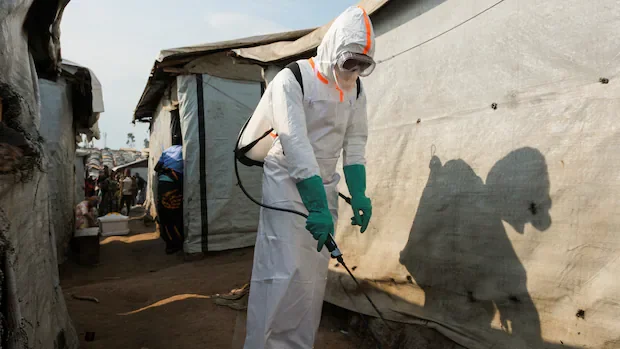
Ebola in the Democratic Republic of Congo: What's going on and why is the outbreak so alarming?
Armed conflict, lack of vaccines or treatment among factors complicating response
The Ebola outbreak in the Democratic Republic of Congo became the deadliest in the country’s history this week as confirmed cases continue to rise at a pace that is raising alarm around the world.
At least 2,378 deaths have been recorded in the D.R.C. as of Aug. 16, the country’s public health ministry said in its latest update on Tuesday.
"This is now the second-largest Ebola outbreak ever recorded, and it is moving faster than any previous Ebola outbreak. That's why I call it unprecedented speed," Tedros Adhanom Ghebreyesus, head of the World Health Organization (WHO), said on Tuesday.
"We must be frank: the epidemic is far from being under control. It had a big head start, and we are still playing catch-up."
Here's what you need to know about Ebola and the current outbreak.
WATCH | WHO says Ebola spreading at 'unprecedented' rate:## What is Ebola?
Ebola is a serious disease linked to what's known as orthoebolaviruses.
There are different strains of orthoebolaviruses, including four that affect humans: Zaire, Sudan, Taï Forest and Bundibugyo. The Bundibugyo strain has been identified in the current outbreak, the D.R.C.'s 17th on record.
Humans can contract Ebola through close contact with the blood or bodily fluids of infected animals such as fruit bats or chimpanzees. It then passes between people when contact is made with the bodily fluids of someone who is sick or has died from Ebola, or with contaminated objects.
When and where did the current outbreak begin?
Formally declared in May, the outbreak has centred on the eastern D.R.C., near the border with South Sudan and Uganda. Uganda also identified cases but declared itself "Ebola free" in late July.
According to the WHO, the first suspected case was a health worker who had reported symptoms on April 24 and later died at a medical centre in Bunia, the capital of Ituri province.
Why is this outbreak so concerning?
The speed at which Ebola is spreading this time far eclipses previous outbreaks.
For example, 100 days after the first Ebola case was confirmed in the D.R.C. in 2018, 323 cases were reported, according to data cited by the U.S. Centers for Disease Control and Prevention (CDC). Similarly, 398 cases were reported in Guinea at the 100-day mark in 2014.
In the current outbreak, which has yet to reach the 100-day mark, 5,021 cases were reported in the D.R.C. as of Aug. 16, according to the country's public health ministry.
Cases have been confirmed in six D.R.C. provinces, but the vast majority of cases and deaths have been in Ituri. The ministry says the outbreak also has a case fatality rate of 47.4 per cent, and the United Nation's humanitarian aid chief Tom Fletcher said last week that a person is dying every 30 minutes.
What factors are complicating the response?
The first is that there currently is no vaccine or treatment for the Bundibugyo strain of Ebola. (Two vaccine trials, including one in Canada, have begun, but it will likely take months before a wide-scale rollout.)
Armed conflict and mass internal displacement in the eastern D.R.C., regular movement between countries in the border areas and a lack of resources also are important factors. At the same time, residents have been distrustful of the government and public health efforts.
"People who are getting sick are not actively presenting themselves to doctors, hospitals, health-care workers … because they're scared," said Dr. Tyler Evans, a U.S.-based public health physician who has worked on past Ebola outbreaks. "They see Ebola treatment units, these white tents — they're seeing half of these people go in, and they're not coming out.
"All of those [factors] together is really contributing to this perfect storm."
WATCH | How long will it take to contain the outbreak?:## What can — and needs to — be done?
Testing and contact tracing are key, said Dr. Joanne Liu, a physician and professor at McGill University in Montreal who was involved in the response to an Ebola outbreak in West Africa from 2014 to 2016.
That, coupled with safe funerals and treatment in isolation, can help get a "fuller picture" of where the outbreak is going, Liu told CBC. She also said more health workers need to be deployed and protected as they do their work.
A WHO official told reporters from Bunia in Ituri province on Tuesday that the agency is scaling up its response and engaging local communities. Dr. Thierno Baldé, the WHO's incident manager for the disease in the D.R.C., said 100 additional epidemiologists will be deployed while more than 400 beds have been added over the past two weeks.
Liu said Canada and other countries that are concerned about the spread of Ebola should provide more financial support to help teams on the ground.
"If you want to not have a wildfire coming to you, you need to control it where it's happening — not barricading yourself and then closing your border," Liu said. "That might have a small effect, but that will not do the trick in getting control over the outbreak."
With files from Amina Zafar and Lauren Pelley