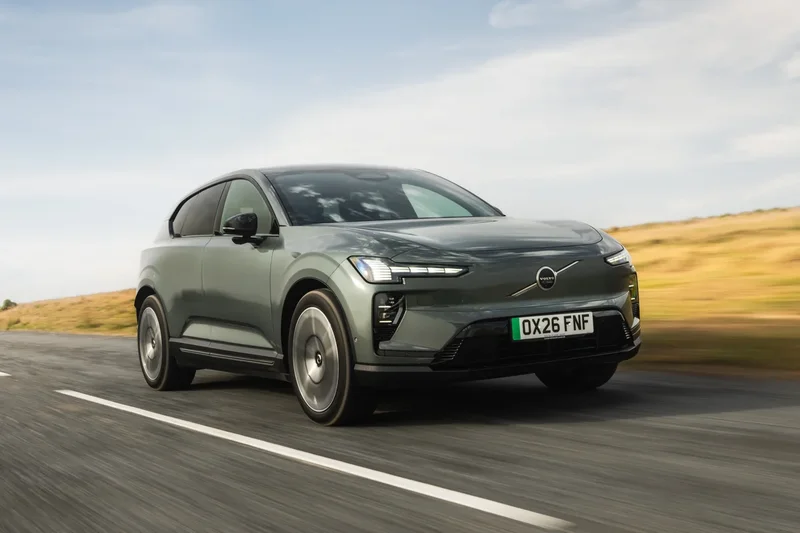
The Volvo EX60 is a big deal for Volvo. The Swedish brand has gone quicker – and more successfully – than many into the world of electrification, but this model is the all-electric equivalent of its all-time best seller, the XC60.
The XC60 continues as a plug-in hybrid – for now – while the EX60 debuts some impressive new technology that’s not only a first for Volvo, but also a first for the car business.
Who’d have had Volvo down as a technology leader? Safety, yes. But tech? However, the EX60 features an all-new platform, a new tech stack built with the help of some of the biggest Silicon Valley mega companies, plus there’s Google’s Gemini voice assistant on board – with much of the tech likely to get better over time thanks to over-the-air updates. It’s the brand’s first, true, software-defined vehicle, and is being built at the company’s Torslanda factory in Gothenburg, Sweden.
Some of the fancy new tech on the EX60 is also going to find its way onto older Volvo models, where hardware allows. And, of course, Volvo hasn’t forgotten about safety – it’s only gone and reinvented the seat belt, using the latest available technology, of course.
The EX60 arrives in one of the most competitive parts of the EV market. A mid-size electric SUV now has to do almost everything well. It needs to be roomy, comfortable, efficient, quick enough, easy to use, good on a long trip, packed with safety kit, nice inside and not outrageously expensive. The EX60 has clearly been aimed straight at that brief and delivers brilliantly.
There are three versions. The rear-wheel-drive P6 starts from £56,860 in Plus trim, while the P10 AWD starts from £59,860. The faster P12 AWD, which arrives later, starts from £64,860. Ultra trim pushes those prices to £62,360, £65,360 and £70,360 respectively. First UK deliveries of the P6 and P10 AWD are expected soon, with the P12 AWD due from January 2027.
The range figures are the big news. The P6 can officially manage up to 380 miles, the P10 AWD up to 410 miles and the P12 AWD up to 503 miles. That last figure is Volvo’s longest electric range so far, and it puts the EX60 into proper long-distance territory. There’s also rapid charging at up to 370kW in the two all-wheel-drive models.
The new BMW iX3 promises a lower starting price and longer range for the cash, but I’m not a fan of its overly firm ride and you can decide for yourself on the looks. The EX60 is the better all-rounder: quiet, comfortable, spacious and very easy to get on with. It also has one of the most impressive in-car audio systems I’ve experienced.
How I tested
Having first driven the EX60 in and around Barcelona in Spain, I’ve now had a chance to properly assess the car back here in the UK. I drove the car along the motorways, dual carriageways, A-roads and country lanes of Somerset, even popping into a supermarket to check on parking. As well as the driving, I took time to assess the quality, the practicality and the visibility, while also crunching the numbers. And, of course, I took time to fully test the Dolby Atmos Bowers and Wilkins audio setup.
Independent rating: 10/10
- Pros:Long range, rapid charging, strong performance, excellent safety kit, quiet cabin, brilliant Google system, superb Bowers & Wilkins audio, lots of space
- Cons:Not much – some interior plastics feel a bit cheap and the touchscreen takes getting used to
- Price from:£56,860
- Battery- size:83, 92 & 117kWh
- Maximum claimed range:503 miles
- Maximum charging rate:Up to 370kW DC, 10-80 per cent from 16 minutes
Battery, range, charging, performance and drive
The EX60 comes with three electric powertrain options. The P6 is rear-wheel drive and has a single motor producing 369bhp and 480Nm of torque. It has an 83kWh battery, with 80kWh usable, and manages 0–60mph in 5.7 seconds. That is already plenty for a family SUV.
The P10 AWD adds a second motor for four-wheel drive and increases power to 503bhp and 710Nm. It uses a 95kWh battery, with 92kWh usable, and cuts the 0–60mph time to 4.4 seconds. Then there is the P12 AWD, which uses a larger 117kWh battery, with 112kWh usable, and produces 671bhp and 790Nm. That version gets from 0–60mph in 3.8 seconds, which is very quick indeed for something this size. All three versions have a 112mph top speed.
Having driven the P6 and P10 initially on the international launch, I spent time in the P10 in the UK in and around Somerset. Although the early cars I drove were representative of production models, there’s no substitute for driving a car here in the UK and the P10 eased any fears I might have had over the ride quality.
The P6 gets steel springs and was fine when I drove it abroad. But the P10 gets adaptive air suspension. It rode really well on UK roads, soaking up the worst of the lumps and bumps yet still communicating what was going on under the tyres. Body control is good, too – kids in the back won’t be turning green, while the steering is nicely weighted and accurate enough.
The P6 is the one many buyers are likely to look at first, because it has the lowest price and still offers good performance – it certainly never felt underpowered. Electric cars are good at making modest numbers feel stronger than they look on paper, but the P6 is not modest anyway. It pulls away smoothly, has plenty of shove for overtaking and feels relaxed at motorway speeds.
The P10 is a different thing again. It is not silly or showy, but it is properly rapid. The extra traction of all-wheel drive helps, and the power delivery is beautifully smooth. It’s one of those cars that gathers speed with very little fuss but it’s still fun, which fits the Volvo character nicely. There is lots of power, but it is not delivered in a way that makes the car feel aggressive or tiring.
The brakes are good, too. They have a natural feel by EV standards, and the regenerative braking blends in cleanly.
Range is one of the EX60’s strongest cards. The P6 has an official combined range of between 380 and 385 miles, depending on specification and wheel choice, while the P10 AWD manages up to 410 miles. The P12 AWD can go up to 503 miles, and I’ll hopefully be driving that version in the coming months.
Charging should make long trips straightforward. The P6 can charge at up to 320kW, while the P10 and P12 can charge at up to 370kW. Volvo says the P6 and P10 can charge from 10 to 80 per cent in 16 minutes, while the P12 takes 19 minutes. In 10 minutes, the P6 can add up to 186 miles, the P10 up to 196 miles and the P12 up to 211 miles. With charging speed a key battle ground, the EX60 makes for a great long-distance EV.
Like the EX90 and ES60, the cabin is very hushed – you don’t have to drive too far to notice that – and that really helps the car feel properly premium. It is also relaxing on the motorway, with good visibility, really comfortable seats and adaptive cruise control that worked well during my test drive.
To get into the EX60 you have to use the car’s novel door handles, which protrude from the top of the door like small bat wings. They work well, are said to contribute to an extra couple of miles of range, but you can catch sight of them when looking over your shoulder and think there’s something odd in your blind spot!
The small steering wheel is a lovely thing, though. It makes the EX60 feel more wieldy than you might expect and leaves you wondering why so many other steering wheels are so big. This is still a substantial SUV at 4,803mm long, 1,899mm wide and 1,639mm tall, with a 2,970mm wheelbase, but it does not feel clumsy. The turning circle is 11.3 metres kerb to kerb, and the car is easy to place. For comparison, the current XC60 is 4,708mm long, 1,902mm wide and 1,655mm tall, with a wheelbase of 2,865mm.
Overall, the EX60 drives like a good Volvo should. It is quick, quiet, comfortable, secure and easy to trust, making it an impressive option for family life on UK roads.
Interior, practicality and boot space
The EX60’s cabin is a calm, spacious and comfortable place to spend time, which is exactly what you want from a Volvo SUV. The driving position is great; visibility is strong and there is a genuine sense of space in both rows. It feels like a car designed to make family life easier rather than to show off.
The seats are very comfortable, and there is loads of room in the back. The official figures give front and rear headroom with the panoramic roof of 1,041mm and 1,030mm, while front and rear legroom is 1,058mm and 951mm. Shoulder room is 1,437mm in the front and 1,374mm in the back. In normal human terms, that means adults should be very happy in the rear seats, and the EX60 feels properly roomy without becoming enormous on the outside. I’m close to six feet tall and with the front seat set for me, I still had bags of room in the back.
The boot is useful, too. Volvo quotes 523 litres of open luggage space with the rear seats up, or 998 litres with the rear seats folded and cargo loaded to the lower window line. The largest luggage volume, including underfloor storage and loaded higher, is 634 litres with the rear seats up and 1,647 litres with them folded. There are also clever separate storage areas in the luggage compartment of up to 91 litres, plus a front boot under the bonnet. Volvo lists the frunk at 58 litres with the tyre mobility kit, 60 litres without it, or up to 85 litres depending on version.
There are plenty of clever Volvo touches, as you’d expect. The rear luggage space has a 40/60-split floor that reveals a divided storage space – useful for charging cables or smaller items that you do not want rolling around in the boot. The central glove compartment can be reached from either side and includes removable storage for smaller bits and pieces. There is also a sliding cupholder between the front seats that can take two normal cups or cans, plus one slimmer energy-drink-style can in-between, and the frame can slide back to open up more storage space.
The cabin generally feels well put together and nicely designed, but there are a few signs of cost-cutting. The hard plastic around the door bins stands out, and the slide-out tray with cupholders feels a bit cheap. The light-coloured interior in the car I tried probably did not help, because lighter finishes can make cheaper materials more obvious, but it was still noticeable either way.
The door grabs are also too far back on the doors. That sounds like a small thing, but these are the details you notice when you use a car every day.
The materials story is otherwise interesting. Volvo uses bio-attributed Nordico, which is its leather alternative, along with a tailored wool blend made from 30 per cent wool and 70 per cent recycled polyester, FSC-certified wood decor and recycled polyester on the instrument panel. Volvo also says the EX60 has the highest amount of recycled content of any Volvo car to date, at 27 per cent, and one of the lowest carbon footprints of any fully electric Volvo.
There is an electrochromic panoramic roof, too, which can switch between transparent and translucent depending on how much light or privacy you want. Six ambient light themes are inspired by Scandinavian nature, which is a very Volvo way of doing mood lighting. And one of my favourite things is the sound of the indicator being a sample of a twig breaking – brilliant!
The EX60 also has a few clever engineering details under the skin. Volvo says the cell-to-body construction integrates the battery cells directly into the car’s structure, which helps reduce weight, free up interior space with a lower floor and improve stiffness and impact protection. The rear floor is also made from a single aluminium mega-casting rather than more than 100 welded pieces, which is designed to use less material and reduce weight.
In practical terms, the EX60 feels like a proper, excellent family SUV. There is lots of space in the back, a large boot, a useful frunk, good visibility and a comfortable cabin.
Technology, stereo and infotainment
The EX60 leans heavily on its central touchscreen, and – having lived with the car for a bit longer now – it’s not the issue some people might think it could be.
The main screen is a 15.04-inch OLED display mounted horizontally, with a slight convex curve so it is easier for both driver and passenger to see. The graphics are crisp, the layout is clean and the Google-based software works brilliantly. Navigation, media and other key features are grouped sensibly, and the contextual area close to the driver shows relevant functions when they are needed.
Google built-in remains one of the best infotainment foundations in the car world. It’s familiar, quick and easy to understand, and the mapping is excellent. The EX60 also gets Gemini, Google’s conversational AI assistant, which means you can speak to the car more naturally. In practice, it works well and can even be quite entertaining when you start having a conversation with it. The only issue Gemini has – as does Apple Music when you use that – is its reliance on the UK’s mobile network. If you can’t get a decent signal – and let’s be honest, that’s tricky sometimes – then these tech features simply won’t work. It’s not Volvo’s fault in the slightest, but annoying nonetheless.
The new Gemini voice assistant essentially has two modes; one works in the same way as Google Assistant and is summoned with the familiar “Hey Google”, while the flowing conversation mode, which was still in beta mode at the time of driving, is activated with “Hey Google, let’s talk”. The latter lets you gave a long, flowing, back-and-forth chat, and Volvo says it’ll soon be updated to be more helpful with car-specific tasks. For example, you’ll be able to ask it how to connect your phone to the car.
There are few proper physical controls in the EX60, and some everyday functions would be a bit easier if they had their own buttons. But this is hardly unusual in a modern EV, and for the most part it’s not a problem, especially when you take the time to set the car up properly, key settings are linked to the key (whether that’s the physical key or your phone) and voice control is getting better with every software update.
Digital Key Plus is available, allowing access through an iPhone, Apple Watch or compatible Android phone. You carry the device with the digital key stored in the Wallet app, then unlock the doors and drive away. It can also be shared with friends and family.
The safety roster is seriously impressive, as you would expect from Volvo. The EX60 uses Volvo’s Safe Space Technology and includes multi-adaptive front safety belts – another Volvo safety first. These clever restraints use data from the car’s interior and exterior sensors, including crash speed, crash direction, occupant size, body shape and seating position, to apply the best restraining force through the belts. The car also uses Volvo’s core computer to support its safety systems.
There are high-definition pixel headlights on Ultra models, with 25,600 adaptive pixels. Volvo says they are designed to make night driving more relaxing while further improving safety. The EX60 also has a drag coefficient of 0.26, helped by aerodynamic details including those unusual winglet door handles.
The real technology highlight, though, is the Bowers & Wilkins audio system with Dolby Atmos and Apple Music now built in – it’s brilliant. The EX60’s I’ve driven were so quiet on the move that the sound system had the perfect stage to work on, and the result is the best in-car audio systems I’ve experienced. I just wanted to sit in the car and listen to music.
The system has 28 high-performance speakers and 1,820 watts of output. That includes five 25mm Nautilus Double Dome tweeters, six 80mm Continuum midrange speakers, four 40mm height speakers, eight 50mm headrest speakers, four 170mm woofers and one 265mm fresh air subwoofer. For the first time in a Volvo, headrest speakers are fitted in all four main seats, with two per seat. These help with Dolby Atmos, but also mean the driver can be fed navigation instructions without everyone else’s music being disturbed.
There is a lot of serious audio tech from Bowers & Wilkins here. Tweeter-on-Top tech helps reduce reflection from the windscreen and direct sound towards occupants. Nautilus technology absorbs unwanted sound from behind the tweeter. Continuum midrange speakers are designed to reproduce voices and instruments cleanly. Dirac Unison uses acoustic measurements to tune the sound for the cabin, while vehicle noise compensation adjusts the sound in real time to account for road and wind noise. QuantumLogic Immersion can separate stereo audio into individual streams such as performers, instruments and room sound.
There are also different listening modes. Focus can optimise the sound for all seats, the driver, the front, the centre or the rear. Room settings include Living Room, Downtown Club, Gothenburg Concert Hall and 3D Surround. Seat mode plays sound mainly through the headrest speakers for a more personal experience.
Dolby Atmos adds another layer, and this is the most successful Atmos in-car integration I’ve listened to. It allows individual sounds to move around the cabin in a multidimensional soundscape, and in the EX60 it works through the Bowers & Wilkins system. To use Dolby Atmos in the car, you need a data connection, an Apple Music or Tidal subscription and Dolby Atmos content selected through, in my case, Apple Music. As well as the cars own app, Dolby Atmos music can now also be streamed over your Apple CarPlay connection.
If you love music, I urge you to pop into a Volvo dealer and try it, especially with Dolby Atmos. Listen to Atmos mixes of Pink Floyd’s Wish You Were Here, Roxy Music’s Take A Chance With Me, Michael Jackson’s Black and White, BOOM by Tiësto and Sevenn and Sam Smith’s Unholy and you’ll be hooked. It’s the sort of system that lets you discover new bits of old music – it’s fantastic.
Prices and running costs
The Volvo EX60 starts from £56,860 for the P6 in Plus trim. The P10 AWD Plus costs £59,860, while the P12 AWD Plus costs ££64,860. Move up to Ultra trim and the P6 costs ££62,360, the P10 AWD costs £65,360 and the P12 AWD costs £70,360.
Kit levels are strong, and even the entry point brings the big-car Volvo feel, long range, fast charging and a generous safety package.
The Plus range includes the P6, P10 AWD and P12 AWD powertrains, while Ultra adds more equipment: high-definition pixel headlights with adaptive shadow technology and cornering lights, headlight cleaning, 21-inch five-spoke alloy wheels, dark tinted rear side windows and rear screen, the electrochromic fixed panoramic sunroof, laminated side windows, multi-directional lumbar support, perforated Nordico upholstery with front-seat ventilation, and the Bowers & Wilkins High Fidelity audio system.
Wheel choices include 21-inch and 22-inch designs – we’d always go for the smaller wheels to try and protect ride comfort. Exterior colours include Ice White, Onyx Black, Denim Blue, Vapour Grey, Sand Dune, Aurora Silver, Forest Lake and Heather Bronze.
Interior options include Nordico that can be perforated and ventilated, perforated Nappa leather, and a tailored wool blend.
Running costs should be helped by the EX60’s efficiency, particularly considering its size and performance. The P6 is officially rated at between 3.5 and 4.2 miles per kWh, while the P10 AWD manages between 3.2 and 3.8 miles per kWh. The P12 AWD is listed at 3.9 miles per kWh. Those are strong numbers for a large electric SUV, especially one with this much power.
The range also helps running costs in a less obvious way. If a car can comfortably do more of its mileage from home charging, and needs fewer expensive public rapid charging stops, it can be cheaper and easier to live with. The P6’s official range of up to 380 miles and the P10 AWD’s up to 410 miles should be more than enough for most drivers. The P12 AWD’s 503-mile figure is the headline grabber, but buyers will have to wait longer for that version.
Towing capacity is useful, too. The rear-wheel-drive car can tow up to 2,000kg, while the all-wheel-drive models can tow up to 2,400kg. The maximum roof load is 100kg, and the EX60 has 450mm of wading capability at walking speed.
The EX60 isn’t cheap, but it does feel well placed for a premium electric SUV with this much range, safety kit, performance and charging speed. The P6 looks like the sensible one, the P10 AWD feels like the sweet spot if you want extra pace and traction, and the P12 AWD is the big-range, big-performance flagship.
The verdict: Volvo EX60
In my opinion, the EX60 is the best car Volvo has ever made and one of the best cars I’ve driven this year. It’s a hugely appealing electric family SUV, and also probably one of the most important cars Volvo has launched in years.
It does the big things extremely well. The range is impressive, the charging speeds are excellent, the cabin is quiet, performance is strong and the safety kit is seriously comprehensive. The P6 has more than enough power for normal use, while the P10 AWD adds the sort of effortless pace and extra traction that suit a premium electric SUV very nicely. The P12 AWD, with up to 503 miles of range, will be the one that really grabs attention when it arrives.
It is also a very easy car to like and to live with. The seats are comfortable, visibility is good, there is loads of room in the back and the boot is usefully large. The Google software works brilliantly, Gemini is effective and occasionally entertaining, and the adaptive cruise control worked well. The small steering wheel is a particular highlight, making the EX60 feel more manageable and more wieldy than its size suggests.
Then there is the Bowers & Wilkins audio system. It is not just good; it is a proper highlight. With Dolby Atmos, Apple Music integration, 28 speakers and headrest speakers in all four main seats, it turns the EX60 into one of the best places to listen to music on four wheels. The fact the car is so quiet only makes it better.
It’s a tough market with the likes of the BMW iX3 and Mercedes GLC Electric out there, but the overall Volvo package is very convincing. The EX60 feels like a proper electric Volvo: safe, calm, quick, quiet, practical and easy to live with. It’s a brilliant car, and one that deserves to be high on the shortlist for anyone looking at a premium electric family SUV.
Volvo EX60 rivals:
FAQs
How long does it take to charge?
The Volvo EX60 can officially travel up to 380 miles in P6 form, up to 410 miles as the P10 AWD and up to 503 miles as the P12 AWD. The P6 can rapid charge at up to 320kW, while the P10 AWD and P12 AWD can charge at up to 370kW. Volvo says a 10-80 per cent charge can take as little as 16 minutes in the P6 and P10 AWD, and 19 minutes in the P12 AWD.
How much does it cost – is it worth it?
The Volvo EX60 starts from £55,995, so it is not a cheap electric SUV. However, it comes with strong range, very fast charging, high power outputs, lots of safety technology and generous equipment levels. The P6 looks like the best-value version, while the P10 AWD adds more performance and all-wheel drive. Ultra trim is expensive, but adds desirable equipment including the Bowers & Wilkins audio system.
Does Volvo replace batteries for free?
There’s a three-year warranty on the whole car and eight year’s cover for the battery.
Why trust us
Our team of motoring experts have decades of experience driving, reviewing and reporting on the latest EV cars, and our verdicts are reached with every kind of driver in mind. We thoroughly test drive every car we recommend, so you can be sure our verdicts are honest, unbiased and authentic.
With more than 30 years of experience, Steve Fowler is one of the UK’s best-known automative journalists. Steve has interviewed key industry figures, from Tesla’s Elon Musk to Ford’s Jim Farley, and is a judge for both Germany’s and India’s Car of the Year Awards, as well as being a director of World Car of the Year. When it comes to electric vehicles, Steve reviews all the latest models for The Independent as they launch, from Abarth to Zeekr, and he uses his expert knowledge of car buyers' needs to provide a comprehensive verdict.