TechRadar Verdict
A truly impressive device. Although its abilities are slightly oversold by Thermal Master, the ability to pick out thermal signatures behind foliage and darkness makes it the idea bird-watching companion. But its software is incredibly poor.
Pros
- +Long range detection
- +256x192 native sensor with 512x384 Super IR
- +20 mK NETD sensitivity
- +Wi-Fi streaming
- +Works independently of a computer or phone
Cons
- -Comes with only one battery
- -One pixel detection isn’t realistic
- -Unfinished software
- -Illogical menu structures
Why you can trust TechRadar
Thermal Master DV2: 30-second review
The Thermal Master DV2 is a handheld thermal imaging monocular that the maker positions in different ways depending on which storefront is visited. On its own birdwatching page, it is billed as the first dedicated thermal camera built specifically for spotting birds and wildlife.
Elsewhere in the same company's catalog, and on Amazon, it appears instead as a general-purpose thermal monocular for hunting, camping and rescue work. Whatever your interest, the hardware underneath is identical.
At the centre of the device sits a 256 x 192 sensor with a 12-micron pixel pitch. Thermal Master runs that raw feed through what it calls the RazorX engine, a three-core processing pipeline built from an FPGA, an ASIC and an AI upscaling block badged X³IR. The result is a 512 x 384 output image, twice the native resolution, though this is achieved through interpolation rather than by a genuinely higher-resolution sensor.
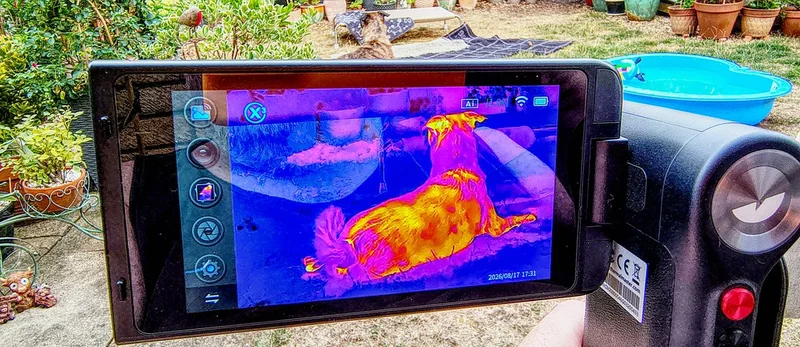
Detection is rated up to 1000m for a human-scale target, with shorter recognition distances quoted for smaller subjects such as birds. A 10mm f/0.8 manual focus lens feeds that sensor, and the whole thing is viewed on a 5-inch touchscreen running at 1280 x 720. That screen rotates and folds, making it compact to carry and easy to use. And the camera can be used without a phone, making deployment quicker and easier.
Connectivity can be used for streaming over Wi-Fi or for offloading captured images and video from the camera, and it supports RTSP for near-no-lag transmission. A laser pointer helps mark whatever has been spotted, and a Picatinny rail fitting lets you mount the DV2 on other equipment.
Thermal Master sells the DV2 directly from its own site and through Amazon in several regions. Pricing is $499/£459 via Amazon, which seems reasonable since this isn’t a phone add-on, but a standalone camera.
The value of this product entirely pivots on the use case. If you need to identify animals or people at range, then it could be invaluable, but it's not suitable for every job.
Thermal Master DV2: price and availability
- How much does it cost?$500/£460/€530
- When is it out?It is available now
- Where can you get it?Direct from the Thermal Master website, with shipping from regional warehouses in the US, UK, EU, and China. And via online retailers.
At the time of review, the DV2 carries a price of $489 USD direct from Thermal Master. For that price, you get the camera, a battery charger, one battery and a few accessories, like the Picatinny rail attachment and carry case.
For quick delivery, it can be purchased from Amazon.com for $499, from Amazon.co.uk for £459.99 and from the EU Amazon sites for €529.99.
There aren’t any obvious retail competitors because professional bird watching isn’t something most companies see as a new market opportunity.
A more general-purpose device is the Axion Compact Thermal Monocular, but that’s priced at $1449.97 on Amazon for those in the USA.
A slightly more realistic choice is the TOPDON TS004 and TS004 Pro, monoculars designed for hunting, rather than birdwatching. The standard TS004 has a resolution of 256 x 192 and costs a little over $400, while its Pro brother is $759.95 and sports 384 x 288 resolution. The Pro quotes detection at up to 650 yards, which is less than the DV2.
- Value score: 3.5/5
Thermal Master DV2: Specs
|
|
|
|
| 256 x 192, 12μm pitch |
|
| ≤20mK @ 25°C, f/0.8 |
|
| 512 x 384 via X³IR interpolation |
|
| 10mm f/0.8, manual focus |
|
| 17.5° x 13.1° (some listings simplify this to 18°) |
|
| 5 inch touchscreen, 1280 x 720, 360° rotating, 180° folding |
|
| 50Hz |
|
| Triple-core: FPGA, ASIC, AI upscaling block (RazorX engine) |
|
| Up to 1094 yards for a human-sized target |
|
| 8x |
|
| 9 tactical modes, 5 colours |
|
| 5 |
|
| Wi-Fi streaming, RTSP support confirmed independently, USB-C |
|
| 32GB internal |
|
| Picatinny rail adapter |
|
| 512g including battery |
|
| 1x 21700 5000mAh Battery |
|
| 2 years |
Thermal Master DV2: Design
- Camcorder vibe
- Large touch screen
- Only one battery included
- Confusing buttons
Many handheld thermal cameras still borrow the shape of a barcode scanner or a torch, but the DV2 looks closer to a small camcorder. The optics are at the top end, with a lens cap protecting the manual-focus telephoto. The lens cap isn’t tethered, so I recommend not dropping that black item in the dark the first time you use this device.
Its defining feature is the fold-out 5-inch touchscreen, which rotates 360 degrees and folds 180 degrees, rather than staying fixed in one position. This lets the operator adjust the display if the target area is above or below the camera's natural line of sight.
The rotating, folding screen lets the display angle toward the eye, whether the DV2 is held low, mounted on a tripod, or fitted to a rail system via its Picatinny adapter.
A downside of this design choice is that if you fold out the display at 90 degrees to the camera, its most natural position, the weight causes the camera to fall over. Therefore, at a minimum, you need a small tripod, even if one isn’t included with the DV2.
To operate the device, the red button on the rear is depressed for what seems like an inordinately long time before a fancy video graphic announces that the DV2 is ready for action.
But before you do that, the 21700 battery needs to be inserted into the DV2, something you are told to do, but there are no indicators I could see which end of the battery goes in first.
Eventually, I found a video of someone demonstrating the camera and realised the correct orientation, but it wasn’t labelled or mentioned in the quick start guide.
Documentation for this product isn't a strong point, since months after release there is still no proper manual.
What’s also slightly odd about the battery is that the case has positions for two, but Thermal Master provides only one. And yet, the charger accepts two. Given that the retail unit cost of a 21700 battery is less than $10, and it would be much less than that for Thermal Master, it's confusing why two aren’t provided from the outset.
If you don’t intend to buy another, then the charger is also superfluous, since you can charge the one included in the DV2 by using a provided USB-C cable. Except you might not want to, because you might struggle to power the DV2 while it's on a tripod, since the USB-C port is on the same underside as the threaded tripod hole.
That’s confusing, but the bit that genuinely made me scratch my head was that the second button next to the power on/off one didn’t initiate video and picture capture. No, it toggles through the different colour representations, something most people would set and forget.
To take a picture or video, you have to touch the screen, which, if you're zoomed in on a distant bird or animal, is likely to twist the camera and ruin the framing. Not sure who made the choice not to include a shooting trigger, but it was a poor decision.
Another slightly odd feature is that this device has a laser pointer, activated by a quick press of the power button. I can’t think of anything more likely to cause roosting birds or other wildlife to exit stage left than being shot in the eye with a laser, so why they included this, I’m unsure.
I'm also confused by the addition of the Picatinny rail adapter, which implies that after you've watched the birds, your next step is to shoot them. That's not really the sort of bird watching I'm familiar with, but what do I know?
Overall, the build quality is decent, and it feels relatively robust. From a design perspective, there appear to be numerous aspects where the engineers creating it didn’t really appreciate how it might be used and what potential customers might be expecting.
Design score: 3.5/5
Thermal Master DV2: User experience
- Questionable ergonomics
- Dire mobile app
- Focus challenges
- Recognition vs detection
I might have got the wrong end of the stick, but the primary purpose of this device is to take pictures and video using the thermal sensor, isn’t it?
This seems obvious, but due to how poorly organized the device menus are for doing just that, perhaps I’ve entirely misunderstood this device.
I’ve already mentioned that you can’t initiate capture with a simple button, but the touch screen menu goes one step further. Taking a picture isn’t on the top-level menu; it requires you to go to a second page, and then a third, to do the one task this device is made for.
The top level is full of things you won’t want immediate access to, I’d contest, and this arrangement makes almost no sense I can fathom.
At first, I concluded you were probably meant to use the mobile app to take pictures so you don’t touch the camera, but I was wrong.
Connecting the camera to the phone involves an overly complicated procedure that would make anyone used to Apple or Bambu Labs products incandescent.
For starters, both devices need to be on the same Wi-Fi network, so this won’t work in the field unless you bring a portable Wi-Fi access point along.
The phone needs an app that, for Android users, needs to be downloaded from the support pages and then side-loaded onto the phone. I’ve long been critical of Thermal Master apps, and how there is always a new one for each camera, and this one isn’t even on the Play Store.
Once you install the app, you can go to a specific page on the camera with no instructions on which icon it's behind, then get a QR code that connects the two.
To use this feature, you must be in control mode, where the barcode is shown, so you can’t do anything on the camera when the phone takes over. Once the two are connected, you have three features.
One of which is the color control, another is the Thermal Master eye (Red/Green imaging mode), and the other recalibrates on the image. There isn’t any way to change from still image to video, use the aiming reticule, hotspot tracking, or access the picture album, so 80% of what the DV2 does is unavailable.
But also, you can’t take a picture other than using your phone's inbuilt feature to take a screenshot. And, if you capture images using the phone, they are not transferred to the phone.
So anything you manage to capture needs to be downloaded from the camera in a separate exercise using a USB-C cable.
Being brutally honest, it appears that the hardware team started work on the DV2 many months before the software people, who appear to have met it a couple of weeks before it was launched.
I suspect that this connectivity was supposed to use Bluetooth, but time ran out, and it also did for all the other missing features of the phone app.
If you ignore the phone app nonsense - and I recommend you do - and focus instead on the functionality built into the camera, then the user experience is much better, if a little limited compared with some of the other Thermal cameras that this brand makes.
What’s lacking here is a visible-light sensor, the data from which could be used to enhance thermal captures and help with focusing. I’d put focusing as the single most challenging part of using the DV2, because when you're presented with blobs of moving colour on the screen, it's hard to tell whether they’re moving in or out of focus.
Once focus is dialled in, as long as you don’t move the camera, you definitely need a tripod; then you can develop a practical workflow.
What’s important to realise is that this is for capturing things that aren’t especially close, and this hardware would be of zero use to anyone repairing electronics or fixing engine problems. And, because it's not meant for that, some of the features seen on other cameras, like floating temperature text, are missing on the DV2.
Also, the range of this device allows you to identify the thermal signatures of humans and animals long before you can determine where they are going or what they are doing.
Hilariously, to make this understandable, the DV2 datasheet breaks this down into four detection range levels, where the thing being detected will trigger up to three pixels on the sensor. These are 300m for a 1.8m human, 250m for 1 1.5m Hog, 200m for a 1.2m Coyote, and 50m for a 0.3m Dove.
Where I live in England, we have only two of those creatures since Wild Hogs and Coyotes aren’t endemic, but I get the idea. The camera's relatively high frame rate helps with identification, but only when they’re larger than three pixels on the sensor.
Thermal Master marketing takes this capability and extrapolates it to claim the camera can detect human-sized heat signatures at 1094 yards (1000m, or 1km). To be clear, at that range, an adult human would be a single pixel on the sensor, and for them to be recognised as such, they’d need to be four times closer.
I guess the single pixel, if consistently lit, might tell you something is coming, just not what it was.
- User experience score: 2/5
Thermal Master DV2: Camera
Image output is a 512 x 384 frame, built from a native 256 x 192 sensor through the RazorX engine's AI upscaling. As with any interpolated output, this can improve apparent detail without genuinely increasing sensor resolution.
And, in the DV2, this works well enough, making the thermal image clear and readable, with good separation between different heat sources even at a distance.
Digital zoom is available up to 8x, but zooming this way involves taking smaller and smaller sections of the sensor area, which results in grainy/blocky results. When you start with such a low sensor resolution, this is always going to be an issue.
Five colour palettes are available for translating temperature data into a viewable image, along with nine tactical reticule modes in five colours, a feature set that leans towards the hunting and outdoor positioning of the device rather than its birdwatching marketing. Since that type of hunting isn’t common in the UK, I can’t comment on its usefulness for that role.
But in other regions, where the number of people accidentally shot by others during the hunting seasons is significant, it could be a lifesaver.
A 50Hz refresh rate should keep motion reasonably smooth when tracking a moving subject, whether that is a bird taking flight or an animal moving through undergrowth. The issue here is that there is a sweet range where this can happen, but the further out a target is, the more difficult it becomes to track, especially if it moves out of frame.
There is a tendency to scan wildly around, trying to locate the heat source before it moves behind an obstruction or leaves the area entirely.
The camera offers similar technology to what Thermal Master is providing with its accessory phone cameras, but the optics here are predictably better. That results in better end results and clearer images, even if the resolution is still relatively low.
- Camera score: 3/5
Thermal Master DV2: Final verdict
The device's underlying hardware is solid. However, other aspects of this device are less than perfect, and the lack of proper documentation alongside some less-than-polished software detracts from the overall experience.
That’s a shame because the fundamental foundations of this device are good; it just needed to come to market in a more holistic package than it did.
I hope Thermal Master is motivated to finish the DV2 like it patently should have been. With some effort on the interface and software components, it could be something all dedicated birdwatchers and wildlife enthusiasts will want in their backpacks.
But at this time, especially in terms of the software and menu ergonomics, it still needs some work.
Should I buy a Thermal Master DV2?
| Attributes | Notes | Rating |
|---|---|---|
| Value | Not inexpensive, but impressive specifications | 3.5/5 |
| Design | Poor button choices and menu arrangement | 3.5/5 |
| User experience | Limited phone app that works over WiFi | 2/5 |
| Camera | Zoom is digital, and sensor is 256 x 192, but the optics help | 3/5 |
| Overall | Solid hardware let down by rushed software | 3.5/5 |
Buy it if...
You are tracking at range
The ability to pick up thermal data at a range of 1km is useful, but only if you are looking for people or larger animals. This camera can determine people-sized heat signatures at range, rather than small birds at a distance.
You wish to remain unseen
A handheld thermal monocular with a rotating, folding touchscreen rather than a fixed eyepiece is an advantage if you wish to remain out of sight. Light from the screen might be visible at night, but you can adjust the brightness.
Don't buy it if...
You want to capture using a phone
At this time, the phone app can relay a live feed using RTSP, but it can’t capture images or video. And, the connection between the two requires a WiFi network. Those expecting complete remote control with a phone will be disappointed.
Your interest is birds at range
If small bird detection at real distance is your primary use case, then this is a problem. Because the sensor is low resolution and there is no optical zoom.
Mark is an expert on 3D printers, drones and phones. He also covers storage, including SSDs, NAS drives and portable hard drives. He started writing in 1986 and has contributed to MicroMart, PC Format, 3D World, among others.