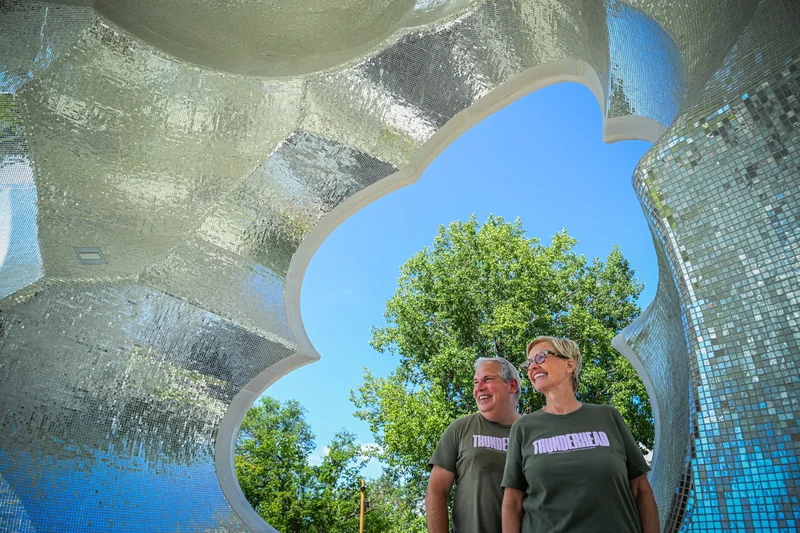
Every night, on the banks of the Ottawa River, a thundercloud will glow like a disco ball.
The cloud, reflecting light through thousands of mirrored tiles, is formed by the hollowed-out space in a 30-foot cylinder. The sculpture is one part of a national monument, named Thunderhead, opening Friday in Ottawa. It is dedicated to recognizing the discrimination faced by LGBTQ Canadians, including a decades-long campaign to identify and fire thousands of people from the public service, the Canadian Armed Forces and the RCMP for their sexual orientation.
A thunderhead is a storm cloud, imagined in the sculpture as billowing from the inside of a concrete column, sparkling as it breaks through.
“We didn’t stay in the mould. We blew it up,” said Martine Roy, who was among those targeted by the federal government in what has become known as the LGBT Purge.
In 1983, Ms. Roy was arrested at 19 years old when she was working as a medical assistant in the Canadian Forces and subsequently dismissed from the military for being a lesbian. She was later one of three plaintiffs in a historic class-action settlement against the Canadian government in 2018, which allocated more than $100-million to survivors of the sustained campaign of persecution against LGBTQ members.
The LGBT Purge started in the 1950s and continued for four decades until 1996. Former prime minister Justin Trudeau apologized for the systemic discrimination faced by LGBTQ public servants in 2017.
As part of the class-action settlement, $24-million was allocated to an organization called the LGBT Purge Fund with a mandate to create a national monument and develop an exhibit for the Winnipeg-based Canadian Museum for Human Rights. The non-profit is also preserving documents related to the LGBT Purge and improving training related to LGBTQ inclusion in the federal government.
Now a co-chair on the board of the LGBT Purge Fund, Ms. Roy spent years as an advocate, setting up LGBTQ resource groups and founding Pride at Work Canada, an organization that promotes inclusion in the workplace. In 2023, she was appointed to the Order of Canada for her advocacy for LGBTQ communities across Canada.
Michelle Douglas, executive director of the LGBT Purge Fund, was fired from the Forces in 1989 for being “not advantageously employable due to homosexuality.” Three years later, she took the Forces to court for her dismissal. The lawsuit was settled, and the military removed the discriminatory policy which allowed for her firing.
She said the monument reflects the journey of LGBTQ individuals who have been resilient against oppression, from the time of colonization to today.
“It’s really important for a community that has at times been erased or attempted to be erased,” she said. “We are here, we have stood up, we have fought back and here we are today.”
Designed by the Winnipeg-based architecture firm Public City, the monument contains different elements for the public to use and live in the space, said Liz Wreford, principal architect at the firm. The central sculpture doubles as a stage, with lighting and a sloping lawn for seating.
Winding paths take visitors to an orchard, a medicinal plant garden and a healing circle with a firepit for ceremony, surrounded by seating made of Manitoban Tyndall Stone, a mottled limestone full of fossilized life. The firepit is ringed with 13 decorative stones, collected from each province and territory by Indigenous elders, Indigiqueer and Two-Spirit people.
Todd Ross, one of the plaintiffs in the class-action settlement and co-chair of the LGBT Purge Fund, remembered walking up to the monument for the first time in June.
“There was a feeling of almost disbelief that something that we talked about, something that we dreamed about, so many years ago is now standing and will continue to stand for decades and hopefully centuries beyond,” he said.
For him, the monument is an apology to the LGBTQ community in a physical form.
“It’s a commitment to remember, and it’s a commitment that we won’t go backward, that we fight to continue to move forward,” he said.
Lieutenant-Commander Tony Wright, spokesperson for the Department of National Defence, said in an e-mailed statement that the department is working to make its workplace safer for all members, allowing them to serve authentically and reach their full potential.
The statement said the Forces and DND have implemented recommendations from the LGBT Purge settlement, removed gender-specific requirements in dress code and increased support for LGBTQ employees through a pride advisory organization and dedicated advocates.
Ms. Roy said she saw the difference in the Forces firsthand when attending the Montreal pride parade on Aug. 9.
“We were about 60 from the military, walking together, and I think it’s beautiful. And most of them are not from the community, they’re allies,” she said.
“We would not see that before.”