Crossing a ‘red’ line? Chinese comedy star investigated over altered song lyrics
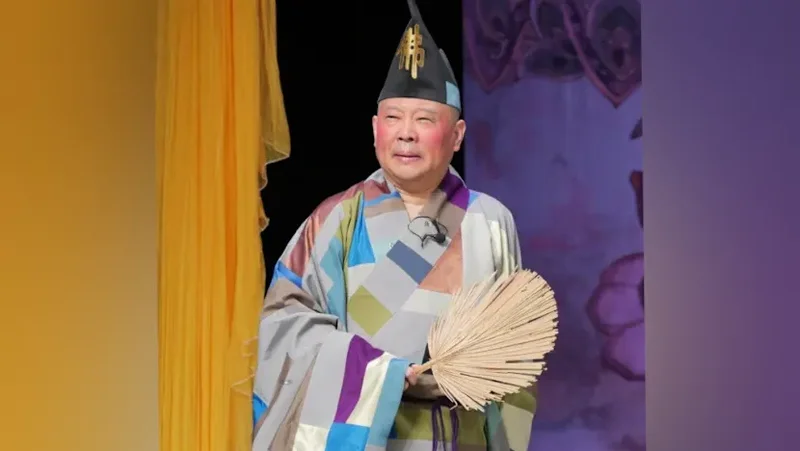
Guo Degang was accused of “violating public order and good customs” after changing the lyrics of a classic Chinese revolutionary song during a recent performance.
WUHAN: Prominent Chinese comedian Guo Degang has come under investigation after improvising new lyrics to a well-known revolutionary song, with a complaint accusing him of violating “social order and good customs”.
The incident spotlights the fine line performers in China must navigate between creative licence and political sensitivities, amid Beijing’s continued emphasis on ideological discipline.
Guo changed the lyrics of Playing My Beloved Pipa during a Peking opera adaptation of Ji Gong, a legendary Chinese Buddhist monk and folk hero, held in Wuhan on Jul 24, reported Shanghai-based news outlet The Paper. Guo starred as Ji Gong in the production.
Playing My Beloved Pipa was featured in the 1956 film Railway Guerrilla - a well-known revolutionary classic depicting a group of railway workers and farmers who form a guerrilla force to fight invading imperial Japanese forces.
It was among the 100 songs chosen by the Communist Party in 2019 to celebrate the 70th anniversary of the founding of the People’s Republic of China.
The original lyrics are: “The sun is about to set in the west; all is quiet on Weishan lake.” However, Guo changed the lyrics to “all is quiet in the Forbidden City … I am Buddha … mummy mummy please,” The Paper reported.
An unidentified audience member submitted a complaint to Wuhan’s culture and tourism bureau on Aug 3, accusing Guo of distorting a “classic red song” and “violating public order and good customs”.
In its reply on Aug 11, the bureau said the specific segment Guo had performed “was not reflected in the materials filed for record”.
The bureau said it had launched an investigation as the unapproved segment was suspected of violating regulations on commercial performances.
“The matter will subsequently be handled in accordance with laws and regulations,” it said.
A household name in China, Guo, 53, is known for his xiangsheng (crosstalk in Mandarin) comedy. He has 72.4 million followers on Chinese microblogging platform Weibo.
Guo has not posted on his public Weibo page since Aug 9.
His performance on Jul 24 has sparked discussion on social media, with clips posted online.
Hu Xijin, the former top editor of state-linked Global Times, was among those who weighed in on the debate.
In a Weibo post on Aug 13, Hu said he had felt “uncomfortable hearing a revolutionary song adapted and sung through the mouth of Ji Gong”.
“I thought it was inappropriate. But how serious is this matter, how should it be characterised, and how should it be dealt with?” he wrote.
As investigations were still ongoing, Hu called on the public to “respect” the bureau’s eventual findings and its decision on any penalties given.
However, Hu also seemed to defend Guo’s gaffe. In his post, he wrote that if a person has handled something “poorly” or appeared to have crossed a boundary but with “no malicious intent”, the matter “should be dealt with according to generally applicable rules”.
“Moreover, we should have a basic understanding: People who deliberately and maliciously cross such boundaries are extremely rare in our literary and artistic circles.”
Guo is not the first Chinese performer to face scrutiny over his words.
In March, Uyghur stand-up comedian Xiao Pa had her Weibo account suspended after making a joke about marriage in a post, the South China Morning Post reported.
Xiao Pa, whose real name is Paziliyaer Paerhati, had posted "information that stirred up gender conflicts and created anxiety over marriage and childbirth", a Weibo community manager said at the time.
In 2023, Chinese comedy company Shanghai Xiaoguo Culture Media was fined 14.7 million yuan (US$2.18 million) after one of its comedians made a joke that was deemed demeaning to the military, Reuters reported.