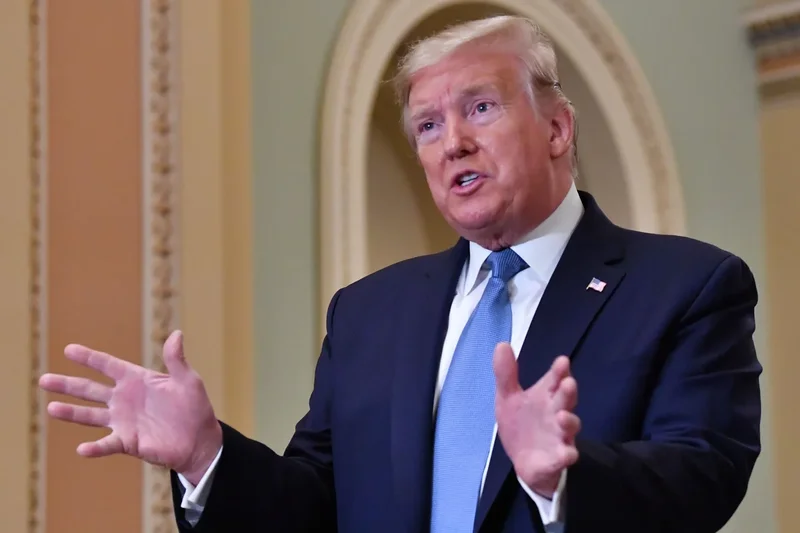
Iran is considering launching attacks on US military targets in Europe if President Donald Trump escalates the conflict, according to a report.
Sources close to Iran’s government told the Financial Times that potential targets included a British air base in Cyprus that was targeted by a drone in March.
Other countries in southeastern Europe such as Bulgaria, which approved US access to its Bezmer air base for refuelling last month, were also weighed up as a potential target for strikes.
It follows warnings that Tehran is considering switching to a “fully offensive” strategy, a senior Iranian official told Reuters on Monday.
A deal between the US and Iran appears further away than ever as Trump declared the Strait of Hormuz as American territory on Tuesday.
Sharing a bizarre map of the region with a large blue circle around the waterway, he declared the vital shipping route “NEW US territory” on Truth Social.
Shortly after sharing the image, the US leader announced that there are “no talks or conversations going on, or scheduled with the Islamic Republic of Iran”.
“The Naval Blockade remains in full force and effect,” he continued on the platform. “The Hormuz Strait is open and operating. All water mines have been removed or detonated.”
However, data shared by Kpler with The Independent shows that only ten vessels passed through on Monday, compared to 130 to 140 before the outbreak of war. Six commodity vessels crossed the strait on Tuesday, according to Kpler data seen by Reuters.
Iran had earlier said the shipping route is to remain closed until the US meet the conditions agreed in an interim deal, according to Iran’s top negotiator Mohammed Bagher Ghalibaf in comments shared by state media.
Conditions include lifting a marine blockade and sanctions as well as releasing Iran’s frozen assets.
Saudi Arabia’s Aramco resumed oil loading from inside the Strait last week with more waiting to load, according to shipping data and trade sources who spoke to Reuters.
Tehran says it has reached an agreement with Oman over a plan for ships to transit the Strait and that they are now working to finalise details for a joint statement.
Muscat has been working on a resolution to reopen shipping through the waterway, which passes through both countries.
On Monday, the US leader threatened to launch an attack on Oman as a 60-day period to negotiate a ceasefire deal expired.
“If Oman gets in the way, we’ll bomb the s**t out of them,” Trump said in an interview with Fox News, after reports Oman and Iran are working out their own solution to control the strategic waterway.
He was later asked if he was out of patience with Oman and told reporters: "No, I don't think they behaved very well, but we'd handle them very easily, just like we do other things."
A deal appeared to be in sight after Iran and the US agreed to a 14-point memorandum of understanding brokered by Pakistan over two months ago.
But the agreement collapsed last month over different understandings surrounding a clause on the Strait of Hormuz.
Iran attacked three commercial vessels passing through the Omani corridor of the waterway. The US almost immediately revoked sanctions relief on Iranian oil sales and US Central Command launched a wave of strikes on more than 80 military targets in response.
Both sides accused the other of violating the ceasefire agreement.
The fifth clause of the MOU states that the Islamic Republic of Iran will “make arrangements using its best efforts for the safe passage of commercial vessels, with no charge for 60 days only, from the Persian Gulf to the Sea of Oman, and vice versa.”
It adds: “The traffic of commercial vessels will immediately start, and considering the need for removing the technical and military obstacles, and de-mining by the Islamic Republic of Iran, will be instated within 30 days.”
The confusion arises over the next section, stating that both sides “will conduct dialogue with the Sultanate of Oman, to define the future administration and maritime services in the Strait of Hormuz, in discussions with other Persian Gulf Littoral States, in line with applicable international law and the sovereign rights of coastal states of the Strait of Hormuz.”
Iran says that this means that the governance of the strait remains under Iranian control and that passage without approval constitutes a violation but the US says that attacks on vessels are a violation of Tehran’s promise to allow commercial vessels unfettered access.