She walked home slowly, glancing over her shoulder with the practised instinct of a woman who had learnt that fear has footsteps. Somewhere in the back of her mind lingered the President’s Women’s Day promise at the Union building. Women should live “free from violence, abuse and discrimination”. She might have smiled at the irony, had it not been so cruel.
The man she feared was her husband. The bruises had spoken before she did. She had gone to the police. She had asked for protection. She had explained the threats, the stalking, the intimidation. Yet somehow the machinery of justice, so magnificent in statute and so sluggish at the police station, could offer little comfort. So what exactly must happen before the state considers her danger dangerous enough? Must she be beaten to a pulp? Must she become another woman whose photograph is circulated after her death, accompanied by outrage, social media campaigns and solemn promises that this must never happen again? South Africa just celebrated its women. Today, some of those women are still looking over their shoulders. A country cannot call that freedom.
Women’s Day 2026 is just political. It is a convenient stage where we perform unity while quietly ignoring the very women who shape this country in every possible sphere.
It divides more than it unites. It reduces women to symbols of struggle while overlooking the full spectrum of their contribution. Black, white, Indian, coloured women in South Africa had filed patents that changed lives, built companies, led institutions, shaped policy and transformed communities. Yet we rarely named them. We remembered a few icons, recycled a few slogans and moved on.
In South Africa, we have developed a habit of celebrating political nostalgia more readily than lived excellence. We are accomplished custodians of yesterday, yet remarkably hesitant to honour the women shaping today. And the truth is that much of this nation rests upon their shoulders.
They lead in government, business, academia, civil society and communities, often without ceremony or applause. In journalism, women such as Ferial Haffajee continue to stand their ground in the difficult pursuit of truth, asking uncomfortable questions when silence would be safer and acquiescence considerably easier. These are not merely women occupying prominent positions. They are women helping to hold the democratic centre together. Perhaps Women’s Day should spend less time polishing the monuments of our past and more time recognising the living courage standing among us.
We remember SABC journalist Suna Venter, who resisted editorial interference during the Hlaudi Motsoeneng reign of terror at considerable personal cost. We remember young innovators such as Gabriella Mogale, whose work on low-cost, fire-resistant materials for informal settlements sought answers to one of South Africa’s recurring tragedies. There are countless women whose courage was not ceremonial, but costly. Yet their names disappear from national memory because they do not fit neatly into the template. We have become masters of selective remembrance.
Just a month earlier, our government sat in meetings that many felt normalised the presence of March on March, an unsavoury lobby group associated with human rights violations, violence and the mistreatment of foreign African women. Women with babies were allegedly mistreated, humiliated in the name of identity. Armed gangs associated with the broader anti-migrant sentiment entered homes to threaten families, forcing mothers, including those with newborns and small infants, to flee South Africa at once. And yet, in the same breath, we gathered to celebrate Women’s Day with polished speeches and hashtags. The contradiction is difficult to ignore. It raises an uncomfortable question: are we honouring women, or are we performing honour while tolerating harm?
What exactly are we celebrating? Perhaps this is the question South Africa avoids because ceremonies are easier than answers. What exactly are we celebrating on Women’s Day? Are we celebrating history? If so, let us say so.
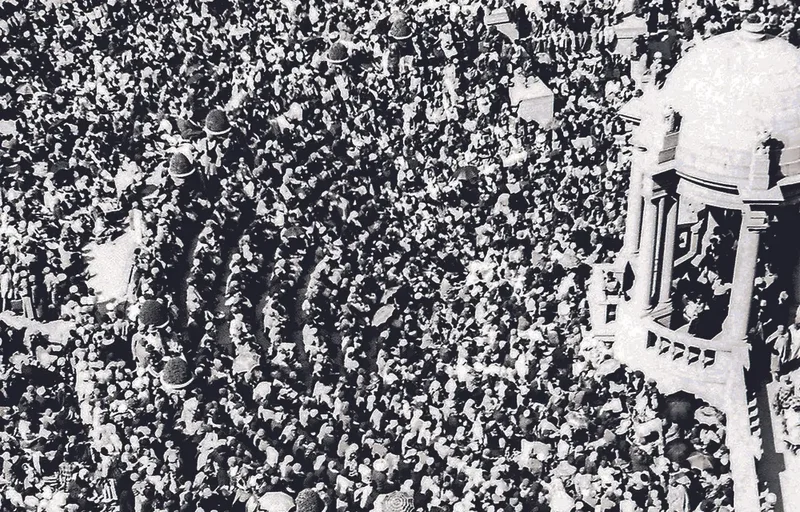
On 9 August 1956, more than 20,000 women marched to the Union Buildings against the extension of the pass laws. Seventy years later, their courage deserves neither historical amnesia nor ceremonial trivialisation. Those women did something honourable. They confronted racism. They inconvenienced injustice. They placed themselves inside history rather than merely attending an event commemorating it. That is worth celebrating.
But if Women’s Day has become something more than remembrance, then we have to ask a harder question: what are we celebrating every August 9th? Perhaps amid the speeches, marquees, television cameras and political choreography, we have forgotten the woman who seldom reached the podium. The mother. The grandmother. The widow.
The single mother who raised three children on one salary and somehow sent one to university. The woman who woke before everybody else because somebody had to prepare the children for school. The mother who postponed her own ambitions so that her daughter might discover hers. The grandmother whose pension somehow acquired the elasticity of a national budget because unemployed children and grandchildren depended upon it. The woman who held a family together when everything around that family appeared determined to pull it apart.
There were women whose names would never appear on plaques, yet their children were their monuments. Some mothers never attended university but produced graduates. Women who never occupied an executive office but managed households through unemployment, illness, bereavement and economic hardship with a competence that would have embarrassed some corporate boards. Single mothers were performing the work of two parents with the resources of one.
They deserved more than flowers. They deserved a nation that saw and noticed them. And therein lay the contradiction of Women’s Day. South Africa has become good at celebrating women symbolically, while failing them practically. We applauded resilience when we should have been asking why such resilience was required in the first place. We called women “rocks”, yet even rocks fractured under sustained pressure.
So perhaps the most respectful thing government could have done on Women’s Day was not only tell women how strong they were but ask what could be removed from their shoulders: childcare burdens, economic exclusion, unsafe public transport, poor frail care, domestic and sexual violence, unemployment, failures in the criminal justice system, and the invisible weight of unpaid care. These are not sentimental issues. They are policy issues.
The government has done nothing. There is a National Strategic Plan on Gender-Based Violence and Femicide. Institutional structures existed and implementation was set to be accelerated in 2026/27 following the classification of GBVF as a national disaster and a Cabinet-approved action plan. The Department of Women, Youth and Persons with Disabilities carried a mandate for advocacy, monitoring, evaluation and socioeconomic transformation. Women’s Month 2026 even opened with the EmpowerHer Market Trade Fair, linking women-owned businesses to markets, investors and development finance institutions. That was more than symbolic.
But policy existence is not policy impact. A strategy document cannot console a battered woman. A framework cannot prosecute an offender. A podium cannot create a job. An annual theme cannot measure national progress.
Parliament itself had acknowledged this gap. In July 2026, the Portfolio Committee welcomed a joint inquiry by three Chapter 9 institutions into systemic failures in the justice system’s response to GBVF, calling it long overdue and pointing to serious shortcomings in victim support. That was where the national conversation had to begin.
Women’s Day needed an impact pathway. If public money was spent commemorating women, citizens had to be able to ask what had changed between one Women’s Day and the next. How many women-owned businesses secured sustainable procurement? How many survivors received meaningful support? How many GBVF cases were successfully prosecuted? How many women entered employment? How many accessed finance? How many single mothers received tangible support that improved their children’s prospects? How many women became safer?
Not how many attended. Not how many spoke. Not how many hashtags trended. Because the government could not call violence against women a national crisis while allowing its commemoration to remain largely ceremonial.
The women of 1956 did not march for nostalgia. They marched for change. The greatest tribute we could have paid them was to recover the disruptive courage they embodied. They were not decorations in the liberation struggle. They were disruptors of an intolerable status quo. National Women’s Day has to carry that spirit.
So yes, go on celebrating. Buy the flowers. Take Granny to lunch. Honour the wife who had carried a family through years no one else saw. Salute the single mother who worked overtime, stretched groceries, paid school fees, and watched her child graduate.
But when the flowers faded and the cameras left, ask the only question that matters: What was different this August 9th.
If there was no answer, then we had confused commemoration with transformation.
History deserved remembrance. Women deserved results.
Reverend Lionel Jean Michel is a journalist, communication specialist and thought leader. He writes on faith, governance and looks at the moral compass that guides both individuals and institutions.