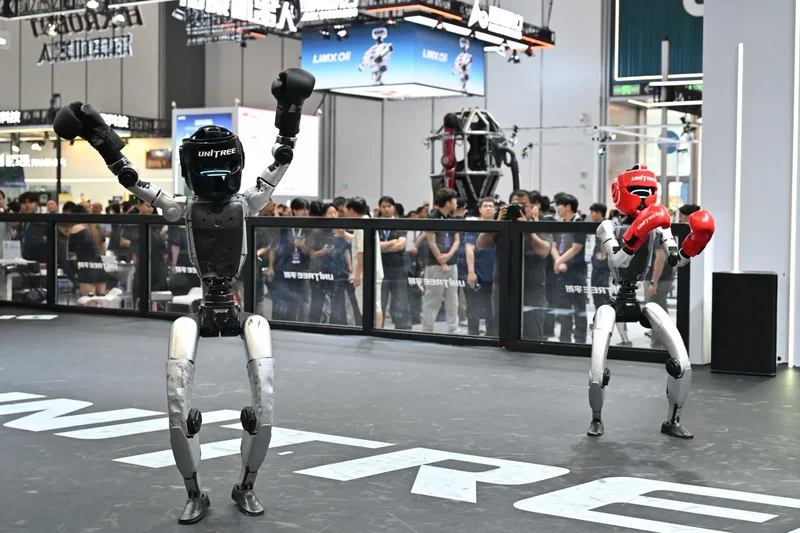
Shares in Unitree, one of China’s largest manufacturers of humanoid robots, closed their first day of trading by more than 460%, showing strong investor appetite for China’s robotics sector.
Unitree raised around $900 million in its IPO on Shanghai’s STAR Market, the city’s board for technology startups, at a valuation of $9 billion. After today’s surge, Unitree is now worth around $66 billion, ahead of larger Chinese tech firms like Baidu and JD.com. It’s also worth more than the most valuable U.S. robotics company, Figure AI, which got a $39 billion valuation in a September 2025 funding round.
Unitree reported 1.7 billion yuan ($252 million) in revenue in 2025, with almost 45% of that coming from overseas sales. It also generated 600 million yuan ($89 million) in profit last year. Most of Unitree’s sales go towards research purposes, though some Chinese tech companies and state-owned enterprises are starting to explore using humanoid robots in their operations.
Unitree has been backed by fellow Hangzhou startup DeepSeek, as well as big tech firms like Alibaba, Ant Group and Tencent, as well as several state-backed investment funds.
Nomura, which gave a “buy” rating to Unitree shares on Wednesday, credited Unitree’s “rapid product iteration and continuous innovation” as the foundation of a “first-mover advantage.”
The Hangzhou-based startup, founded in 2016, has quickly become something akin to a national champion in China’s robotics sector. Synchronized dance performances by its humanoid robots are now a key feature of the CCTV Spring Festival Gala, China’s most-watched TV show. In 2025, Unitree founder Wang Xingxing got a rare invitation to a meeting with Chinese President Xi Jinping, alongside other tech luminaries like Alibaba founder Jack Ma, BYD founder Wang Chuanfu, and DeepSeek founder Liang Wenfeng.
China’s robotics sector, particularly humanoids, is becoming increasingly sophisticated. Days before its listing, Unitree revealed its “Superman” robot, which it claimed could beat human records on jumping height and running speed.
Still, not everyone is convinced by predictions of a coming humanoid robotics boom. “We believe the surge in shipments for robot makers could be illusionary,” HSBC analysts wrote in a mid-July report. “In the absence of a significant improvement in the AI model capability of robot makers, the current humanoid robot shipment upcycle is unlikely to be sustained over the next 1-2 years.”
Chinese AI and hardware IPOs are booming
A large trading-day pop is common for heavily anticipated Chinese IPOs. Mainland Chinese regulators try to keep IPO valuations low to protect retail investors if a newly listed stock fails to live up to the hype.
Shares in ChangXin Memory Technologies (CXMT), one of the world’s largest manufacturers of memory chips, surged by 460% on their first day of trading in Shanghai on July 27, after the company raised over $8 billion in its IPO. The company’s stock has continued to climb since then, and it’s now the most valuable Chinese company, ahead of tech giant Tencent.
One of Unitree’s domestic competitors, UBTech, listed in Hong Kong in late 2023. Another robotics startup, Agibot, is planning its own Hong Kong IPO.
Other major AI and hardware companies considering an IPO, either in Shanghai or Hong Kong, include LLM developers Kimi developer Moonshot AI and DeepSeek, memory chipmaker Yangtze Memory Technologies, Baidu chip subsidiary Kunlunxin, and Nvidia competitor Moore Threads.
The U.S. just banned foreign-made robots. Is that bad for Unitree?
In late July, the U.S. imposed a ban on foreign-made robots, citing the risk to national security. (Models already sold in the U.S. are exempt.) That hits a major market for Unitree, which last year generated 18% of its revenue from the U.S. The Pentagon has also placed Unitree on a list of “Chinese military companies,” or firms the U.S. believes has ties to China’s armed forces.
“Losing access [to the U.S.] could noticeably affect [Unitree’s] revenue growth–particularly because the company has been among the most successful Chinese firms at selling relatively low-cost robots overseas,” wrote Morningstar analyst Kangyuxiao Li on Aug. 18, the day before Unitree’s trading debut.
He adds that robotics firms like Unitree, in addition to losing a “large developed market customer base,” might also lose valuable feedback from U.S. customers that could improve their products.
But the U.S. robotics sector could lose out just as much from Washington’s ban. Without access to cheap Chinese robots and components, robotics startups may struggle to develop and manufacture affordable products. Some U.S. startups are even resorting to carrying Chinese robotics components in their luggage, according to The Information.
breaks the traditional barrier between audience and newsroom. The show transforms
Fortune DailyFortune’s trusted reporting into actionable, conversational, and entertaining insights for an emerging class of business leaders.
Watch here.