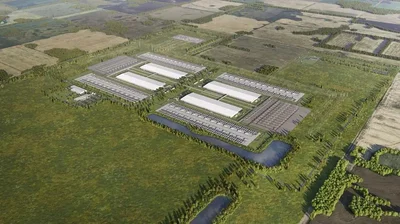
As Alberta encourages more AI data centre investment and more projects are proposed in the province, a new poll shows most people are concerned about the potential impacts.
The Leger poll shows 44 per cent of Canadians would support AI data centre development in their own province, while 42 per cent would oppose it.
The concerns are more one-sided.
Eighty-one per cent of respondents are concerned about potential increases to their household electricity bills and 79 per cent are worried about environmental impacts.
“On the data centres themselves, people are still trying to understand them better and what it all means,” said Leger executive vice-president Andrew Enns.
“Where they’re certainly firm on is they don’t want to pay more for their electricity.”
Story continues below advertisement
The answers are similar in Alberta.
About four in five Albertans polled also had concerns about electricity costs and how the facilities could impact the environment.
The polling comes as Alberta pushes to be what it calls a global leader in the field.
2:13
Meta to build $13 billion data centre in Alberta, largest outside the U.S.
Earlier this month, Meta announced a major centre in Sturgeon County, just north of Edmonton.
Get breaking National news
Get breaking Canada news delivered to your inbox as it happens so you won't miss a trending story.
At the time, Technology and Innovation Minister Nate Glubish said there are talks with at least 60 proponents on projects of different sizes.
“We can definitely support more data centres in terms of the energy usage and our cold climate also gives us an advantage, because around half of the energy consumption from a data centre is around the cooling,” said Yize Chen, an assistant professor in the University of Alberta’s electrical and computer engineer department.
Story continues below advertisement
“It definitely brings us a lot of benefits for computing and industry development, but at the same time we need to be cautious of the outcomes.”
Last month, Manitoba rejected a hyperscale data centre plan over environmental concerns.
1:58
Why there’s growing pushback against AI data centres
Albertans living near several proposed project sites, such as in Olds, Wheatland County and the Grande Prairie region, are opposing the developments.
“I understand that some Albertans have concerns with data centres, based largely on how other jurisdictions have managed them,” Glubish said in a statement to Global News.
“We set out to be the smartest. Over the past two years, we modernized our electricity legislation, introduced a new tax framework to ensure Albertans see a financial benefit from these projects, and maintained strong water regulations,” Glubish said.
Story continues below advertisement
“We did our homework, and now we’re ready to build responsibly into the future.”
Pollsters say the rollout could change people’s minds, one way or another, as these developments become more common in Canada.
Methodology: The Leger study is based on an online survey of 1,505 Canadian residents aged 18 and older, conducted fromJuly 10 to 13, 2026, using Leger’s LEO online panel. Results were weighted according to age, gender, mother tongue, region, education, and presence of children in the household to ensure a representative sample of the Canadian population. A margin of error cannot be associated with a non-probability sample, but for comparison, a probability sample of this size would have a margin of error of ±2.53%, 19 times out of 20.
1:59
Sturgeon County data centre construction draws concerns from residents
Previous Video
Next Video
© 2026 Global News, a division of Corus Entertainment Inc.