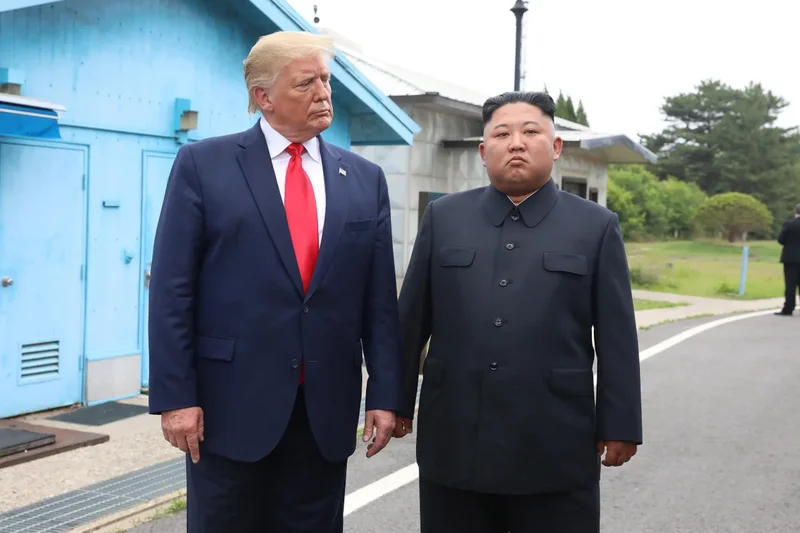
North Korea has dismissed a decision by Washington to scale back joint military exercises with Seoul, insisting the move does nothing to alter the aggressive character of the drills and dampening hopes for a diplomatic breakthrough between U.S. President Donald Trump and Kim Jong Un.
The response came in a late-night statement from Kim Yo Jong, the influential sister of the North Korean leader, marking the regime's initial reaction to Trump’s directive to significantly scale down the annual joint operations.
"We think it’s not worth making comments on that and we have no any interest in it," Kim Yo Jong said in a statement released by state media. "The provocative, aggressive nature of the drills won’t change even though their duration and size were reduced."
Her remarks were published hours after military authorities in Seoul and Washington confirmed a major reduction in joint maneuvers, following Trump’s sudden order aimed at reopening communication channels with Kim Jong Un.
Trump instructed the Pentagon to "substantially reduce" the joint Ulchi Freedom Shield exercises shortly before their scheduled 11-day run commenced on Monday. He pointed to his rapport with Kim and criticized South Korea for failing to back his stance regarding Iran.
Officials in Seoul admitted the unexpected announcement arrived without warning, catching observers off guard across the Asian country and prompting anxieties over joint defense readiness.
South Korea’s defense ministry stated Wednesday that both nations agreed to adjust the scale and length of the exercises following American requests. Consequently, current drills will conclude this Friday rather than August 27, alongside reductions in field training operations.
The Pentagon clarified that it was "continuing training that enhances tactical capability" while converting select events into computer simulations. "These adjustments preserve essential readiness and training objectives. There will be no degradation to U.S. training objectives," the Pentagon stated.
Shortening of drills sparks worries over military readiness
Concerns are growing among security analysts that truncating the maneuvers could undermine joint military preparedness and destabilize the long-standing alliance.
Experts highlight that regular drills are essential due to routine rotation of military personnel. According to Yang Uk, a researcher at Seoul’s Asan Institute for Policy Studies, missing full-scale exercises leaves incoming commanders unfamiliar with critical operational procedures when drills eventually resume.
The Ulchi Freedom Shield exercises primarily consist of computer-simulated command post scenarios designed to test defense strategies against potential aggression from Pyongyang, typically accompanied by live field training.
Alongside similar springtime drills, the operation serves as a cornerstone of the Washington-Seoul alliance established during the 1950-53 Korean War. However, Pyongyang consistently views them as invasion rehearsals, often launching missile tests in response, including two ballistic missiles fired into the sea just days before this month's drills began.
This month’s maneuvers were planned in two stages to simulate responses to North Korean offensives, with defensive operations running through Friday and counteroffensive strategies scheduled until August 27. South Korean media notes that Pyongyang reacts with particular sensitivity to counteroffensive simulations.
North Korea slams US-South Korea drills and vows to respond
Earlier Wednesday, North Korean state news agency KCNA published a commentary describing the joint maneuvers as "frantic" and "extremely dangerous", pledging to counter rival actions completely.
"The dangerous escalation of the war drills staged by the U.S. and its vassal forces is posing a more serious threat to the security" of the regime, the commentary stated. "Our exercise of right to self-defense will continue to completely neutralize the enemies’ military threat."
Observers suggest Kim, supported by a growing nuclear program and closer military cooperation with Russia, is unlikely to engage with Trump without substantial concessions, such as abandoning the demand for North Korean denuclearization as a prerequisite for negotiations.
Diplomatic efforts between Trump and Kim between 2018 and 2019 collapsed over disagreements regarding the extent of sanctions relief demanded in exchange for limited nuclear dismantling steps.
On Monday, the office of South Korean President Lee Jae Myung expressed optimism that personal rapport between Trump and Kim could spark "meaningful dialogue" for regional stability. Lee is a liberal who favors rapprochement with the North.
However, Lee’s stance sparked strong criticism from conservative opponents, who argued his administration was prioritizing diplomatic optics over pressuring issues caused by Trump’s abrupt military modifications.
Trump's move may focus on South Korea
In a social media statement, Trump asserted the exercises were expensive and "send a signal that is totally inappropriate and hostile" toward a regime he claimed was "unthreatening and respectful" during his tenure. He added that he asked Lee if Seoul would join efforts on the "denuclearization" of Iran, to which Lee responded, "No thanks!"
Speaking at separate parliamentary sessions on Wednesday, South Korean Foreign Minister Cho Hyun and Defense Minister Ahn Gyu-back acknowledged they received no prior warning regarding Trump’s social media post.
Cho stressed the bilateral alliance remains firm, while Ahn confirmed defense officials were maintaining active communication with American counterparts.
Analysts contend Trump’s decision was largely intended to exert leverage over Seoul regarding Iran, rather than acting as a direct diplomatic gesture toward North Korea.
"Trump's message is that if you don’t cooperate with us on Iran, we’re not cooperating with you" on military drills, noted Yang. He suggested Trump is pressing South Korea to contribute to Middle Eastern security, perhaps through naval deployments or missile defense support.
South Korean officials noted that both governments are actively discussing potential practical and military contributions Seoul could offer to protect freedom of navigation in the Strait of Hormuz.
Reductions in allied military exercises are not without precedent. In 2018, following his initial summit with Kim, Trump unexpectedly halted major war games, arguing at the time that stopping "provocative" drills would save substantial financial resources.
Subsequent exercises were scaled back or canceled to facilitate diplomacy or manage the COVID-19 pandemic, measures that defense experts argue have eroded combined readiness over time.