Most galaxies are known to host a supermassive black hole at their centers, and supermassive black holes are known to spin. Thereâs still a lot scientists donât understand about these two statements, thanks to the general elusiveness of black holes, but the discovery of an odd star in the heart of our galaxy may offer new insights into the mystery.
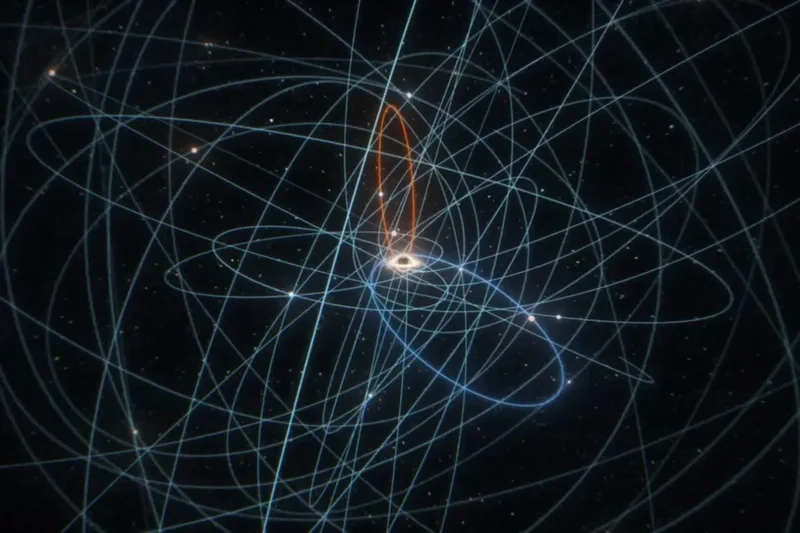
In a paper published today in Nature, astronomers report the discovery of S301, an extremely faint star orbiting Sagittarius A, the supermassive black hole at the center of the Milky Way. While S301 isnât the only star to orbit Sagittarius A, its journey around the black hole is the closest and fastest ever known. At its closest, the star approaches the black hole at a distance roughly equivalent with that between the Sun and Saturn. The extreme orbit of the star appears to be closely linked to the black holeâs spin, which could offer astronomers an unprecedented opportunity to directly measure the spin of a black hole.
âThis is truly a discovery we could not plan for,â Stefan Gillessen, the studyâs corresponding author and a staff scientist at the Max Planck Institute for Extraterrestrial Physics in Germany, told Gizmodo. âWe hoped for such stars to exist, but we would not know beforehand.â
Itâs a metaphor
One outstanding hypothesis surrounding black holes is called the no-hair theorem. Very simply put, the theory says isolated black holes can be described by just three numbers: mass, charge, and angular momentum (it’s rate of rotation, or spin). All other informationâwhich physicist Jacob Bekenstein likened to âhairsââis hidden to external observers via the effects of general relativity. Gillessen explained that measuring the first two factors is relatively straightforward, but that âwe simply donât know anythingâ about the spin.
âSo it is obvious that we would like to determine it,â he said. âAlso, we expect massive black holes to rotateâeverything in the Universe rotates, and massive black holes should do so as well, as the mass assembly over cosmic time should spin them up. And for those black holes that show jets, we can only understand that phenomenon if the black holes are rotatingâotherwise one could not power the jets.â
Flying in hairy space
According to a statement from the Max Planck Institute, S301 is extremely faint, and filtering out its signal was âlike trying to hear the buzz of a fly while a symphony orchestra is playing.” Gillessen and colleagues at the GRAVITY+ Collaboration first spotted the star in 2023, although it took nearly two years for the team to collect enough images to ascertain that theyâd found a âspecialâ star, he explained to Gizmodo. Further investigations revealed that the star had an orbital period of 8.7 years and that it was traveling so close to Sagittarius A* that its orbit, naturally, became warped by the sheer gravitational force of the black hole.
âS301 is the first star to orbit directly in the region around Sagittarius A* where the frame-dragging effect is extreme,â Felix Mang, the studyâs corresponding author and a doctoral student at the Max Planck Institute, said in the statement. âWeâre not just measuring spacetime curvature; we are measuring how it gets distorted by the rotation of the black hole itself. That is unique.â
A piece of the puzzle
That said, the team noted in the paper that S301 alone cannot confirm the spin of a black hole, although, if the teamâs measurements are correct, it would be âone of the first and currently only practical ways to measure the spin of Sgr A with stellar dynamics.â At the very least, the star could open new avenues for astronomers to explore the no-hair theorem and whether the spin of Sagittarius A, as indicated by S301, appears consistent with the predictions of general relativity.
âThis is only the beginning,â Gillessen told Gizmodo. The team will continue to follow the starâs journey around Sagittarius A*, he added, which should hopefully give astronomers more cluesâand maybe even more stars with similar behaviors.