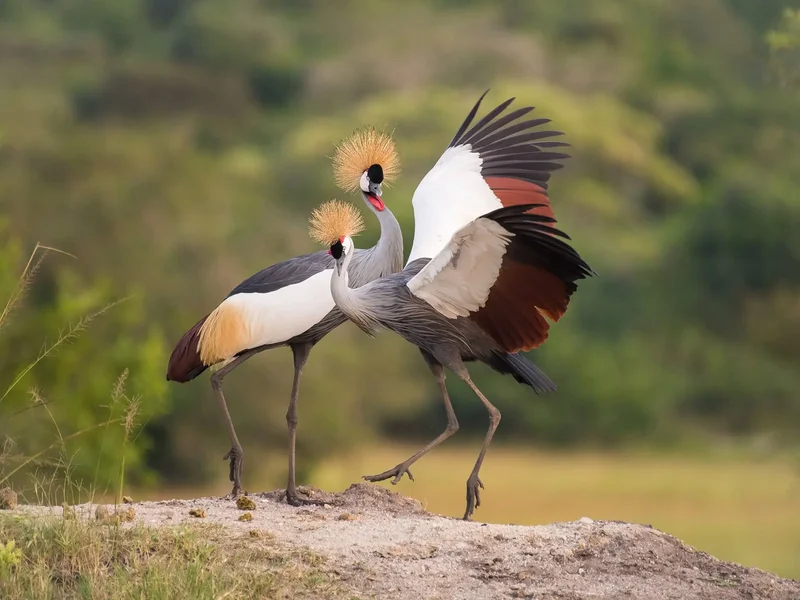
Rwanda’s grey crowned cranes have staged a remarkable comeback, with their national population rising from fewer than 300 birds a decade ago to 1 438 today.
The recovery, documented through 10 consecutive national censuses, is being hailed as evidence of what sustained conservation, protected wetlands and community action can achieve for a species once at risk of disappearing from the country.
When the Rwanda Wildlife Conservation Association (RWCA) began its crane conservation programme in 2015, illegal captivity and wetland degradation had pushed the endangered species towards local extinction.
The first nationwide census, conducted in 2017, recorded 487 cranes, establishing the country’s first scientifically verified population baseline.
The RWCA attributed the success to sustained conservation action: ending illegal captivity
and returning cranes to the wild, protecting and restoring wetlands, strengthening monitoring and enforcement and putting local communities at the heart of conservation.
“This milestone belongs to the people who made it possible. Ten years of consistent monitoring has given us more than a population count,” said Dr Deo Ruhagazi, the association’s deputy chief executive. “They’ve shown us where cranes breed, where they're threatened and where our efforts need to go next.”
That knowledge, Ruhagazi said, exists “because our community conservation champions and community rangers gather it wetland by wetland, day after day and because communities have chosen to protect cranes rather than capture them. Rwanda's crane population came back because Rwandans brought them back.”
For the 10 years that Rwanda has counted its grey crowned cranes, each year’s monitoring has revealed not only the changes in population size but also where cranes breed and feed, how they move between wetlands and where threats are emerging.
This information, the RWCA said, has helped it identify priority habitats and direct conservation efforts where they are most needed.
The recovery began by tackling the threats that had pushed Rwanda’s grey crowned cranes towards local extinction, including illegal capture for the pet trade and the degradation of wetlands. Working with the Rwandan government, RWCA registered captive cranes, rescued and rehabilitated illegally kept birds and returned many to the wild.
But conservation soon extended beyond individual birds. Ten years of monitoring showed that healthy, interconnected wetlands are essential to the cranes’ survival, prompting a community-led approach combining wetland restoration, scientific monitoring, threat reduction and conservation education.
Community rangers and conservation champions now monitor breeding sites, report threats and work with communities to protect key habitats.
The transformation is particularly striking at Rugezi Marsh, where crane numbers have increased from only 71 in 2017 to 378 this year. The marsh now supports more than a quarter of Rwanda’s entire crane population, alongside years of investment in wetland protection and a team of 75 community rangers who patrol the area daily.
GPS tracking has also shown that the cranes regularly cross into Uganda and Tanzania, leading to a transboundary conservation initiative involving partners in Rwanda, Uganda, Tanzania and Burundi.
Despite the recovery, the species remains endangered, with wetland degradation, agricultural expansion, disturbance and human-wildlife conflict continuing to pose threats.