At least 600 people have been evacuated from their homes after a series of relentless earthquakes hit Granada on Tuesday, triggering safety cordons and forcing residents into temporary public shelters.
Authorities ordered the urgent evacuation of six apartment blocks — holding 371 homes — in Las Gabias, southwestern Granada, after deep structural cracks appeared in building walls following dozens of tremors throughout the day.
Andalucian emergency services minister Antonio Sanz confirmed that the mass movement of residents was ordered as a precautionary measure, noting that none of the residential structures appeared to be in immediate danger of collapse.
Speaking to reporters, Mr Sanz said: “The situation will now be evaluated, but there is no imminent danger.
“We are going to analyse whether there is structural damage and, in the meantime, they have been evacuated as a precaution,” the minister added.
The surge in evacuations was sparked by a 4.8-magnitude earthquake centred in Alhendín, which struck at 10:37am on Tuesday morning.
The initial jolt was swiftly followed by a wave of secondary shocks, including at least four measuring above magnitude four.
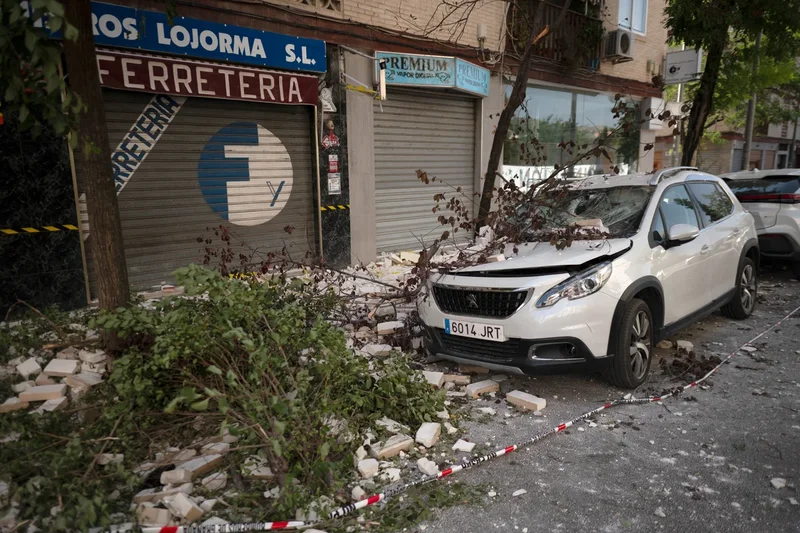
Terrified residents spilled into the streets as fallen masonry and building debris crushed parked cars and felled trees across the city. Emergency services have cordoned off at least nine streets over ongoing safety hazards.
Overnight, the ground failed to settle. Further tremors continued into the early hours of Wednesday, with 2.3 and 2.5-magnitude jolts recorded at 4:29am and 5:43am respectively.
According to Spain’s National Geographic Institute (IGN), a staggering 493 earthquakes have been logged in the region since Saturday.
Geologists have described this phenomenon as a “seismic swarm” — a rapid sequence of multiple earthquakes occurring within a localised geographical area over a compressed timeframe. Granada sits in one of mainland Spain’s most seismically active zones, intersected by a complex network of fault lines.
Nieves Sanchez Guitian, president of the Official College of Geologists, has reassured the public that the flurry of activity recorded on Tuesday remains “within the normal range.”
“A fault does not necessarily release all its energy at once; in this case, it is releasing it over a longer period and through successive tremors,” she explained.
“It is clear that this is the same place, the same fault and the same geological area. The accumulated tension is being released gradually, which is positive because it means there is less damage.”
Structural engineers and safety experts remain on site in Las Gabias to determine when evacuated families will be permitted to return to their homes.