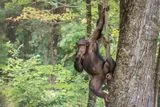
Before humans and chimpanzees split off into separate evolutionary lines millions of years ago, we shared a last common ancestor. Unfortunately, we don’t know exactly what this anonymous ancestor was like. One of the central questions embedded in this mystery is: Did the species climb tree trunks like modern chimps, or did it primarily move high in the treetops like modern monkeys?
The answer, according to a new study published in the Proceedings of the National Academy of Sciences, is likely that the last common ancestor climbed trees; researchers came to this conclusion after examining video footage of wild sooty mangabey monkeys in West Africa, finding that it displayed nearly the same level of bone flexibility as chimpanzees. This suggests that the last common ancestor had the ability to climb up trees, a detail that could eventually help us figure out how bipedalism arose in humans.
“Part of paleoanthropology is understanding how our evolution happened, and it’s often through the hallmark of how we move because modern humans move quite differently than our cousins, the chimpanzees, do, and they’re the living primate we’re most closely related to,” said first study author Luke Fannin, an assistant professor of anthropology at Ohio State University, in a statement. “And we’re trying to understand why that is.”
The Last Common Ancestor Puzzle
Identifying the last common ancestor of chimpanzees and humans has always been a struggle. The period when chimpanzees and humans diverged is often estimated to have occurred between 8 million and 6 million years ago, during the Late Miocene. The problem is, fossil evidence of great apes in Africa during this period is severely lacking.
Gaps in the Late Miocene fossil record of African great apes have, as a result, made it difficult to infer what the last common ancestor looked like and how it moved.
The new study, however, has gained ground in this evolutionary mystery with video evidence recorded by researchers at the Taï Forest Monkey Project field station in Ivory Coast. Footage of sooty mangabey monkeys has allowed researchers to observe the monkeys’ bone flexibility and compare it with that of chimpanzees.
“The great thing about having the video is that it allows us to capture exactly what the monkey is doing in a high-resolution manner. So we can actually say how the joint is loaded. Before, we had hunches, but in this way, it’s far more precise,” said W. Scott McGraw, professor and chair of anthropology at Ohio State University.
Ape Foot or Monkey Foot
Theories on how the last common ancestor moved have largely been based on what its foot may have looked like. One theory proposes that it had an ape-like foot with skeletal traits designed for tree climbing. A competing theory argues that its feet were more like those of cercopithecoid monkeys (Old World monkeys such as baboons, macaques, and mangabeys), and that the last common ancestor clambered high in trees rather than living on the ground.
But with video footage of the sooty mangabey monkey’s foot flexibility, researchers contend that it may not even matter what the ancestor’s foot looked like.
The researchers confirmed that sooty mangabeys can achieve a 46-degree flex in their midfoot during a vertical climb. Chimpanzee ankles, meanwhile, can flex upward at a very similar 45-degree angle during a tree climb (most humans’ ankles have the capacity to flex about 20 degrees).
Humans' Ancestral Connection to Trees
The study shows that it may not be necessary to have a foot like an advanced ape to climb trees, since there are living monkeys climbing trees with the same proficiency. The last common ancestor, in that case, may have been a tree climber regardless of whether its foot was more ape-like or more monkey-like.
At the end of the day, the lack of fossils still leaves many questions surrounding the last common ancestor unanswered. Nonetheless, humans have always had a connection to trees and made efforts to climb them, which has shaped our anatomy over time, according to the researchers.
“Regardless of where you’re starting from, which we don’t know yet, vertical climbing is universal, and the anatomy is going to perform that behavior. So I think that to get at the question of a monkey-like or ape-like last common ancestor, we need more fossils,” said Fannin.
Read More: Humans Evolved From A Common Ancestor That Appeared 6 Million Years Ago
Article Sources
Our writers at Discovermagazine.com use peer-reviewed studies and high-quality sources for our articles, and our editors review for scientific accuracy and editorial standards. Review the sources used below for this article:
- This article references information from a study published in the Proceedings of the National Academy of Sciences:A kinematic convergence in ape and monkey vertical climbing informs debates on early hominin arborealism