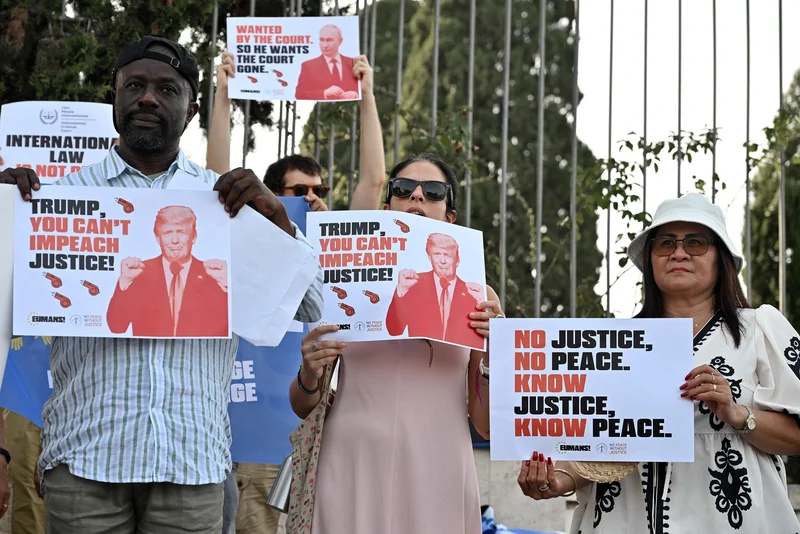
A phone call from Washington on July 23 was enough for Chad, a Central African country that has been a member of the International Criminal Court (ICC) since 2007, to announce four days later that it was withdrawing from the institution. Chad’s government, led by politician and military officer Mahamat Déby, now argued the court showed “undeniable selectivity” in its focus on the Global South.
On July 24, Venezuela, which was the first Latin American country to join the ICC when it opened its doors in 2002, followed suit. Caracas argued that it “perpetuates the persecution of the Venezuelan people.” Both decisions were welcomed by the United States, which has launched a campaign to dismantle an institution it considers harmful to its national interests, and to those of its key ally Israel, despite not being a member of the ICC itself.
On Tuesday, U.S. authorities imposed sanctions on Tomoko Akane, the president of the ICC. She joins eight judges and four prosecutors who have already been sanctioned by Washington. Those sanctioned are effectively excluded from the U.S. financial system, on which most international banks rely. The sanctions also affect any companies, institutions, or individuals who cooperate with them and directly hamper support for victims of the crimes prosecuted by the ICC: genocide, war crimes, crimes against humanity, and the crime of aggression.
Nevertheless, the ICC continues its work to protect justice and the international rule of law, although it now depends more than ever on its member states to defend its mission and independence.
After Frank García, the U.S. assistant secretary for African affairs, urged Chad to “review its accession to the Rome Statute,” the ICC’s founding treaty, the Chadian government argued that the court’s effectiveness had been “limited and inconsistent” since its creation and that it displayed “an undeniable selectivity” in its treatment of the Global South.
For its part, Venezuela, under U.S. tutelage following the arrest of Nicolás Maduro last January, maintains that the ICC, in addition to “perpetuating the persecution” of Venezuelans, “deepens the inequalities that international justice should be correcting.”
In a statement issued on Wednesday, the ICC described the latest round of sanctions as a “flagrant attack against the independence of an impartial judicial institution which operates pursuant to the mandate conferred by its States Parties from across regions.”
“When judicial actors are threatened for applying the law, it is the international legal order itself that is placed at risk,” it said. “The ICC values the consistent demonstrations of solidarity of States Parties, civil society and all those who support the rule of law and justice for the victims of international crimes.”
European Council President António Costa also weighed in on Wednesday. “President von der Leyen and I stand firmly with the International Criminal Court President Tomoko Akane and the officials who uphold its mission,” he wrote on X. “The ICC helps deliver justice to the victims of some of the world’s most horrific crimes. To carry out this essential work, its judges and officials must be able to act independently and without external pressure.
In his first interview since Chad and Venezuela announced their withdrawals, and since the United States began its campaign against the ICC, Osvaldo Zavala, the Court’s registrar, told EL PAÍS that the institution believes that “defending justice is even more important when doing so is difficult.” “We feel that we are taking blows that are fundamentally aimed at multilateralism and the international rule of law,” he added.
The Ecuadorian lawyer put it this way: “The attacks we are facing from major powers at different levels reflect not only the ICC’s relevance, but also the independence and impartiality with which it operates.”
To make his point clear, Zavala stressed that the Court’s work “will always be seen from a political perspective, but it is a judicial organization.”
García’s call was preceded by remarks from U.S. Secretary of State Marco Rubio, who described the ICC as a threat to national sovereignty and later argued: “We will dismantle the ICC—brick by brick, if necessary.”
The current tensions with the United States, Zavala added, “come on top of the difficulties of the past three and a half years, beginning with Russia, which launched criminal proceedings against ICC judges and ultimately, [in 2025], secured prison sentences of up to 15 years against nine of them.” In 2023, the ICC issued an arrest warrant for Russian President Vladimir Putin for the war crime of unlawfully deporting Ukrainian children to Russia.
“In 2023 we suffered a cyberattack, and then came the whole debate over sanctions,” recalled the head of the Hague-based institution. He was referring to the nine judges and four prosecutors currently sanctioned by Donald Trump, as well as anyone who collaborates with the ICC.
At the same time, Zavala emphasized: “There is a great deal of support from member states, and that can also be read as a political message. The court’s budget is today 95% funded; and it is very rare for an international organization to have that degree of liquidity.”
The ICC is therefore pressing ahead. Indeed, Zavala stressed that the court “is working on technical solutions to remain operational, because sanctions have extraterritorial effects even within Europe by targeting any entity that provides material support to the court.”
Burkina Faso, Niger and Mali, three countries in Africa’s Sahel region, as well as Burundi and the Philippines, had previously expressed their intention to leave the ICC, although those decisions were unrelated to U.S. pressure. Withdrawals take effect one year after notification and do not affect investigations already underway, which continue regardless.
The announcements by Chad and Venezuela coincided with the dismissal of Karim Khan as ICC chief prosecutor over inappropriate sexual conduct.
“Not all of these withdrawals are the same,” war-crimes lawyer Reed Brody said in a telephone interview. “Burundi and the Philippines tried to evade investigations into their own crimes, but they did not succeed.”
As evidence, he pointed to the fact that former Philippine president Rodrigo Duterte is due to appear before the ICC from November over killings committed during his country’s war on drugs.
Reed believes that the three Sahel states, all governed by military juntas, “are withdrawing as a sign of rupture with the West.” As for Venezuela and Chad, there, “Washington’s hand is visible.” “The Chadian statement itself acknowledges that the United States asked it to ‘reconsider’ its accession, and Venezuela’s government is now operating under Washington’s direction,” Brody said.
For Alette Smeulers, professor of international crimes at the University of Groningen, the United States is seeking to advance a new world order “in which the strongest decide without any limitations.” She said the Trump administration “is trying to tear down the international legal order by dismantling the ICC.” In her view, this approach “gives others the opportunity to do the same and gain more power for themselves.”
Both experts agree on the dangers of a world order “where the ‘good guys’ would be the countries loyal to Trump,” as Smeulers put it. Contrary to Washington’s claims, she argues, the ICC does not limit state sovereignty: “It only limits states’ actions by preventing them from committing serious human-rights violations and the gravest crimes the court prosecutes, within the territory of the court’s member states.”
On January 8, Trump made clear what he sees as the only check on his authority as commander in chief: “My own morality. My own mind. It’s the only thing that can stop me.”
For the University of Groningen professor, such rhetoric “is almost a form of psychological manipulation.” Trump, she says, claims that his opposition to the ICC “is about protecting freedom and democracy, when in reality he is trying to dismantle all the checks and balances that ensure governments cannot rule without restraint.”
Brody argues that the European Union should activate its Blocking Statute as soon as possible to neutralize U.S. sanctions against ICC officials. He also proposes that “the U.N. General Assembly condemn these sanctions and request an advisory opinion from the International Court of Justice on their legality.”
For her part, Smeulers advocates “forming a common front of all ICC member states to see how they will protect it.” “European countries, Western countries and many African and Latin American countries support it,” she says.
The ICC has no police force of its own to enforce arrest warrants, whether against a seemingly less powerful African suspect, Russian President Vladimir Putin, or Israeli Prime Minister Benjamin Netanyahu.
“There is unequal commitment to the court, but even countries most indulgent toward Israel for historical reasons, such as Germany, have defence of international law in their DNA,” said Brody.