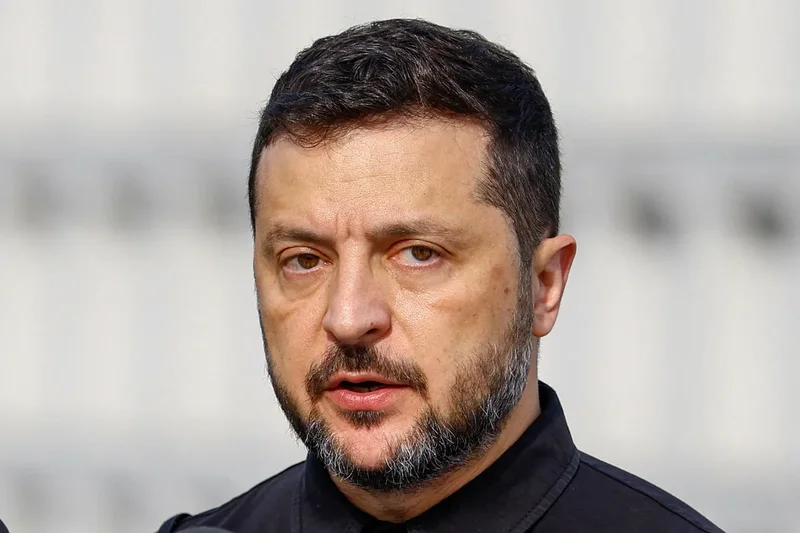
Ukraine’s corruption crisis continues to deepen, with President Volodymyr Zelensky forced to fire one of his most senior officials after they were suspected of money-laundering.
Iryna Mudra was sacked on Wednesday, the day after recently-fired defence minister Mykhailo Fedorov put further pressure on the Ukrainian leader by calling for national elections.
While Kyiv has seized the initiative in its war with Russia with an ongoing long-range drone strike campaign, Zelensky continues to be beset by domestic political challenges.
Corruption investigators have not given much away about the ongoing probe, which is working to expose a criminal organization allegedly involving senior officials from the presidential office and others.
They stand accused of having laundered 150 million hryvnias (£2.5 million) to pay bail for a defendant in a major graft case last year, the National Anti-Corruption Bureau said.
Zelensky’s political resilience has been tested several times in the past year. His former chief of staff was charged with corruption and money laundering in May as Ukraine’s galvanised watchdog pressed on with its widening investigation.
The Independent looks at the implications of the ongoing inquiries into alleged Ukrainian corruption.
What are the latest allegations to rock Ukraine?
The latest suspects in the corruption case include a former lawmaker, the chairperson of a state bank’s board and the head of the bank’s supervisory board, the bureau said.
It also involves a deputy head of the presidential office, it added.
Zelensky, who has not been personally implicated, has not made any public comment on the investigation. But on Wednesday, he issued a decree dismissing Mudra - who has not been named by investigators - as the deputy head of the Office of the President.
Mudra’s office was searched on Wednesday, lawmaker Oleksii Honcharenko said according to The Associated Press.
A source told The Kyiv Independent that the offices member of parliament Vadym Stolar and Maksym Mykytas, a former member of parliament, were also being searched during the probe.
Stolar said in a post on Facebook: “I can confirm that the NABU is conducting investigative actions at my home. I am fully cooperating with the bureau and am not obstructing the work of law enforcement in any way."
Officials from Sense Bank that are under investigation are allegedly CEO Oleksiy Stupak and Mykola Hladyshchenko, the outlet reported.
The Yermak case
Zelensky has been dogged by high-level graft investigations into some of his closest allies.
Andriy Yermak, who was until late last year the president’s closest advisor, was accused of laundering some UAH 460 million (£7.73m) through luxury accommodation near Kyiv. He denies ownership in the project.
Ukraine’s top anti-corruption agencies announced today they had charged six suspects in connection to the probe, which they said was linked to Operation Midas, the growing crackdown on an alleged plot to skim $100m from the country’s energy sector.
The National Anti-Corruption Bureau of Ukraine (NABU) and the Specialized Anti-Corruption Prosecutor's Office (SAP) alleged the suspects were part of an organised group laundering assets they had obtained illegally.
A law enforcement source told the Kyiv Independent that Timur Mindich, a close associate of Zelensky, and former deputy prime minister Oleksiy Chenyshov were also among those newly charged.
The head of the bureau, buoyed in recent years to investigate allegations of graft in the top tiers of government, said on Tuesday that Zelensky was not currently a subject of any such probe.
They say the money was laundered over a period of four years, from 2021 to 2025, through the cottage complex in Kozyn, a settlement of 3,500 people just south of Kyiv.
A source told the Kyiv Independent that suspects in that case allegedly gave money to Chernyshov, the former deputy PM, for the construction of the homes in Kozyn.
One of the houses said to have been financed through the Energoatom scheme was meant for Yermak, the source said.
What is Operation Midas?
The watchdogs said Yermak’s charges relate to Midas, an investigation into an alleged $100m (£74m) corruption scandal surrounding Energoatom, a public energy company and the largest producer of electricity in Ukraine.
Anti-corruption investigators announced Operation Midas in November, saying their discovery was the result of 15 months of wiretapping work and cited 1,000 hours of audio recordings and more than 70 raids.
At the heart of the probe was $100 million in funds that NABU said had been laundered by an alleged criminal organisation consisting of current and former energy officials, government ministers, a former deputy prime minister, and a businessman.
The accused are said to have manipulated contracts at Energoatom, Ukraine’s state nuclear energy company, to take kickbacks - secret payments in exchange for favours.
NABU said the group took bribes from contractors worth some 10-15 per cent of each contract’s value.
Crucially, some of these contracts were handed out to build up fortifications against Russian attacks on energy infrastructure.
The scandal emerged as Ukraine battled rolling blackouts as Russia pounded energy infrastructure through a particularly bleak winter.
Who has been affected?
Investigators claim to have traced the scheme to Timur Mindich, a film producer and co-owner of President Zelensky’s former TV studio, Kvartal95.
The two were close until at least 2021, when Mindich held a surprise party for Zelensky at his flat, during the lockdowns.
Mindich fled Ukraine in the night of 10 November 2025, just hours before NABU enforcers raided his home.
Prosecutors also claimed that Rustem Umerov, a former defence minister, was pressured to buy cheaply made Chinese bulletproof vests at extortionate rates.
He has not been charged and has denied wrongdoing, saying the contract was terminated due to the product’s failure to meet requirements.
Umerov remains heavily involved in Ukraine’s dialogues with the United States aimed at ending the war with Russia.
German Galushchenko, who led the energy department from 2021 until 2025, was detained by border guards in February as he tried to leave the country on a train, officials said.
Investigators said the charges were related to an alleged scheme involving offshore companies benefiting his relatives. Galushchenko - also known as Herman Halushchenko - has denied wrongdoing.
How widespread is corruption in Ukraine?
Ukraine inherited a legacy of corruption when it gained independence from the Soviet Union in 1991. Despite the considerable strides of NABU and SAPO since 2015, corruption remains endemic.
Today, 87 per cent of Ukrainians perceive corruption as a widespread phenomenon, according to a survey of more than 1,000 respondents last summer.
This is more sharply felt in rural communities. But only seven per cent of respondents believe corruption has improved as a whole since last year.
Last year, Transparency International - an organisation monitoring corruption around the world - gave Ukraine a score of 36 out of 100 in the Corruption Perceptions Index, with a lower score reflecting higher rates of corruption.
The UK, by comparison, received a score of 70 in 2025, reflecting a steady backslide from 82 over the last decade.
Andrii Borovyk, executive director at Transparency International Ukraine, said that despite limited improvements - such as a push for greater transparency on the handling of seized assets - reforms have been overshadowed by efforts to limit the independence of the anti-corruption agencies, until they collapsed under public and international pressure.
Ukraine saw the first major protests in the streets since the 2022 invasion in July after Zelensky suggested reining NABU and SAPO in to “cleanse” them of what he called “Russian influence”.
The EU has said deep-seated corruption is one of the major hurdles for the membership in the economic bloc Ukraine keenly desires.